


My ‘zest quest’ is on to explore the abundance of citrus grown here in Hawke’s Bay and how citrus infiltrates our cuisine. Citrus is the backbone of so many recipes and is often the unsung hero in many dishes.
Lemons are so versatile. They can be used for their juice and zest in everything from cooking to cocktails, their citric acid gives dishes a perfect tart twist. Lemons are generally available all year round which again makes them useful in so many recipes. The zest has the aromatic perfume while the juice carries the flavour.
Limoncello is the famous Italian liqueur made with the zest of lemons. Locally the National Distillery in Ahuriri makes a superb one with 100% Hawke’s Bay Meyer lemons sourced from Kevin, an orchard grower in Clive. They have extended this range to incorporate a new Orangecello one too.
Limoncello is relatively easy to make at home, but the National Distillery have some liquid secrets to achieve their quality product. Premium vodka is essential and they use an aqua source from the volcanic plateau which accomplishes a smooth and pure product. They peel 100kg of lemons a week and now have an automatic peeling machine which takes some of the back-break out of it. Their Art Deco Gin is a true celebration of Hawke’s Bay citrus using lemons, limes and oranges and their motto ‘Make gin not war’ made me giggle.

Sean at National Distillery with their Limoncello and Orangecello
Originating in Asia, the lime is older than the lemon and is more widely used in tropical countries than the lemon. Limes are packed full of vitamin C and Captain James Cook warded off scurvy on board the Endeavour by issuing his crew with lime juice.
Without lime juice the classic margarita cocktail would not be possible. The lime juice gives it a tart, refreshing kick and if you use a touch of sweet orange liqueur the two balance nicely. So many cocktails use citrus – a negroni would not be complete without the zing of an orange and a classic punch uses lemons and oranges. A blood orange will add “je ne sais quoi” to any cocktail.
If you want to raise the home-bar stakes try using the margarita sour mix from St Andrew’s Limes. All you need then is to have some Triple Sec and tequila to finish the cocktail. Established in 2002 this iconic brand is family owned by Matt and Tracy Day. With a stand at the Hawke’s Bay Farmers Market on Sunday you can purchase some of their zesty, sassy local lime and lemon products.
Talking to Gretta at Hapi Organic Café on Hastings Street, we agreed that citrus is the forgotten resource. But not at Hapi as her Zummo juice machine takes squeezing to the next level. It has three settings to juice small mandarins and limes and then can also squeeze large grapefruit. One of their most popular tonics is the ‘Cleanse’ which uses fresh organic oranges, lemons and turmeric root which are cold pressed into a rich juice and potentised with cayenne pepper and milk thistle tincture.
Chefs are always hunting for new flavour profiles and there are so many unusual citrus varieties that can be incorporated into recipes. If you are lucky enough to be able to find finger limes or caviar limes, as they are sometimes referred to, their little seed pearls will garnish seafood and fresh oysters to the next level. Finger limes are the smallest lime variety in the world and are so named because of their tiny (2 to 5 cm) size.
On the hunt for local citrus orchards I was drawn into the Bradshaw’s property on Te Mata Road. Their 3,000 tree orchard, 10 acre plot is home to lemons, limes, finger limes, key limes, oranges and pomegranates. They are sold on site and Judy and Wayne’s plan is to provide locals with sustainable produce. I had never seen a finger lime shrub before and Judy mentioned it is essential to use gloves when picking these little beasties due to their spikes.
The kaffir lime is an essential flavouring in Thai cooking. The kaffir lime tree take years to fruit and it is the leaves that provide an exquisitely fragrant citrus addition to recipes. Short on preparation but big on flavour try a fresh fish ceviche using shredded kaffir lime leaves and grated lime rind.
So, when life gives you lemons, take a high five and keep squeezing.
Prue Barton, Mister D Dining
Photos by Stephen Robinson
Lemon meringue pie
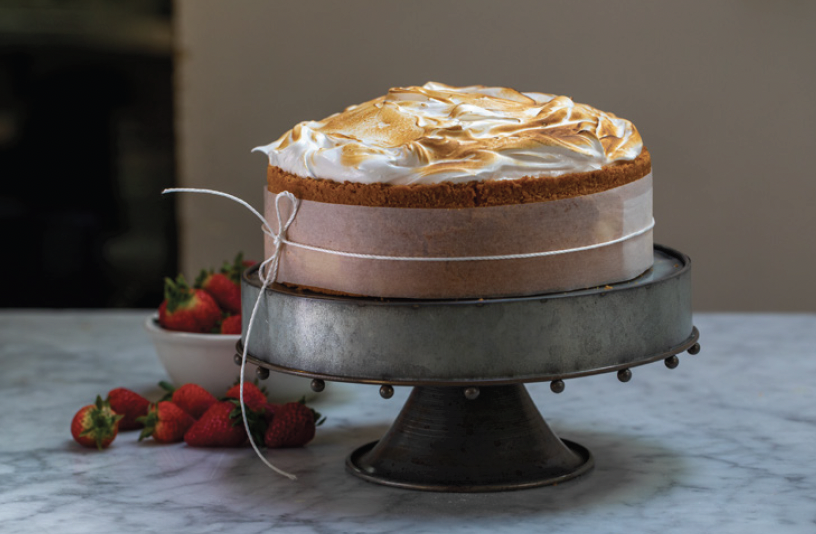
Always popular, the classic lemon meringue pie is a great dessert and can be fancied up with bowls of fresh berries and cream for festive parties. Try our pastry chef Andi’s special recipe. Apparently she is banned from making it at her home now due to months of experimentation and expanding waistlines.
Almond pastry
250 g unsalted cold butter, cut into small cubes
125g caster sugar
150g ground almonds
350g flour
4 egg yolks
In a food processor, blitz the butter, sugar, almonds and flour until a sandy texture.
Add the egg yolks and mix until it just comes together.
Tip onto bench and bring into a ball. Wrap in plastic wrap and chill for several hours.
Roll the chill pastry between two sheets of baking paper until 2-3mm thick.
Line the tin with the pastry. Chill the pastry case in the freezer until completely frozen, at least 2 hours.
Bake blind the chilled pastry case at 170°c for 8 minutes and then remove baking beads and cook for another 8-10 minutes until golden.
Leave the pastry to cool whilst making the lemon curd.
Lemon curd
380g lemon juice
12 egg yolks
6 whole eggs
300g caster sugar
250g unsalted cold butter, cut in cubes
In a roomy pot, bring the lemon juice to a boil.
In a large bowl, whisk together the egg yolks, whole eggs and sugar.
Once the juice has reached boil, slowly stream the hot juice into the egg mix whilst whisking continuously. Pour the mix back into the juice pot and on a medium heat, bring it to a boil, stirring with a spatula all the time.
Once its boiled, pour the curd through a sieve into a clean bowl, to remove any lumps.
In two parts, put the curd into a blender and blitz, adding the cold butter one cube at a time until all incorporated. As soon as all the butter is added, pour the finished curd straight into the cooked case. It will start to set straight away. Chill in the pie whilst making the meringue top. The longer it’s in the fridge, the better, ideally overnight.
Swiss meringue
4 egg whites
200g caster sugar
Pinch of salt
2 tsp vanilla paste
Combine the egg whites, sugar and salt in a metal bowl and give a little stir to mix together.
Over a pot of simmering water, gently heat the egg whites until the sugar has dissolved, stirring occasionally.
Pour into the bowl of a stand mixer and whisk until the meringue is whippy and glossy, and the outside of the bowl doesn’t feel warm to the touch.
Assembly
Scoop the meringue onto the top of the pie, spreading into whippy peaks.
Using a blow torch, burn the top of the meringue a little, till golden.
