

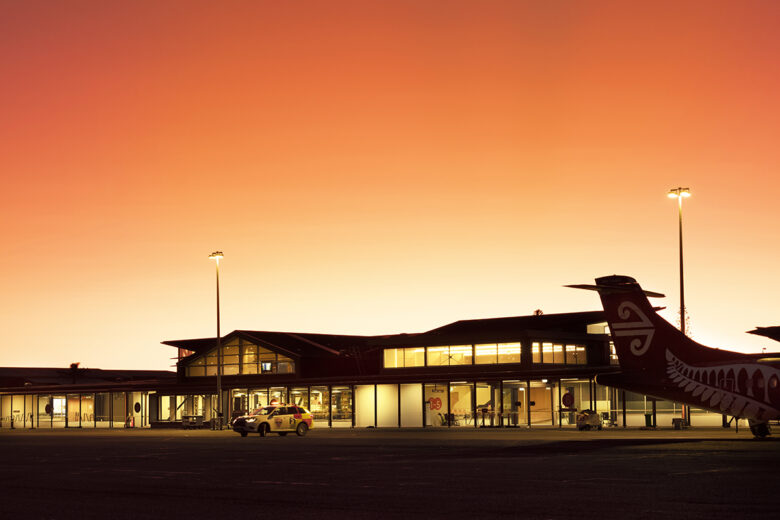
We’re violating journo rules by working our way down to the biggest news …
But first, the airport has new runway lights … higher intensity but energy-saving. Able to be controlled ‘after hours’ by approaching pilots. A new fire truck has been delivered. And the airport has now qualified, with necessary ability to handle customs and biosecurity, to receive aircraft arriving directly from overseas. Think small jets from Oz and Hawaii. Cool.
Nearly 200 people participated in the airport’s recent ‘Run the Runway’ event, with 147 runners charging down the runway (none lifted off). The fastest runner was Robin Moore, who completed the 4km course in less than 13 minutes. The event raised more than $4,000 for the Graeme Dingle Foundation.
Getting to heavier news, HB Airport reported its latest financials to the Hastings Council (a 24% shareholder), for the six months ending December 2024. For that window, the Airport earned a $1.6 million net profit after tax, off revenue of $7.6 million.
However Air New Zealand is the biggest revenue source and their capacity to HB Airport has reduced 5-6% and passenger movements were down 4%. The past 12 months have seen 641,000 passengers; this is expected to drop further to 625,000 in the next fiscal year.
In its Strategic Issue Letter to airport shareholders, the airport (HBAL) noted concerns about “potential long-term operational restrictions as a result of the development of noise sensitive activities or activities that increase bird strike risk in close proximity to airport operations or flight paths … Allowing residential development or increased bird habitats around airports and in proximity to flight paths, and failure to manage reverse sensitivity effects, will undermine the current and future operation of HBAL.”
The need to resolve these competing interests – air transport connectivity, biodiversity enhancement, and housing – already vexing, might become even more complicated by the biggest news of all …
Announcement of the intention of the Mana Ahuriri Trust (MAT) to purchase the 50% share of the airport now owned by the Crown, as enabled by MAT’s Treaty settlement (joining HDC’s aforementioned 24% and NCC’s 26%). The purchase only awaits MAT’s completion of due diligence, expected shortly. An enterprising commercial move by the iwi.
However, MAT could find itself in almost a conflict of interest situation. As major shareholder in the airport, it would be bound to pursue optimisation of revenue for the company, which means more flights and passengers.
However, as signalled in its application to the Napier-Hastings Future Development Strategy, MAT has also proposes a massive re-development of Ahuriri Station, the 1,300 hectare station effectively surrounding the airport (now a Landcorp farm). The development would include about 1,000 residences, a commercial/industrial park, and an ecological park of roughly 500 hectares.
Talk about reverse sensitivities! Watch this space.

I can see a few complications coming up with a residential growth in the area – the complaints about noise will be numerous (even though it would have been a choice to live there despite the airport – but people are weird at best)
I think it is amazing that Mana Ahuriri has signalled a 500ha ecological park which will not only enhance the area but will also be a transformative blueprint for the future to foster the environment and build community resilience. Mana Ahuriri has been working with the councils and DoC on restoring the mauri of Te Whanganui ā Orotu through a legislative masterplan which originates from the Ahuriri Hapū Claims Settlement Act 2021. Yes agree there are a lot of issues which Mana Ahuriri will focus on including the economic and social outcomes linked to the preservation of the taiao. Outcomes others including Councils grapple with on a daily basis.
Agree Tania > with MA now strong Shareholder in HB Airport > i hope along with the stunning 500ha ecological park which will be a critical part of our evolving ecosystem in Napier we will also have a strong development focused partner to take the Airport to the next level of its development
As an organisation only focussed on the wellbeing of Te Whanganui a Ōrotu (Ahuriri Estuary), we watch with trepidation at all the planned development on its borders.
The proposed NZTA FastTrack 4-lane Expressway extension across the estuary will further restrict water flow to the Upper Estuary by the extension of the narrow concrete culverts that let water through the current 2-lane expressway causeway, cut across important habitat for roosting wading birds (The Scrapes at Westshore Wildlife Reserve), and cut into the land of Westshore Wildlife Reserve where a kiwi breeding programme takes place.
The proposed airport extension of their business park, down to the edge of the estuary channel (mid-estuary), would bring on-going disturbance to wildlife ‘over the fence’ and reduce associated wetland areas currently DOC-owned. BirdsNZ count birds in the ‘associated’ wetlands twice yearly.
The proposed solar farm in the airport/Ahuriri Station area will be in the pathway of the arriving godwits/kuaka each year. International research has shown solar farms in these positions are a danger to the migratory birds who, at the end of their journey, think the panels are water and attempt to land on them. In Holland, the Schipol airport closes down when the sun shines directly on to a solar farm nearby as the glare makes it dangerous for pilots.
The FastTrack housing area planned on Ahuriri Station near the Upper Estuary is next to a long-standing, restored Australasian Bittern habitat – a critically endangered native bird. As far as I am aware, the development plans aren’t public yet?
And on the southern border, we are waiting to see the final plans for the Ahuriri Regional Park, and whether the ‘polishing’ of the ‘70%’ of Napier’s untreated stormwater that currently goes straight into the estuary is a feasible project. In the meantime, we see planning for recreation/commercial interests that may cause disturbance to the Wildlife Reserve area on the boundary.
Many unknowns for the long-term well-being of Te Whanganui a Ōrotu and its wildlife inhabitants.
How much further can it be ‘squeezed’ and remain a thriving Wildlife Habitat and a respected passive recreation area close to a city?