


HB’s Regional Economic Development Agency (REDA) has released an important report examining the economic cost to the region of ill-health amongst our working-age Māori population.
The report focuses on Māori aged 15-64 and the incidence of ‘priority conditions’ within that population. ‘Priority conditions’ are considered those where preventive interventions are available to avoid or mitigate the adverse health impact (e.g., diabetes).
The underlying premise is that ill-health amongst these workers significantly lowers their productivity and consequently the economic potential of the region (to say nothing of compromising the personal well-being of those affected).
On short, poor health among working age Māori is bad for business.
In 2022/23, there were at least 1,331 working-age Māori (671 males and 660 females) in HB hospitalised with at least one diagnosis of a priority health condition. Mental illness and diabetes are the most common priority health conditions amongst working-age Māori who were hospitalised in 2022/23.
The study compared HB’s situation with two other regions with sizable Māori populations.
While the Hawke’s Bay working-age Māori population has lower rates of priority condition diagnoses than Auckland and a similar rate to Counties Manukau, compared with these two other regions, the Hawke’s Bay working-age Māori population has:
- the highest rate of emergency department (ED) visits by people with priority conditions
- the lowest rate of outpatient service use overall
- the highest rate of working-age Māori female deaths
- the highest rate of acute inpatient hospitalisations is in the 50-to-64-year age group
- a high prevalence of mental illness (defined here to include mental health conditions, substance use disorders and self-harm), including as a cause of death at young ages, resulting in significant productivity losses (over 90% of the total productivity loss)
- a more extreme pattern of low use of planned services, higher rates of acute illness, and a steeper age-related increase for all indicators in working-age Māori males.
On average, each year, around 50 working-age Māori in HB die, with a priority health condition being the underlying cause of death. Mental illness is the key condition and cause of death in those aged 15 to 29, with diabetes and cardiovascular disease becoming more prominent in later decades.
Overall patterns of health service use suggest preventive care (prevention, early detection and effective management of health conditions) may not be effectively reaching working-age Māori in Hawke’s Bay, resulting in avoidable premature mortality in working-age Māori females and significant ill-health in working-age Māori males as they age.
Presently HB’s working age population includes 31,834 Māori and 76,806 non-Māori, with Māori therefore representing 29% of the total working age population, and 42% of the 15-29-year cohort
Because HB’s Māori population is becoming a greater proportion of the total, the overall productivity of the Hawke’s Bay working-age population will, unless change occurs, increasingly be suppressed by lower Māori productivity.
Māori are overrepresented in the primary industries and meat processing. These industries tend to employ a large proportion of low-skilled workers. The implication is that:
- Māori in Hawke’s Bay are in types of employment with little to no flexibility regarding working hours or remote working.
- Māori in Hawke’s Bay are employed in occupations that often require physical labour.
The report says these implications mean Māori needing to access health services may often need to miss work to do so, and Māori who are not in top physical shape are likely to be less productive than they might be. This is in stark contrast to occupations where people work at a desk and have flexible hours.
The productivity impacts of poor worker health include:
- absenteeism (employed people taking sick days)
- presenteeism (employed people experiencing reduced performance at work due to health issues)
- reduced employment (being unable to work or working less due to health issues)
- early retirement (withdrawing from the workforce at an earlier age due to health issues)
- premature mortality (dying during one’s working life, reducing the total years of work and lifetime productivity per person).
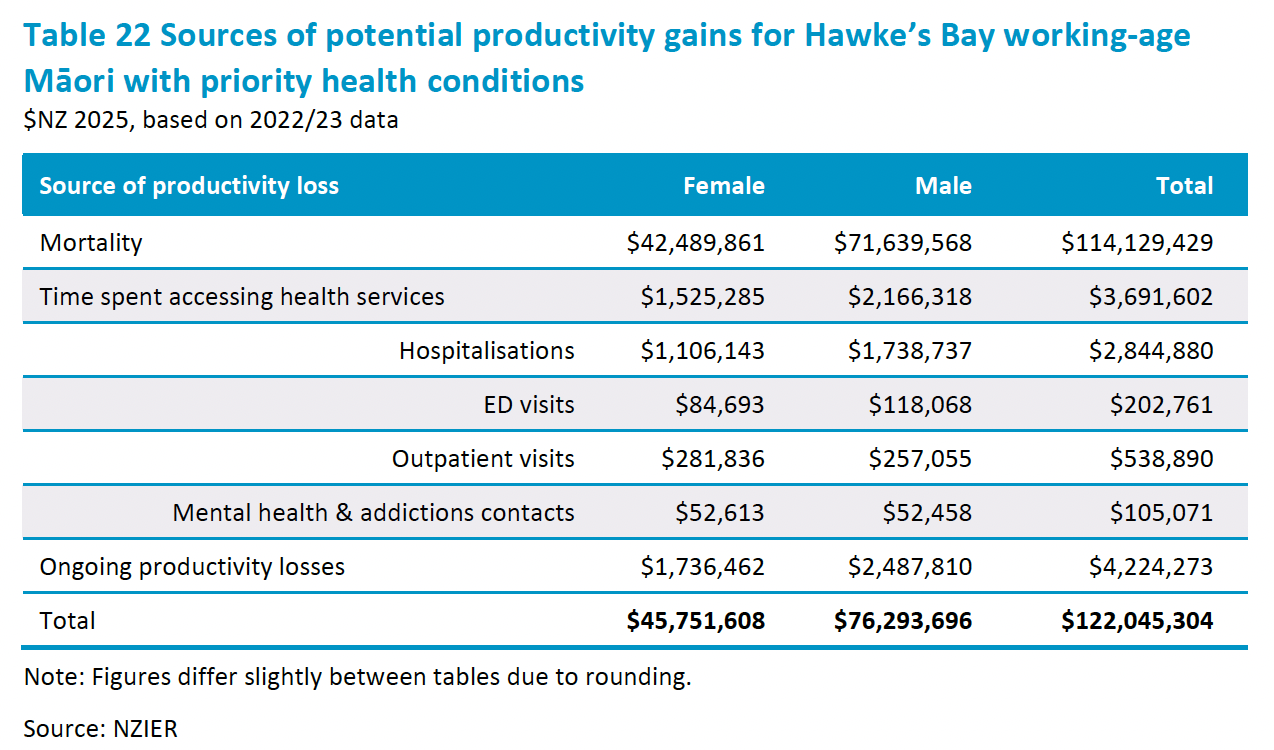
All this at a cost to the regional economy. Or put more positively, the report estimates the total value of the productivity opportunity for the Māori working-age population is around $122 million annually.
What to do?
At the root of the problem is relatively low use of planned care (prevention, early detection and effective management of health conditions) by this population group.
This in turn suggests re-thinking healthcare programmes/providers and funding priorities at the central government level, as ‘locals’ in the health system have little real control over such matters given the present Government’s approach to healthcare.
As Lucy Laitinen, REDA’s chief executive, commented to BayBuzz: “The connection between health and productivity is currently not well understood and not on the radar of the Government. It is important that we get the message across to ministers across government, not just health, but also social investment, economic growth, and social development. If Government understands that link it might be better motivated to reprioritise spend or target it better because there is a clear financial incentive to do so.”
But she also notes that there are opportunities for ‘locals’ to make a difference in this space.
“In the lead up to the release we have been talking to Health NZ, the PHO, businesses with large numbers of Māori employees, iwi/hapū groups, and government departments.
“We have found great examples of collaborative approaches that are working. E.g. some of our companies are investing a lot of their own money providing health services (such as free health checks and mental health support) to their employees in collaboration with health providers. How can we replicate the good practice?
“How can we ensure the health interventions give the biggest bang for buck (e.g. concentrating on those priority, preventable conditions outlined in the report) and how do we track and measure what is happening and what works? How do we bring health services into the work place or other places that reduce barriers to entry and how do we replicate some of the good practices across mental health, for example.”
Important questions. And with REDA being reconstituted over the next year, one wonders who will drive the process that might address them.

Good on REDA for raising this issue of concern. However, it is sad that “loss of productivity” and “poor Māori health [being] bad for business” should be the focus for concern or the pitch to the Government to try to get attention or assistance, rather than the wellbeing and self-determination of Māori in their own right being the primary focus. Had Māori not been deprived of tino rangatiratanga or their mana motuhake historically – or more recently – had Te Aka Whaiora been given a chance to succeed and Māori been resourced to run kaupapa Māori health programmes without the patronising interference and control of the Crown, then things might be very different today. The predominance in particular of mental illness and growing hopelessness is not surprising amongst indigenous peoples worldwide after generations of being violently colonised and dominated by settler governments. Entrenched superiority attitudes abound in our communities – a “we know best what’s good for you” – a ‘one-size fits all’ attitude – or “we are all equal under the law” (so long as we pākehā have made the laws) – which is the mythical mantra of this current Coalition Govt.
Despite being a privileged pākehā I often feel ashamed, depressed and overwhelmed by the inequities and injustices in our communities – how much worse it must be for many Māori to continue to stay positive and hopeful in the face of so much racism, ignorance and injustice.
Let’s call it what it is – and acknowledge and address “structural racism” in our communities rather than use ‘productivity’ or ‘economic growth’ as the reasons to address Māori health inequities (amongst many others eg housing, employment etc)
Our health system certainly appears to be third world (not the wonderful people working on the front line – they give everything they can to help patients – my personal experience has nothing but total praise for these hard working experts). Our Government seems to have their heads in the clouds about health and any criticism of them just brings Seymour’s wrath and abuse and a health minister who just ignores everything
Great comment Marilyn. All this is part of the $863 million its costs this country each & every year in health care inequities between non Maori & Maori, the very reason why Te Aka Whai Ora was set up in the first place, that Luxon choose to say wasn’t working when in fact, it had not been given a chance. And we do know the real reason, as it becomes clearer by the day.
That Brown will not take into consideration the Bowel Screening age, when it is clear that Maori are affected here; taking a fearful that he may be called out as a racist, when the moral stance is the correct one.
This has to be addressed in the future as soon as there is power to do so.
A lot of the below things aren’t a ‘Maori’ problem, they are the ‘choices you make’ problem. That’s why people need to face up to the decisions they make before playing the race card once again. Marilyn, Grant and Leonie, racism breeds racism. Your comments prove that.
Perhaps review the below again for reference:
-absenteeism (employed people taking sick days)
-presenteeism (employed people experiencing reduced performance at work due to health issues)
-reduced employment (being unable to work or working less due to health issues)
-early retirement (withdrawing from the workforce at an earlier age due to health issues)
-premature mortality (dying during one’s working life, reducing the total years of work and lifetime productivity per person).
Agree Mr Parker, the sooner it is Healthcare for all rather than based on race, the better. Same with everything really, it’s divided the country enough. The colour of your skin should not determine your place in the queue. It’s funny that in history we learnt prioritisating a certain people was seen as racist but in 2025 certain people and parties interpret their made up ideals exactly the same. Go figure? As they say, if you don’t learn from history, you are doomed to repeat it. P.s. Spray tan optional Debbie.