

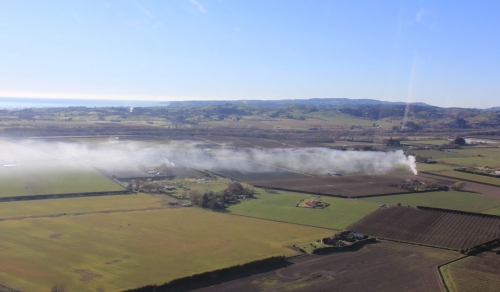
Hawke’s Bay Regional Council would like to respond to claims made in BayBuzz’s article titled Lifting the Fog at HBRC.
The suggestion that we’re ignoring complaints or brushing off smoke as “fog” is simply not true. We’re not in denial – we’re doing the work. Every day, our small, dedicated Pollution Response team is on the ground responding to complaints made through our Pollution Hotline, investigating incidents, and taking enforcement action when the rules are broken.
We know illegal outdoor burning is a problem in Hawke’s Bay and improving air quality is one of our top priorities. We’re committed to reducing the impact of smoke across the region and protecting the health and wellbeing of our communities. Between June 2024 and May 2025, we responded to 162 reports of outdoor burning. From our investigations, we issued 28 infringement notices and five formal warnings.
Industry groups can burn outdoors, but only under strict conditions defined in our Resource Management Plan. This information is available on our website and includes rules on what can be burned, when, and how. These rules are in place for a reason: to protect our air quality and our whānau, especially tamariki, from the harmful impact of smoke during the colder months.
Every year, we also run the We Breathe What You Burn marketing campaign to make the rules clear and encourage people to take personal responsibility for how they burn. But let’s be clear: illegal burning isn’t just a Regional Council issue. Property owners and industry must step up and commit to safer, better burning practices to protect our communities and environment.
Katrina Brunton, Group Manager Policy & Regulation, HBRC

Oh, Katrina, what a load of smoke!
Please direct your complaints and queries to Katrina directly via email [email protected]
One question that needs answering is: how effective is burning at destroying plant pathogens anyway? (If that’s the reason for burnoffs)
“Burning infected plant material has been widely used in the eradication and control of exotic and endemic pathogens. However, there appears to be little or no scientific evidence available to confirm that pathogens are eliminated during this process. Murray (1998) suggested that destroying wheat crops with Karnal bunt by burning could be counterproductive, as spores of the pathogen may rise in the heat currents and be dispersed, *effectively spreading disease* ”
“Several studies have shown temperature is a crucial factor in pathogen mortality, so burn-temperatures need to be above a certain threshold over a period of time. In his review, Hardison (1976) concluded that the effectiveness of burning for disease control needs to be determined for individual diseases, and that a limitation of this strategy is the incomplete burning of residues.”
From
https://bsppjournals.onlinelibrary.wiley.com/doi/full/10.1111/j.1365-3059.2009.02042.x
Once a sausage, always a sausage.