

[As published in July/August BayBuzz magazine.]
In the last few years, Hawke’s Bay has built a thriving, community driven series of biodiversity projects – most of them spearheaded by individuals on a mission who have recruited others in their direct sphere to join them.
Once a region lagging others in this respect, Hawke’s Bay is now home to at least several hundred small and large projects, many driven by landowners in rural, urban and peri-urban areas.
Biodiversity Hawke’s Bay’s Belinda Sleight outlined the range of initiatives. As Biodiversity Community Facilitator she liaises and collaborates with different community groups and projects in a very much ‘on the ground’ capacity.
“Every week or so I hear of some other new group,” she says.
“In Hawke’s Bay, the majority would be doing planting projects, planting native trees and shrubs, sometimes just increasing the amount in an area. Or it can be the restoration of a landscape, recreating ecosystems and habitats that have been there in the past. Like restoring a wetland. Whereas some projects are more like amenity projects, increasing the number of native plants in an area.
“The other side of things is around trapping, focusing on ship and Norway rats or Mustelids like ferrets, stoats, weasels and also possums and feral cats too, which are a real problem in Hawke’s Bay.”
From landscapes to neighbourhoods
Some projects are huge in scale, like the work that Mana Ahuriri is doing with Napier City Council and other stakeholders to restore Ahuriri Estuary – Te Whanganui Ā Orotū – which BayBuzz covered last year in a feature article.
The Estuary is a nationally significant Wildlife Refuge, supporting a diverse flora and fauna, including migratory birds, in a variety of habitats including conservation wetlands, terrestrial wildlife, and native fish spawning areas.
Other high-profile projects include Predator Free Māhia, which removes possums and rats from the Māhia Peninsula and Cape Sanctuary at Ocean Beach, which BayBuzz has also featured.
“They are doing restoration among existing industry operations,” Belinda says. “They have a fence to cut off the supply of possums and predators from the area and they have lots of Kiwi, Kākā, Wētā and of course sea birds that nest in the area. A lot of community members volunteer to check traps and grow and plant trees. It’s a big community project.”
The growing number of catchment groups looking after waterways also count as biodiversity projects.
But the vast majority of projects are relatively small.
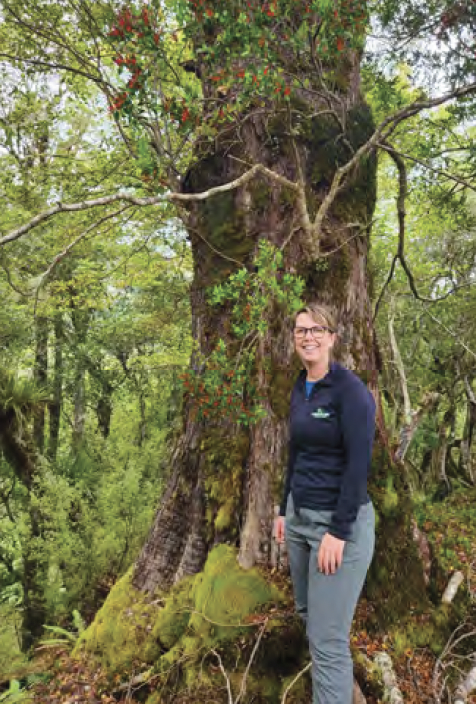
Senior Biodiversity Advisor at Hawke’s Bay Regional Council, Natalie de Burgh says the bread and butter of her team’s work is the Priority Ecosystem Programme, working with mostly private landowners to secure key ecosystems across the region.
“That’s recognising that it’s easier to protect existing ecosystems than bring back old ones … When you are protecting remnant bushland or wetland you can get your outcomes much quicker and cheaper,” she says.
Natalie also sits on the committee that oversees Biodiversity Hawke’s Bay Environmental Enhancement Contestable Fund. In early June, 17 community projects got the green light for funding.
There are two rounds of funding this year for the contestable fund after the Eastern & Central Community Trust joined HBRC to supply a pool of money for biodiversity projects, which is usually about $50,000 a year. This year it has been supersized to $110,000.
There are two bands of funding available to community projects, with a minimum amount of $1,000 and maximum of $15,000 available. The next round of funding opens in September.
Natalie says the money is used for things like fencing material, plants, traps and bait for maintaining traps, while the labour is usually from a volunteer force.
“There is a lot of riparian planting, trapping for pests and then some people have specific species they are looking after, like Kiwi at The Environment, Conservation and Outdoor Education Trust project in the Kaweka Forest Park. At Cape Sanctuary their specific species is Kākā. Then there are Dotterel on Marine Parade – their nests are in the rocks and look like rocks. And then there are long tailed bats in Central Hawke’s Bay, which they are finding more of,” she says.
Urban projects
There are also urban projects for enhancing biodiversity.
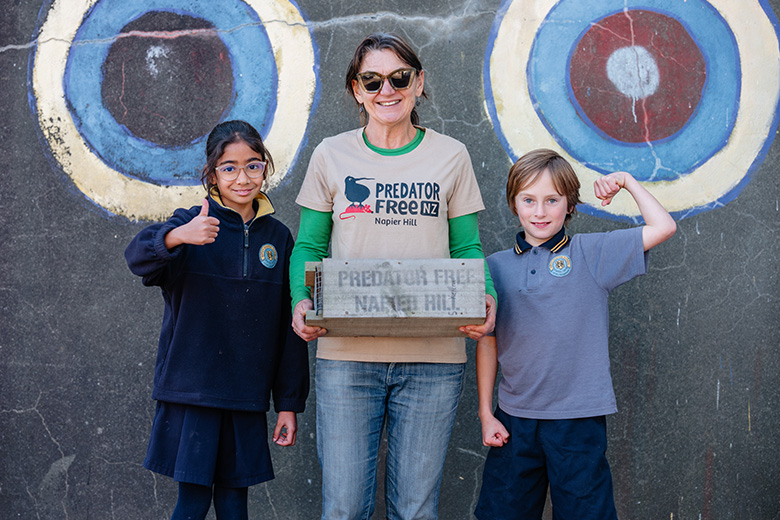
Predator Free Napier Hill is a great example of that. Run by resident Heidi Stiefel, it builds on the success of a previous initiative.
“My family had been trapping up at Boundary Stream for a couple of years and the Predator Free NZ backyard programme had a fund available for small community groups to apply to, so I set up a small project.
“On Napier Hill there was an intensive passive eradication and rat control programme between 2009-2014. Koromako (bellbird) and Tui increased threefold, just from controlling possums. So we have a really good base. There are already Tui here, three or four Kererū, the odd Kākā. We find skinks on Bluff Hill now. That is just from reducing the number of predators.”
Heidi is aiming for 20% of homes on Napier Hill to have traps, or around 500 traps. There are currently 140 traps.
“When you’re working full time it’s hard to get going but I’m trying to build it up and get more of a structure and make it more sustainable, get more people involved … with community groups like ours, you get the benefit of knowing your neighbours and connecting and community resilience. This is well documented,” she says.
Another Napier-based community biodiversity project is the Jervoistown Forest Project, spearheaded by resident Vanessa Moon.
“I had the idea of doing something in 2021, so I contacted Belinda at Biodiversity Hawke’s Bay. Fish and Game HB is in Jervoistown and Belinda suggested we use them as an anchor project because they were extending their grounds and planning to plant lots of natives. They also had a big shade house. We started volunteering there, eight of us, potting up plants. So then our group put in hundreds of hours planting up Fish and Game on Burness Road.”
That led on to other projects, including a big one currently underway planting up the berms in Jervoistown in natives to create an urban corridor of habitat for native species.
“There is a core of five of us and about eight or nine in total, all retired people apart from one,” she says.
“Last year we did a big planting on the southernmost Gordon Road Berm. We used a $1000 grant to buy the plants and that is all planted up now and looking lovely. We try to involve the community by having working bees at the weekend, mostly at Neverman’s Bush, another place we work”.
If you want to learn about projects that might be going on in your area, you can check out Biodiversity Hawke’s Bay’s project portal. And if you want to set something up yourself, Belinda is there to give advice and assistance.
