

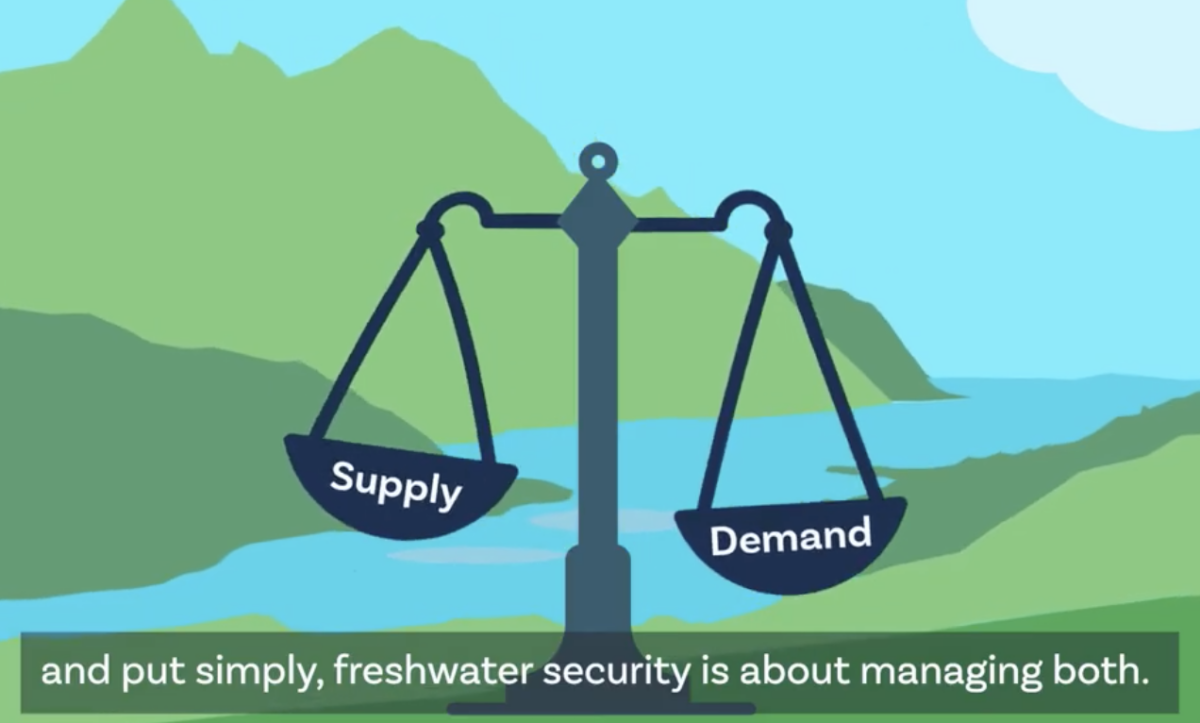
HB Regional Councillors had heaps to digest regarding the future of HB water security at their recent meeting. The status of four potential paths or levers to achieve water security was examined.
CHB Managed Aquifer Recharge (MAR)
This trial investigation will explore the viability of taking water from the Waipawa River during high flows and using it to augment the underlying Ruataniwha aquifer. Two approaches will be tested – using constructed wetlands that will hold and allow the water to seep into the shallow aquifer, and direct injection of water into a deeper layer of the aquifer.
This video explains the trial project, which is consented and funded.
Pre-feasibility modeling indicated that as much as 12 million3 might be captured for such augmentation. This would represent considerable additional water, given that 28.5 million3 is presently allocated.
Heretaunga Water Storage Project (HWSP)
This project is examining the feasibility of building a dam in the upper Ngaruroro catchment that would capture and store 27 million3 of water during winter. It would be released during low-flow periods to support river and aquifer health, offset groundwater abstraction impacts and provide additional water supply for agricultural, industrial and municipal needs.
Although the feasibility work is funded by HBRC, the project’s governance and operational decision-making has been transferred to an independent entity (Heretaunga Water Storage Limited, HWSL) co-governed by commercial water users, Napier and Hastings Councils, and iwi.
HWSL will soon apply for fast-track approval. However, the project will not proceed unless a viable user-pays commercial model is confirmed. That financial case is yet to be built, awaiting detailed cost analysis for the scheme, and is scheduled for completion before year’s end. At that point, the financial resolve of potential water users will be put to the test.
Both this project and the MAR project above need Māori support, and in both cases that verdict is still out, with views apparently differing within that community.
Ngaruroro River Bed Restoration Project
The Heretaunga aquifer, which supports virtually all Hastings and Napier water use, is supplied mainly by recharge from the Ngaruroro. About 80% of that recharge occurs within a short stretch of the river in the Roy’s Hill area.
Research led by Lincoln Agritech has established that different management of the river flow – either widening the channel, raising the gravel riverbed, or both – would allow more water to seep into the aquifer.
If such augmentation proves feasible, potential community benefits include improved groundwater security, support for irrigation reliability, stronger ecosystem health, enhanced cultural and recreational use of the awa, and increased resilience to climate variability.
The work to advance the project, confirm feasibility, develop and implement an action plan would carry into 2028 and beyond (when HBRC would no longer exist).
So far, HBRC and Lincoln Agritech have funded the investigation from existing budgets. Now funding application is being made to MPI (Primary Sector Growth Fund) for the project to proceed (at a cost in the $1.6 million range should the project progress to initiating the physical restoration work). Given the important potential of this water supply augmentation option, Heretaunga Sustainable Water (irrigators group) have pledged financial support for the investigation.
Curbing water demand
Each of the three projects above aim to increase water supply. Unfortunately, curbing water demand still remains a secondary priority, for three reasons.
In part because regional growth advocates, pretty much unchallenged, control the narrative – ‘We are doomed unless we find more water!”
In part because no systematic effort has been made to investigate and project actual concrete water savings potential in the region, leading to unfounded discounting of savings potential based on desktop speculation. To say nothing of ignoring factors like actual use today (which for many irrigators is significantly below current allocations), further disruption to HB’s primary sector, or more realistic population projections (as in flatlining).
In part because curbing demand by households and industrial users (as opposed to irrigators) falls to the territorial authorities (TAs) … and come next July to the new regional water services entity, Water Hawke’s Bay. And for the TAs this has been a non-priority. Perhaps when all water use must be paid for – and that day is coming – a fresh set of priorities will emerge.
Fortunately, at least some Regional Councillors do exhibit concern that curbing water demand must not get lost in the clamour for more supply.
Unfortunately, that holistic mindset – giving all supply and demand options equal time – seems to exist only at the Regional Council, whose water will soon be shut off.
