

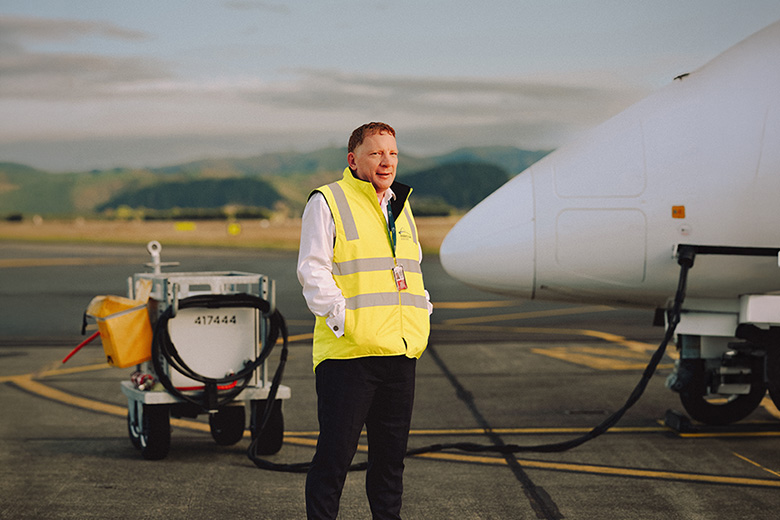
[As published in May/June 2026 BayBuzz magazine.]
The airport wants to transform itself into a thriving airport business over the next decade, with a focus on bringing more visitors to the region and being a driver for greater prosperity for the region as a whole … a plan that could be put in a holding pattern by the Middle East war.
The strategy for Hawke’s Bay Airport out to 2035 is an ambitious evolution from being merely a place to catch a flight into something much bigger and more diverse – what chief executive Nick Flack calls an Airport Business.
Flack, who was a senior executive of Christchurch Airport for twelve years prior to taking on this role, wants the airport to become a major driver of economic growth for the region, a significant contributor to GDP and employment, and a leading voice in advancing regional prosperity.
The airport’s business ambitions cover four key areas, as laid out in its new ten-year strategy – Planes, Passengers, Portfolio and Profile.
What this means:
• Expanding air services by finding and filling planes
• New avenues for commercial returns from ‘park to plane’ – essentially the customer experience at the airport
• Developing airport land for revenue diversification
• Contributing to regional prosperity through growth in the aviation sector and advocacy.
Drilling down, this involves diversifying revenue streams into retail and solar generation among other things, with the major portion of revenue still coming from scheduled Air New Zealand flights. The goal is $4 million in non-aeronautical earnings a year.
But it also means growing its aeronautical offering with new ‘tier two’ airline partnerships, international and local charter jets into Hawke’s Bay (already established, with between 90 and 100 flights a year), and a training ground for future aviation professionals. Air Hawke’s Bay, a pilot training school, has recently taken up residence at the airport, which Flack says fits with the airport’s strategy for the ‘planes’ business, supporting the future of aviation in the region.
Ultimately, Flack says, if the strategy goes to plan, the airport will contribute $400 million to the regional economy a year and grow the number of passengers that pass through the airport to 900,000 a year.
“Our mission stays the same. It’s always been to connect this region, people and businesses in a meaningful way. That diversification is to provide a more resilient financial return to the region – solar parks, what our passenger journey looks like, a better retail experience, a better aeronautical training facility, and tier two charters aligned with regional events like Art Deco, which was done this year by Originair.
“It’s moving the place from a good regional airport to a good commercial business that enables good regional development and security.”
More regional connections
Flack says a big focus will be expanding air services by increasing the number of tier two airlines that offer Hawke’s Bay as a destination.
Charter flights, like the ‘Flapper Flight’ that connected travellers from Nelson Airport on a one-off flight to Hawke’s Bay for the Napier 2026 Art Deco Festival, a first for the region, is one example. He says it both boosts awareness of the festival and Hawke’s Bay as a destination in the Nelson-Tasman region.
“Growing up in Southland I didn’t even know about Art Deco until I was here. You can’t sell a secret. We need to turn it into a well-known fact across New Zealand.”
The same model could be used in future for other events with broad appeal. Another example of leveraging events for regional travel is Air New Zealand’s Regional Event Sponsorship Programme choosing the Bridge Pa Wine Festival as a recipient. Such partnerships can create long term benefits for tourism, he says.
“We need to play a lot more active role in that. About 60% of people who go through this airport are out-of-towners. If we have got no population growth and wage growth is limited, then we need to increase passenger demand and we need to increase tourism. That’s the evolution of this business.”
Inline flights are another potential avenue for expanding visitors to the region. This is when tier two carriers partner with another carrier – usually Air New Zealand – to operate different legs of a journey.
Flack says he’d love to see more small carriers coming to the Bay, as currently there is only Sun Air. Current destinations from Hawke’s Bay are Christchurch, Wellington and Auckland, but he is keen to see links to places like Hamilton, Nelson and Blenheim.
“Air NZ has signed an interline agreement with Chatham Air. It will be interesting to see how that develops and whether those interline agreements are rolled out with more operators. That could unlock more travel routes. And it makes it easy to travel in the smaller regions. The government has had various schemes to support those operators.
“One good operator is Originair out of Nelson, so it would be nice to think there will be some kind of service with them over the next five years. But it starts with a good tourism product and how we are marketing it to the world, and to other regions,” Flack says.
He is doubtful that jetstar will return in the next five years, however. Jetstar previously served Hawke’s Bay with Q300 aircraft, which are no longer part of their fleet, and there has been no indication from the airline that Hawke’s Bay is under consideration in their current or mediumterm network planning.
Retail destination?
Innovation within the terminal is on the cards too. A recent change in cafe operators to F&B has seen a 30% increase in sales, and moves towards other retail experiences are planned.
“We are trying to lean into the innovations store too. What about virtual shopping, or pop-up retail? We had peonies being sold a couple of months ago through a refrigerated vending machine. Or local wine. Why not sell some of the great Hawke’s Bay wine that people can take away with them after visiting?”
Flack says the airport wants to be a destination, rather than just a place people come to get on a plane. “The retail strategy is about having people here throughout the day. And that flows through to our parking facility. So, you can park for 20 minutes and have a coffee and do some shopping.”
Solar ambitions
Although 50% of the airport’s power already comes from solar panels on the roof, Flack says eventually solar will power the whole operation. But it’s also part of the diversification strategy, incorporating the energy the airport might need in the future, including for electric aircraft.
“The difficult thing with solar farms and electric is that you can’t turn it on piecemeal. You have to do it all at once. So that is 15MW that allows all the taps to be turned on all at once. Any solar development we undertake will be commercial – until we need it.”
Electric and hydrogen aircraft coming?
Because the airport’s goal is to be carbon neutral by 2030, and infrastructure work is underway to prepare for potential climate change, the airport is getting ready for future electric and hydrogen aircrafts.
“We’ve done a whole lot of heavy lifting in the last ten years and have just been certified at level 4+ in Airport Carbon Accreditation, an international programme for airports, and we are at the top echelon of that for regional airports. And that requires reducing both scope one & two carbon.
“And then we are linked with all airports through the Airports Association as to how we are preparing ourselves for electric and hydrogen aircraft. The good thing about the aviation industry is that it only takes one person or team to make an electric fleet procurement and it will come right through the industry.”
Air New Zealand is currently testing a beta electric aircraft, which was at Hawke’s Bay Airport recently, and all going to plan will be in Hawke’s Bay again in 2028 and 2029 doing flights between here and Wairoa, Flack says.
Skyline Aviation, an aeromedical service, is also involved in electric aircraft and will have a beta aircraft in 2028.
“And so it’s making sure our infrastructure is prepared for that because they have large electrical charging loads.”
This also points to the logic of a solar farm.
With regards to hydrogen technology, it all depends on what Air New Zealand wants to do with its fleet.
“Christchurch Airport is manufacturing and testing hydrogen infrastructure and they are using electric training aircraft as well. One of the difficult things coming out of Covid was getting enough pilots trained to re-enter the workforce. Those pilot training hours are difficult to get but in electric aircraft it’s much cheaper. We have Air Hawke’s Bay here that have three training aircraft and they are in the air continuously,” he says.
Looming fuel shortages
These ambitious plans for expansion and greater visitor numbers could all be in danger, however, if the conflict in the Middle East doesn’t come to a close soon, and the Strait of Hormuz remains partially or fully blocked. In fact, many commentators say the damage is already done to global supply chains and the effects will linger over the coming weeks and months even if the Strait were to open tomorrow. And New Zealand is in the unenviable position of being at the end of a very long supply chain.
As at April 19 New Zealand had 47 days of jet fuel (MBIE), of which 26 days was actually in-country. The picture of how steady the fuel supply is, is murky at best. Ships are looking steady into early May, but after that there is deep uncertainty.
“We’re doing scenario modelling from maintaining current status quo, to what does a 10% reduction in flying look like, through to what does another Covid look like? So, what happens if the world just stops flying and we can’t get jet fuel,” Flack says.
Flack says he managed Christchurch Airport through the Mosque Terror Attack and Covid-19, and says the airport has done a whole lot of groundwork to make sure that Hawke’s Bay is set up to deal with an impact of some kind. Specifically, the airport’s profitability has been lifted, debt is in a manageable position, and asset management plans have been “locked down”.
“And that is even without mentioning the difficulty of airline businesses, which is tight margins as well. So, airports should be prepared and should be expecting that in every five or 10 year period there is going to be some kind of shock”.
“We’ve also got a really good relationship with Air New Zealand, which we have worked on over the last twelve months. So we feel really really prepared.”
By early April, fuel costs for Air New Zealand had gone from nearly a third of its input costs for putting a plane in the air, to more like half. Managing that involvesputting more people on every plane and cutting services, Flack says.
At the time of writing that had not translated into a drop in the total number of passengers coming though the airport. The situation in six months times would be different, however, he says.
Pre-booked travel would provide a buffer for now, but given consumer and business confidence had both taken a hit in March, it was difficult to predict how big a drop in plane numbers coming to the Bay might be.
“But we are well prepared for that. Then it’s about making sure our finances are managed really well so that when it flows through to inflation and interest rates, we’re ready for that.”
Ironically, New Zealand may be in a slightly better position than Australia due its hedged fuel supply agreements with South Korea and Singapore that are now kicking in. These were set up because of our distance from the refineries, and mean we don’t have to barter on the wholesale market to secure fuel supply as others do, Flack says.
However South Korea and Singapore could eventually reach a point where continuing to supply other countries, regardless of supply chain agreements, would eat into their own strategic reserves, at which point Flack concedes they would be forced to “cut us”.
“We’ve got good fuel agreements and one of them is around jet fuel supply. But it’s only a matter of time before they look after themselves. We might not be flying at all .”
A sobering thought.

All sounds like good, forward thinking plans. If only the Orange Man would get out of Iran things may improve and the future will look brighter – but there’s likely to be no change for some time with the USA having no idea on how to get out of the Iran adventure – they’ve managed to trap themselves into a long term problem for themselves and the world