

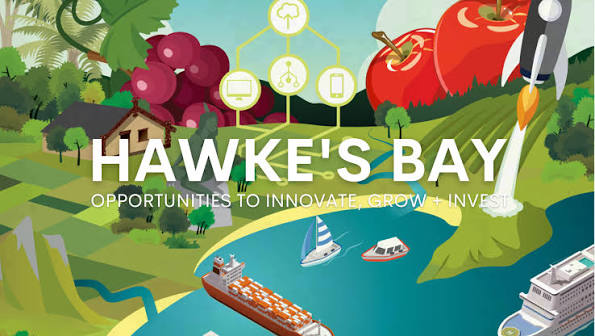
At precisely the moment the world around us is changing faster than at any time in a generation, Hawke’s Bay is again debating the structure of local government.
It is easy for that debate to become consumed by questions of rates, debt and local voice. Those issues matter. But they are not the biggest question facing Hawke’s Bay.
The bigger question is whether our region is equipped to thrive in a world which is becoming more competitive, more uncertain and more unpredictable.
Around the world, successful regions are responding to profound economic change.
Geopolitical rivalry is reshaping trade and investment. Technology is transforming industries at unprecedented speed. Climate change is disrupting traditional patterns of production and settlement. Capital, talent and ideas are increasingly mobile, flowing to places that combine clear leadership with ambition and a compelling plan for the future.
Those forces are not bypassing Hawke’s Bay. They are felt here in higher insurance costs, more fragile supply chains, pressure on exporters, rising costs of doing business and the growing impact of extreme weather. They are also reflected in company closures, empty shop fronts and concerns about jobs and crime.
Hawke’s Bay is a jewel and few other regions possess such a combination of natural advantages: world-class food and fibre, internationally recognised wines, tourism, niche manufacturing, a growing technology sector and talented, innovative people. And yet, despite those strengths, the region has too often underperformed in terms of growth and job creation. Cyclone Gabrielle explains part of that story, but not all of it.
The uncomfortable question is why.
Part of the answer lies beyond our control. Slower global growth, rising protectionism and geopolitical uncertainty have made international companies like Wattie’s and McCain more cautious about investment decisions and international markets less predictable. We’ve shared the whole country’s experience with a slow Covid rebound and high inflation and interest rates.
But successful regions do not spend their time lamenting global events. They adapt to them. They develop a shared vision and plan, build confidence, attract investment and relentlessly back their industries to succeed.
That is where Hawke’s Bay has work to do.
One thing is striking. Just when competition between regions is intensifying, Hawke’s Bay no longer has a strong regional economic development agency.
Since the demise of HBREDA, momentum behind a coordinated economic strategy appears to have stalled. We have seen this movie before: good intentions, some promising work, then a failure to stick to a practical, achievable plan. This is exactly the wrong moment for drift. This is not simply an institutional gap. It is a leadership gap.
Other regions have moved faster. The Bay of Plenty and Taranaki, among others, have worked hard to turn regional strengths into growth. Hawke’s Bay is now competing with them and others — for capital, for skilled workers, for visitors and for new industries. That competition will only get sharper.
Regional ambition is not something that just happens. It is something a region chooses.
FoodEast-Haumako demonstrates what that choice can look like. It is bringing together researchers, entrepreneurs, food producers and investors to create more value from the products Hawke’s Bay already grows so well. But initiatives like FoodEast should not sit on the margins. They should sit at the centre of a regional strategy that aims to capture more processing, innovation, branding and high-value manufacturing here in Hawke’s Bay.
This is why the amalgamation debate matters.
As has been only too evident over the years, the greatest cost of fragmented local government is the difficulty of bringing the region together behind a common economic purpose.
Amalgamation, by itself, will not create prosperity. Better governance is no substitute for successful businesses, private investment or entrepreneurial energy. But if it enables Hawke’s Bay to speak with one voice, marshal the whole region’s resources and make decisions with greater confidence and purpose, then it will have done far more than reorganise local government.
Ultimately, this debate is not about council boundaries.
It is about whether Hawke’s Bay has the ambition to do much better than more business as usual. That means lifting productivity, using our land, water, people and expertise more intelligently, and backing the industries and enterprises that can compete in a tougher future.
The regions that prosper over the next decade will not necessarily be those with the lowest rates or the fewest councillors. They will be those with the clearest sense of purpose, the strongest partnerships and the confidence to compete in a rapidly changing world.
That is the standard against which amalgamation proposals should be judged.
Stephen Jacobi has had a forty year career in public policy, diplomacy and trade. He lives in Napier.
