

Recent public consultations indicate strong support for amalgamation.
In the Hastings District 75% of the 811 electronic respondents to HDC’s survey preferred one council for all of Hawke’s Bay. That ‘advice’ compares to 52% who actually voted for amalgamation of all HB councils in the 2015 referendum.
About 20% favor a North/South split into two authorities. Only a handful choose letting the Government decide the reorg.
Napier delivers the big news, however. In NCC’s survey, of nearly 1,800 respondents, 66% prefer a single council. And 27% prefer the North/South split. In 2015, 84% of Napier voters opposed the proposed amalgamation.
Again, a survey is a survey, a referendum is a vote.
That notwithstanding, the swing in attitudes is gigantic.
In CHB, submitters to date are equally divided between the two affirmative reorg options, with about 20% preferring to await Government action. That too is a significant swing, as 58% of CHB voters opposed amalgamation in 2015. Wairoa is keeping its cards closest to the chest.
The councils keep telling ratepayers this is just a preliminary step in the reorg process and that the public will get an additional whack at the ball when a final plan is ready for submission by April 2027.
But to be honest, that consultation will be advisory-only as well. Our elected representatives are making the call.
The current Government wants amalgamation (i.e., serious consolidation) done! And there’s no sign a Labour-led regime would reverse this course.
Why would they?
The consultations carried out these past weeks in Hawke’s Bay have made clear that residents want local government that efficiently delivers core infrastructure and is affordable.
Yes, there are concerns about identity and local voice, but from the consultations there’s every indication that these issues today are less determinative of residents’ verdict on amalgamation. Moreover, the ‘localism’ concerns can be managed as reorganisation detail is worked out over the rest of the process.
Cost savings
Affordable local government is the clear driver for consolidation at this point.
HDC has produced a topline estimate of some of ‘governance’ savings achievable via the various reorganised structures.
The model compares the indicative annual steady-state cost of governance, executive and governance-servicing arrangements under the status quo against future governance options. It covers elected member and board remuneration, chief executive and general manager costs, democracy services, meeting servicing, board support and a general governance overhead per organisation. In other words, no service level or programme changes are factored in.
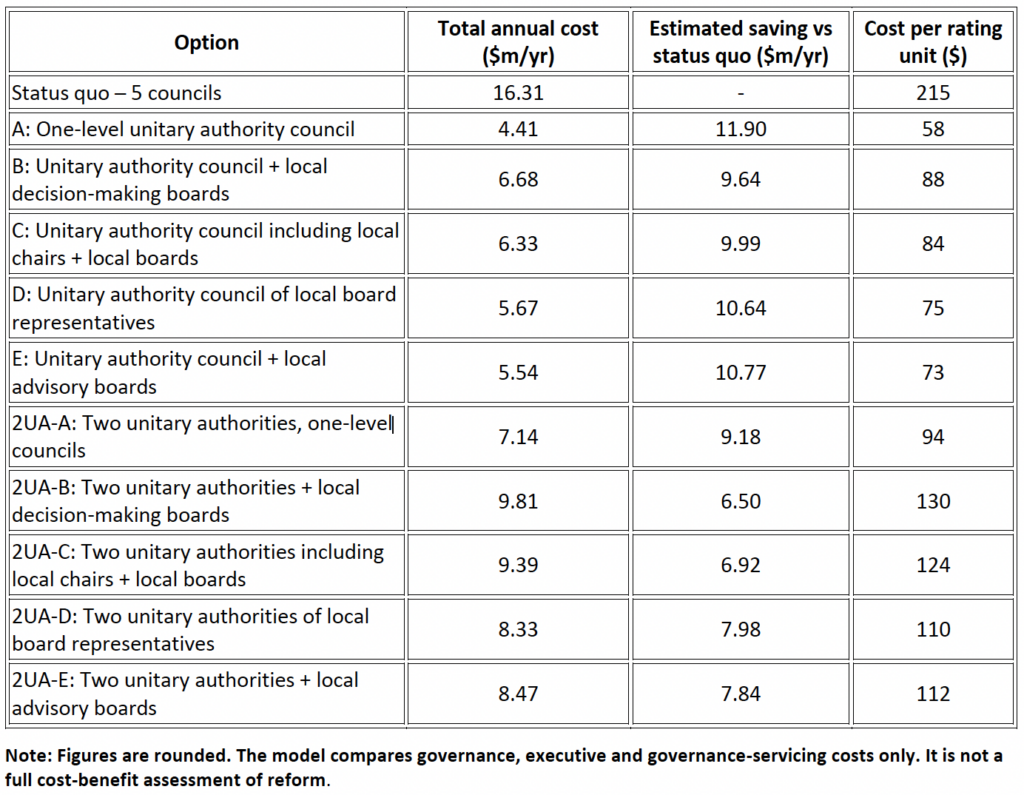
$10 million in governance savings alone from the lead options is not small change. Of course, these and other savings will need be examined in great detail as work on any amalgamation plan proceeds – assuming of course that our councils head that direction as of 9 August.
In our next post on amalgamation, we’ll report whether the Hastings and Napier Councils, both making decisions on 16 July, have indeed read the writing on the wall.
