

[As published in July/August 2026 BayBuzz magazine.]
Saturday morning, King’s Birthday weekend, and I am sitting with a group of people waiting to get something fixed at Napier’s monthly Repair Café.
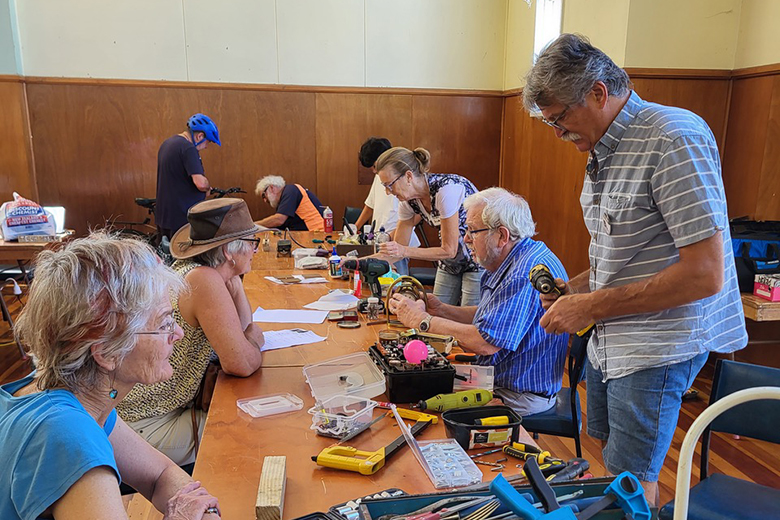
The atmosphere is busy and warm in Asher Hall where the café is held. Volunteers are signing customers in, directing them to tables to wait and enjoy free coffee and homemade baking. A group of children ranging in age from eight to thirteen years old are engrossed at the electronics table using screwdrivers to take apart things like a plastic electric guitar, defunct routers and printers. They attack the objects with gusto and fascination.
At the next table along, a group of women sit at sewing machines, one on an overlocker. They chat over the sound of machines whirring and the buzz of activity in the hall. Two jewellers at the next table are busy too. A bike is wheeled in across the hall to be fixed and there is a grating sound of knives being sharpened. At the electrical table a registered electrician is testing a treasured antique lamp for any signs of life.
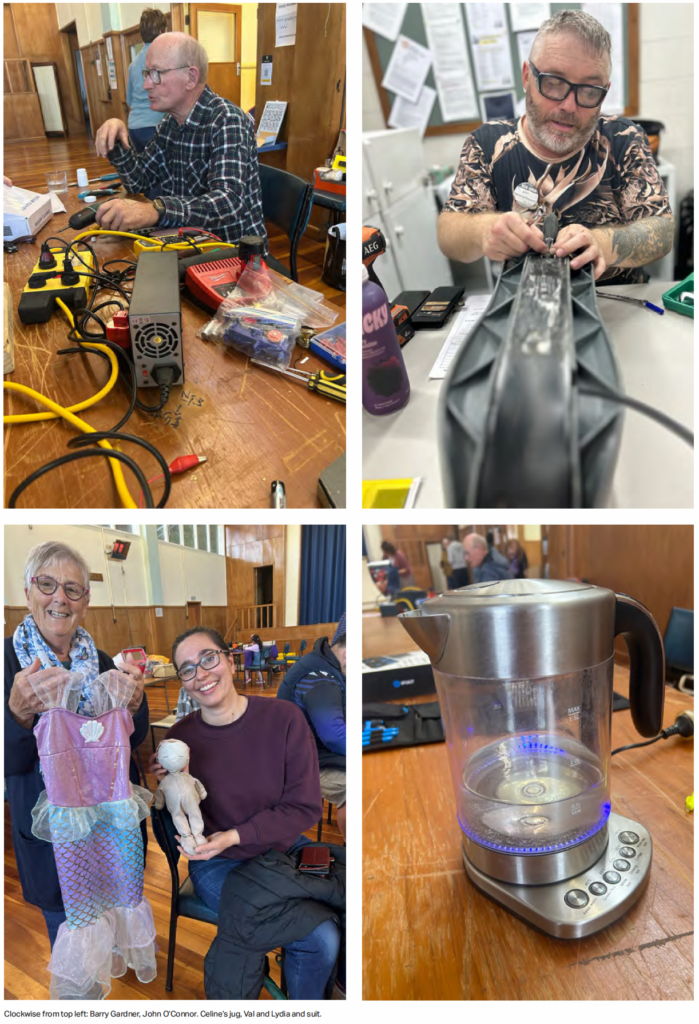
I am sitting next to Celine Harleaux who has driven here from Flaxmere to get her electric jug fixed. “I press the button, but it just doesn’t fire,” she tells me. “It switches off all the time.”
Celine’s kettle cost her “maybe $69 at Kmart two years ago”. She could easily go and buy another one but says she wants to “do the right thing and see if it can be repaired. I feel sorry that things like this are not built to last,” she says.
Beside Celine, Megan Joyce and her husband have lugged in their two-year-old Breville Inverter Microwave which is constantly showing a Err 1 signal when its buttons are pressed. Now they too wait to see if it can be fixed. Lydia Rynhart is also at the table sipping coffee while one of the regular sewists, Val Thompson, tackles her daughter’s frayed mermaid costume.
Napier Repair Café founder Helen Howard circulates around the hall checking everyone, including me, has got what they need. “This is a feel good community event,” she says. “It’s really satisfying repairing things, and skill sharing too.”
Helen, who has a background in conservation and environmental action, launched the Napier Repair Café, which runs on the last Saturday of every month, in 2022. To date the monthly café, with a team of regular, skilled volunteers, has worked on 2,763 items, fixed 2,069 of them, with another 420 considered repairable if the owner could get the right parts. Notably, only 274 items brought to the café over the last three years have been deemed unrepairable and destined for landfill.
“We are pushing back against a disposable mentality,” says Helen of the café’s larger purpose. “The café is about building awareness around treasuring items you have in your own home, rather than throwing them away into the landfill.”
As well as overseeing the café – “the highlight of my month” – Helen is an enviroschools facilitator with the Hawke’s Bay Regional Council’s Environmental Education team. She is hot on promoting waste minimisation in all its manifestations.
So too is James Taylor. A local medical services technician, James was an early volunteer for the Napier Café. But keen to free up his Saturdays for sport, he soon set up the Hastings Repair Café – now based on the second Sunday of each month at the Hastings Bridge Club, 911 Railway Road.
Like Helen, James is passionate about the repair café. He has a busy job, is a father, and plays sport on Saturdays, but he hosts the café as often as he can and works on “anything with a plug” that comes in for repair (He holds an electrical appliance service licence – EAS).
“Up front the café is about stopping things going to landfill,” says James, “but I also love having conversations around repairing things and giving people skills and ideas to repair things themselves.” James is quick to praise his team of volunteers but asks me to put in a plug (no pun intended) for more. “We always need more volunteers. The community gets out of this what they put in.”
Both Hawke’s Bay cafés are members of Repair Café Aotearoa New Zealand (RCANZ) which supports around 80 repair cafés scattered across the country, providing resources including a handbook, promotions, advocacy, and “capacity building to amplify the impact of repair for local communities”.
In October, on International Repair Day, Helen will help host a pop up repair café in conjunction with the Salvage Workshop in Waipukurau, which she hopes may lead to another HB Repair Café opening.
New Zealand’s repair cafés align with the International Repair Café (established in 2009), the Right to Repair movement, and advocacy for mandatory product stewardship in New Zealand. This is lobbying manufacturers to make products repairable and durable by design.
James says his eyes “have been opened to the increasing supply of appliances coming to the café that can’t be repaired. Technology has moved on but there is no gesture by manufacturers towards having parts if something breaks down.”
James and Helen both submitted on the recent, and failed, Consumer Guarantees (Right to Repair) Amendment Bill in NZ, which would have required manufacturers to make repair parts and information available to consumers.
“Essential for waste minimisation, decarbonisation, and climate justice,” said the Bill’s wording.
Using the website Re-starters (restarters.net), which captures global data for Repair Cafés around the world, Helen calculates that the Napier Café alone has prevented 2,261 kg of waste going to landfill since its inception and prevented 19, 268 kgs of CO2 emissions.
“I love the fact we’re not dumping stuff,” says Napier Repair Café long-time volunteer Val Thompson when I check in to see how she is going with the mermaid suit. “It’s seen better days,” she tells me. “But I’ll try and fix it. I love this work and I love being able to do something for people.”
Over at the Napier Café electrical table, Celine Harleaux is watching as Mr Max uses emery paper to clean the electrical contacts on the bottom landing pad of her jug. He then checks the jug’s charge with a multi-meter – all good. The jug is filled with water and starts to boil, the lights that were flicking off are now firmly on as it does its job. Celine smiles. “I am happy,” she says, confirming she is glad she made the effort to cross town to the Repair Café.
Further down the electrics table, Barry Gardener takes the back off Megan Joyce’s microwave. Barry is a retired engineer and paramedic and says he enjoys discovering how things work.
The inner workings of the Breville microwave are clean and tidy but Barry soon discovers the Err-1 signal is something to do with the appliance’s electronics board. He points the screwdriver down on to the inside end of the microwave. “I am sorry, “ he says to Megan, “but I can’t fix this.”
Nonetheless Megan is glad she came to the café anyway and had a cup of tea and chattered to others – but she says she’ll probably have to buy a brand new microwave now!
At the sewists’ table Val has finished the mermaid suit and Lydia Rynhart is delighted, knowing her daughter will be thrilled!
There is no charge for fixing an item at the repair cafes – just an invitation to give a koha – and that’s how both cafes essentially survive, apart from some funding and rental relief when its offered.
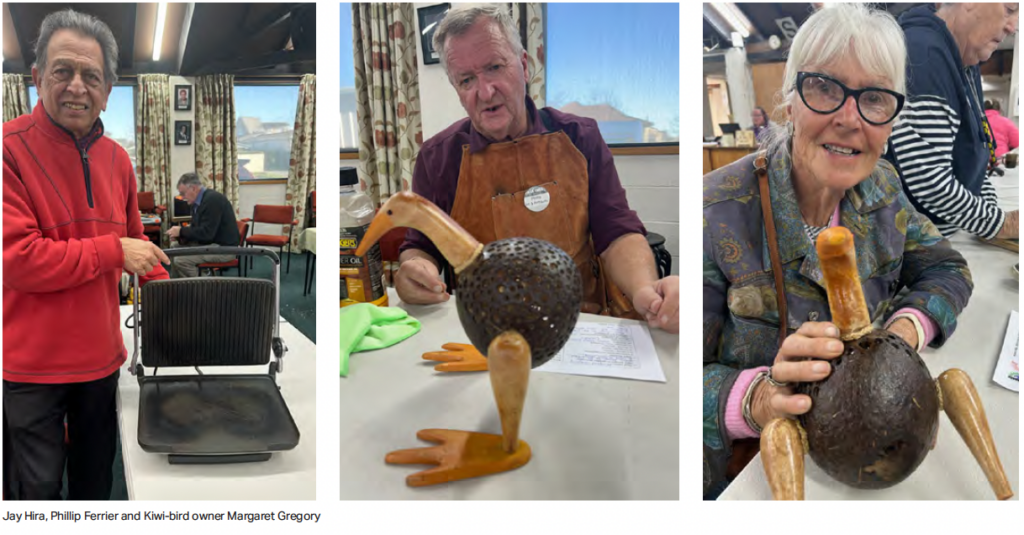
Two weeks later, 14 June, I stand next to the koha sign at the Hastings Repair Café. It is just as busy here as the Napier Café was. I sit and watch as a clock radio, an iron, a spray back-pack, a vacuum cleaner and a bike come in for repair. By the end of the two and half hour session, 35 items will have come into the cafe, with 22 repaired there and then. Jay Hira and his wife Manjula for starters, go home smiling after their three-year old Sunbeam sandwich maker is given a new life. Soon Rebekah Sullivan’s scooter is fixed by long-time café volunteer John O’Connor who works out why the back wheel is locking up.
The most intriguing item to come into the café today is an attractive kiwi bird with its body made out of a coconut shell and sporting a broken nose and wobbly feet. Phillip Ferrier, a trained art and antiquities restorer, JP, and with many more accolades to his name, is soon on the case. The kiwi nose is smoothed and painted and the feet are taken off and re-screwed and the bird’s coconut shell body given a generous oil.
Phillip stands back to admire his work. Recently retired, he is enjoying using a wealth of skills for the community’s good.
Kiwi-bird owner Margaret Gregory didn’t have any expectation when she came to the café but she’s glad she found Phillip, and now she is smiling.
“I’ve owned this bird for a long time,” she says. “I’m very happy.”
Napier Repair Café: www.sustainablenapier.co.nz
Hastings Repair Café: Facebook: Repair-Cafe-Hastings
Other resources:
www.repairnetworkaotearoa.org.nz
www.repaircafe.org/en/
