


Recently environmental advocacy group Wise Water Use HB (WWU HB) brought BayBuzz’s attention to an under-the-radar initiative at the CHB District Council to create a ‘Community Trust’ with a mission to address the district’s ‘water security’ issues.
As it turns out, CHBDC has spent several thousands on legal work to fashion a trust deed, whose real purpose appears to be facilitating efforts of the cash-poor commercial entity Water Holdings Hawke’s Bay (WHHB) to resuscitate the Ruataniwha Dam.
BayBuzz has been told by CHBDC, in effect, ‘not to worry’, the Trust would simply be a vehicle to ensure that all options for meeting CHB’s water needs, including more intensive water conservation measures, were actively discussed and explored by the community.
So far, however, the ‘community’ consulted on the Trust since February has been limited to WHHB and a few select local iwi leaders. A media release from WWU HB queries: “It has to be asked, why have Council staff been in talks with selective parties since February, with the drawing up of a Trust Deed commissioned in July, yet without any public announcement about this work which will clearly have major implications for ratepayers?”
When BayBuzz sought more detail on the Trust, the whole proposition simply became more mysterious, with key questions unanswered, such as:
- Would WHHB hand over to the Trust its assets (the Ruantaniwha consents) and liabilities (the science charges from HBRC for which it continues to seek relief)?
- What other water-related assets and/or liabilities might the Trust hold (e.g., municipal bores, aquifer recharge schemes, other infrastructure)?
- How would the Trust be resourced to explore a wide range of water re-allocation, aquifer recharge, small scale storage, water conservation, land use change and other options, if that were indeed its mission?
- What powers would the Trust have, or is it merely another chat forum?
- If projects the Trust were to support go belly-up, what liability would the Trust bear?
- How would the Trust be appointed to ensure wide community representation?
Such questions and many more have been put to CHBDC by the Wise Water Use group in this detailed Official Information Act request.
“This failed project has consumed over $27 million of Hawke’s Bay ratepayers’ money since its inception in 2012, and now Council are pouring more local ratepayers’ money down the bottomless pit that is the Ruataniwha dam.” said WWU spokesperson Dr Trevor Le Lievre, adding: “This project has only ever existed on paper, yet its appetite for public money is insatiable.”
Forgive my cynicism, but at this point the proposed ‘Community Trust’ looks to be nothing more than a stalking horse for a handful of irrigators, specifically Water Holdings HB, designed to give a patina of wide support for its ambitions to resurrect the Ruataniwha Dam.
As WWU HB sees it, the ‘Trust’ is simply a fundraising vehicle to help impoverished WWHB, already fighting with the HB Regional Council over hundreds of thousands of dollars of science charges, secure funds to “revamp their business case in preparation for a Government announcement that the dam is a pre-approved project under Fast Track legislation.” WWU HB’s Le Lievre says: “[These] are first and foremost hard-nosed businessmen who will be looking to recoup costs and to realise a profit from their assets, and to minimise their future costs. This won’t be a hand-out to the community.”
The CHBDC should not be complicit in such a scheme, spending ratepayer money with no transparency.
As for reviving Dam II, it’s worth recalling a few points:
It is a misconception that Dam I failed only because of an ‘unfortunate’ court decision. That dam was already dead because it could not attract nearly adequate funding at its 2015 cost ($300m for the dam itself and $300m more to pipe the water to irrigators). Think of what that cost would balloon to today … $1b plus.
CHB’s fundamental ‘water security’ problem is an allocation scheme that gives a preponderance of the water to a handful of dairy farmers … the worst conceivable use of the water imaginable – economically and environmentally. More than a water security problem, CHB has a land use problem sustained by a mis-allocation scheme.
The much-touted Regional Water Assessment completed by HBRC projected a water shortfall for the entire region of 25 million (by 2040) to 33 million (by 2060) cubic metres (leaving aside for now their studiously ignored scenario that projected a surplus in the same timeframe with more rigorous water conservation). That’s not a clarion call for a 100m cube dam in CHB! Whatever that ‘gap’ might actually be, massive existing investments by growers on the Heretaunga Plains guarantee that is where any investment in water storage would deliver the most bang for the buck.
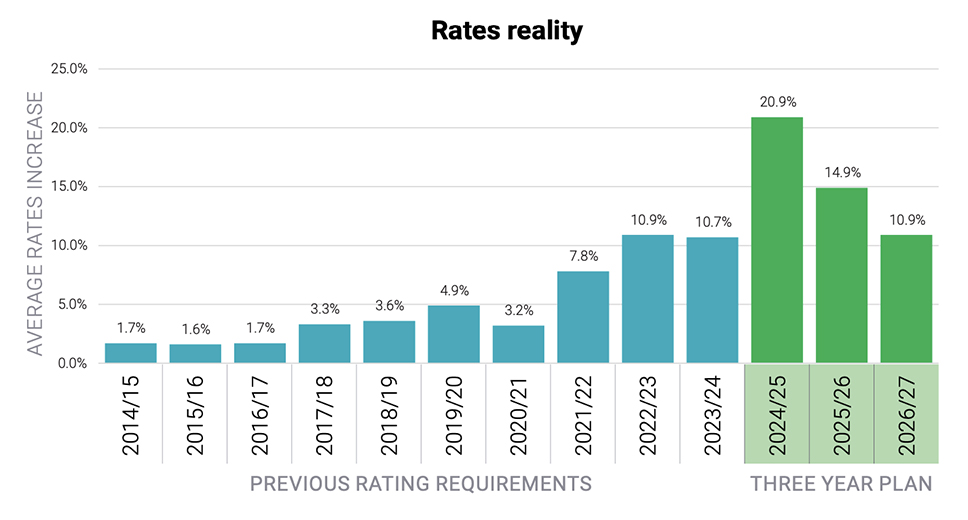
Dam II is already a dead duck, even as it awaits fast tracking. It will be a fast track to an inevitable financial cliff. Keeping its ‘Rates reality’ in mind, CHBDC has better things to do than using ratepayer funds to facilitate the fantasy of a handful of irrigators.

Great article Tom. Talk about flogging a dead horse, or in this case cow. HBRC seems profligate to me.
The reply to the your OIA enquiry should provide the info required. Between this and HDC kids decison maybe the water regulator should do some testing!
Why can’t the people behind this scheme just go away – CHB is a natural dry land farming area and throwing thousands of gallons of precious water into a few dairy farms is just plain stupid. Charge these people with all the costs to date – if they can’t pay it call up their assets and get the debt gone – and let’s get on with basic infrastructure repairs and improvements. CHBDC needs to put the majority of their people first rather than pander to a few landowners.
Sound and sensible reasoning.
This is the reality of irrigation “scheming”:
“The total cost of the Waimea community dam has climbed to $207.5 million, up $1m since July, but more costs are still approaching. An adjudication decision revealed in July favoured Fulton Hogan and Taylors Contracting, the joint venture construction contractor, which then raised the cost of the dam by $8.3m, from $198.2m to $206.5m.”
This is more than double the original “estimate”.
As Grant states, there are no logical reasons for ratepayers to subsidise large farms to use water when they refuse to consider alternatives.
Read/refer to Peter Farley’s book ” Irrigation Scheming” to find that the CHB (mainly dairy) farmers are joining a long list of those subsidised by the public to farm inappropriately with the “resources” they have.
Great article Tom. You get to the point with succinct reasoning. Any dam is a dead horse. Any expenditure on like to haves instead of need to haves is wasted money in anyone’s view. All Hawkes Bay councils seem to have forgotten the majority of submissions that asked them to focus on the still urgent work to be done for the better of all Hawkes Bay communities.
Like many others, I fully support water storage but only where and when there is no downside to the environment. My submission back in 2013 was against this scheme because it would dam a river that supplied 43% of all sand and gravel (according to Tonkin & Taylor) that reaches the coast via the Tukituki River. There were no provisions (eg dredging or trucking) made to ensure this vital material continued to reach the HB coast via the Tukituki River. The HBRC prefers stockpiling and extracting this material at the upper reaches while adequate gravel volumes need to naturally reach the coast where it enters the ‘northerly sediment drift’ and maintains coastal protection for property and public assets. Fortunately, the HBRC ‘Key Issues Report’ that stated “coastal matters are incidental issues for the Dam Proposal” was put aside without discussion when the project was shelved.
Simple points to remember about the Ruataniwha Dam.
There will be no recreational use of the,Dam for fishing boating or even swimming, because it will be the drinking water supply for all of CHB.
The Dam is not viable to generate electricity (not enough flow to generate reliably).
The Dam has a limited life span of 70 to 100 years due to sedimentation. The cost to decommmission the Dam according to international studies is 3 times the cost to build it.
Thanks Tom, for shining a light on this activity ‘behind closed doors’…..my goodness, as if local ratepayers aren’t struggling enough with the very many cost increases, including rates. What are they thinking?
Keep shining that light on it, please.
Thanks for the article. I see this evening the Tukituki Water Security Project is in the list of projects for the Fast Track Approvals Bill. Described as: “Formerly known as the Ruataniwha Water Storage Scheme, the project seeks to dam the Makaroro River
to recreate a water storage reservoir, to enable regional water security and sustainability.” https://www.rnz.co.nz/news/political/529962/government-unveils-149-projects-selected-by-fast-track-approvals-bill