


[As published in November/December BayBuzz magazine.]
Architect William Gummer (1884-1966) designed four houses of outstanding architectural merit in Hawke’s Bay. Tauroa and Arden were featured in BayBuzz May/June 2023 issue. The others are Belmount and Te Mata, built 17 years apart, and illustrate the contrast in Gummer’s stylistic range.
Belmount
Before Belmount there was Craggy Range. Story is, when Mathilda Agnes van Asch saw the huge rugged hill on the southern boundary of the 3,700 acre farm purchased by husband William in 1913, she suggested they name their estate Craggy Range.
One of the first van Asch endeavours was to capture water flow from a small stream running to the Tukituki River and hydro-generate around five kilowatts of electricity, enough to power the house and milking shed.
Encouraging the project was neighbour, Mokepeka station owner, John Chambers Jnr. Twenty years earlier he had built a hydroelectric power station beside the Maraetotara stream.
John Chambers was brother to Thomas Mason, who in 1914 commissioned William Gummer to design a new house after the original Tauroa homestead was destroyed by fire.
Tauroa took two years to build, and choosing Gummer to design Craggy Range seems a consequence of the van Asch and Chambers relationship.
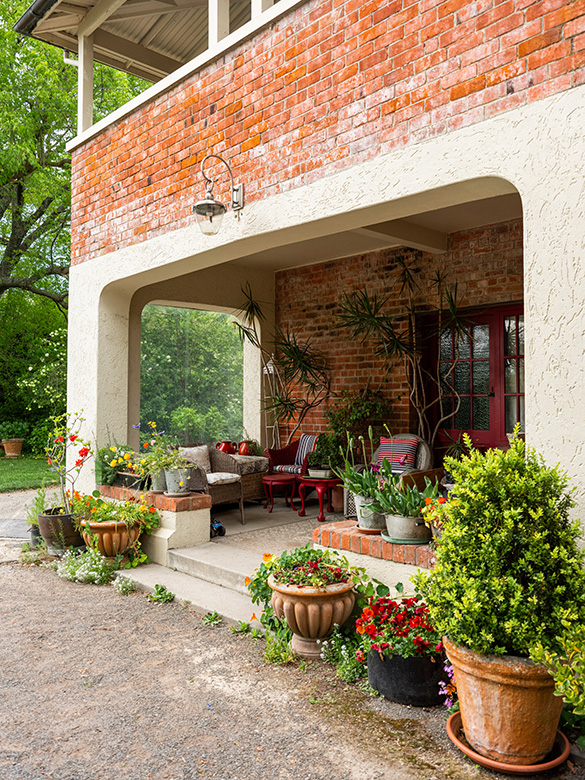
Craggy Range was completed in 1918, construction being the same as Tauroa: steel reinforced concrete frame with double cavity brick walls. Bricks were from the same supplier, Samual Eves, in Havelock North. Builders were Abbot and Crane from Hastings.
There are hints of Tauroa in details like window joinery and timber panelling, but Craggy Range is a different house altogether, being a bold advance in modern architecture for its time.
The Historic Places Trust description says, “Few vestiges of historicism survive in this house.” Translation: the design includes few architectural styles from the past; Tudor, Victorian, Georgian or even Beaux Arts, an underlying design theme of Tauroa. As the Trust explains, Craggy Range was “uncompromisingly modern and represents probably the first such attempt at domestic design in the modern idiom in New Zealand.” And, “The flat roofs, balconies and verandahs were a conscious response to the Hawke’s Bay climate.”
The no frills, geometric-block look of the exterior foreshadows the Bauhaus movement (1919-1933), where “design is often abstract, angular, and geometric, with little ornamentation.”
To my eye the subtle buttresses supporting concrete pillars evoke a no-frills medieval church design.
Formal entrance to the house opens to a timber-lined lobby. A guest bathroom is discretely located to one side, the other side opens to a generous hallway from which dining, sitting, and billiard rooms are accessed. The billiard room was originally partially open to the outside and lined in exposed brick which caused considerable trouble with efflorescence.
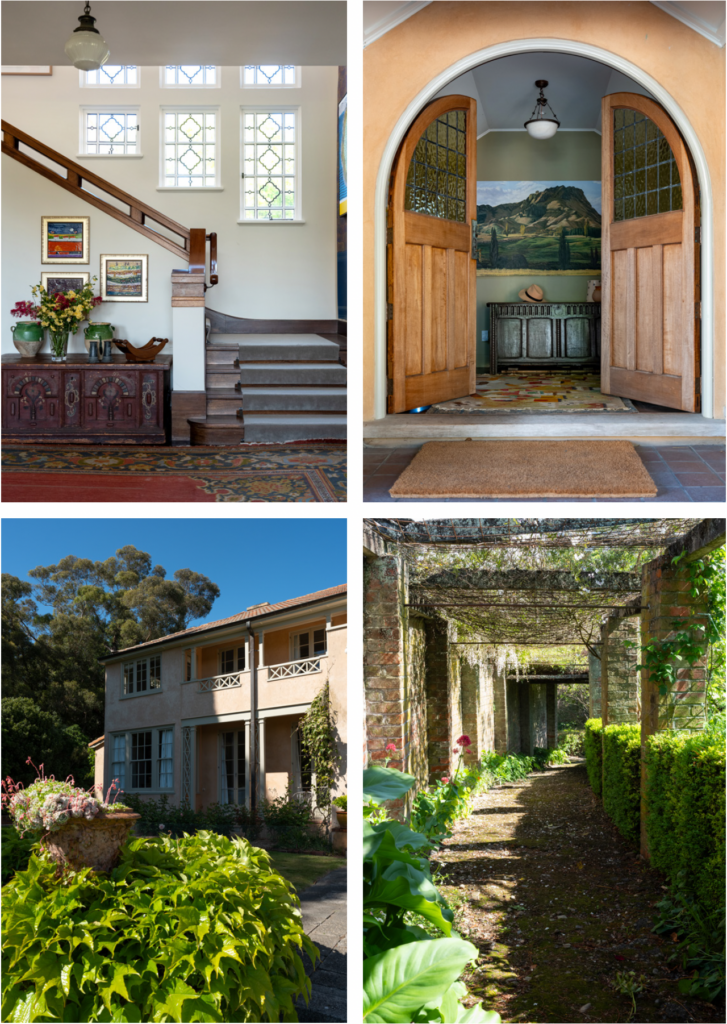
A passage runs past a cosy study with fireplace and library to the large farm kitchen unchanged except for modern appliances replacing the old.
A staircase with several turns leads to upstairs bedrooms and is flooded with light from a north-facing window at the top.
Throughout the house are surprise views of gardens framed by windows, along with wide vistas of surrounding countryside. Te Mata looms large to the west, especially from the first floor master bedroom, and behind the house towers Craggy Range, recently milled of pine trees, currently being partially reshaped into multiple house sites.
Criticism of Gummer’s design is warranted regarding water penetration by employing flat roofs which are notoriously difficult to make weather tight and have been an ongoing problem.
After the death of William van Asch in 1930, Craggy Range was run as a family farm by sons Gerrit, Ivan, and Derek. Their brother Piet was an aviation pioneer in the field of aerial photography. He built a darkroom in the house for processing photographs when he first founded NZ Aerial Mapping in 1937.
By 1946 Craggy Range had been subdivided into five blocks, Gerrit and Ivan taking one each, and three being sold.
The last block to sell was the homestead and 1,200 acres. This was purchased by Felix Campbell who named his new farm, Belmount, after a family estate in Ireland.
Felix worked as a farming cadet on Tirohia Station, Fernhill, from 1938 until joining the Royal NZ Airforce stationed in the Pacific. On returning he married Patricia Reid of Hastings whom he had met before the war.
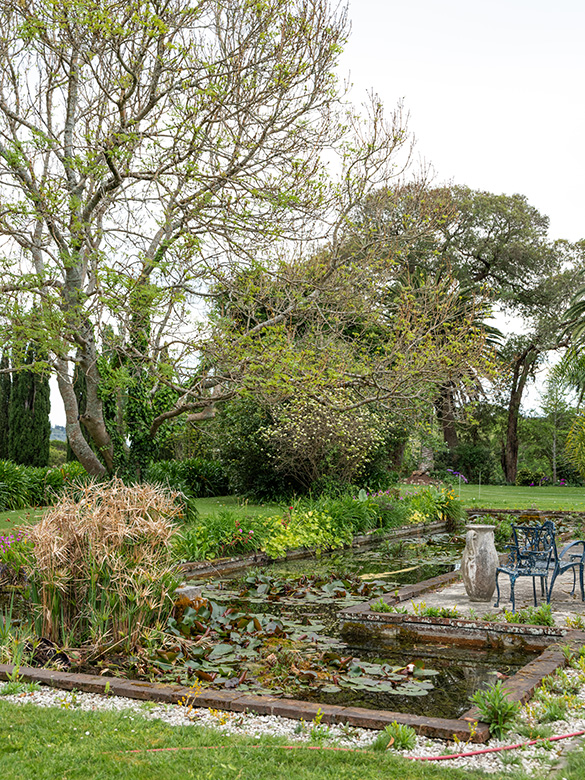
There is a record of Felix Campbell employing landscape designer, Trevor Buxton, to plan the grounds which “included driveway with a cattle stop at its entrance, a turning yard and courtyard, several areas of landscaped garden, and a tennis court.”
Buxton was popular in Hawke’s Bay having designed gardens for families Lyons in Bridge Pā, Duncan in Taihape, Bibby in Onga Onga, and Plummer in Waipawa.
Maintaining the garden at Belmount is a labour of love for Christine Campbell. She and Michael, Felix and Pat’s younger son, took over Belmount after Felix died in 2009.
Brother Patrick is the renowned race horse owner/trainer based in Hastings. Two of his retired champions are grazing a paddock at the garden’s edge.
Te Mata

When the founder of Te Mata winery, Bernard Chambers, sold the business in 1918, he also parted with 2,853 acres and the original Te Mata homestead built by his father John.
Bernard retained 129 acres of hillside across the road and he engaged architect William Rush to design a new Te Mata.
William Rush was the prominent Havelock North architect of this time. His work included Woodford House, Iona College, Hereworth School, and St Luke’s church and hall, and many houses. He designed a shepherd’s cottage for Bernard in 1909, today run as tourist accommodation by Black Barn.
Chambers’ family occupation of their large two-story home was short lived. In March 1922 they moved in, then on 3rd of February 1931, the house was so badly damaged by the 7.8 Napier earthquake it was rendered uninhabitable and had to be demolished. Bernard suffered a stroke in May the same year and died.
Commissioning a new house was undertaken by Lizzie, Bernard’s widow (nee Georgina Elizabeth Lowry). Her decision to choose William Gummer as architect was surely influenced by the fact that Tauroa (1915) Craggy Range (1918) and Arden (1926) survived the earthquake with only minor damage, testament to the structural soundness of Gummer designed buildings.
By 1935 William Gummer was well established in partnership with Charles Ford based in Auckland. Most of their work was commercial and included monumental builds like Auckland Railway Station, Dominion Museum, and the National War Memorial. Other than the four houses, in Hawke’s Bay Gummer (and Ford) designed only the State Insurance building at 58 Tennyson Street, Napier (1934).
Lizzie Chambers and her daughter Hazel moved into their new house in 1936. Builders were C.S Palmer of Hastings, and supervising was architect Eric Phillips (1897-1980) who designed many fine houses, among them Long Acre for Leonard and Jan Williams and Horseshoe Bend for Mason Chambers, son of Arden’s Maurice and Miriama.
In contrast to Belmount’s harsh modernism, Te Mata is a romantic evocation of the English country home, obviously influenced by the time Gummer spent working for Edwin Lutyens in London, who was master of the ‘picturesque cottage’ on a grand scale.
A long driveway climbs the hill to Te Mata, offering fleeting views of the building before coming to the rear south side of the house. Under a porte cochere, the main entrance is through double walnut doors, salvaged from the original house.
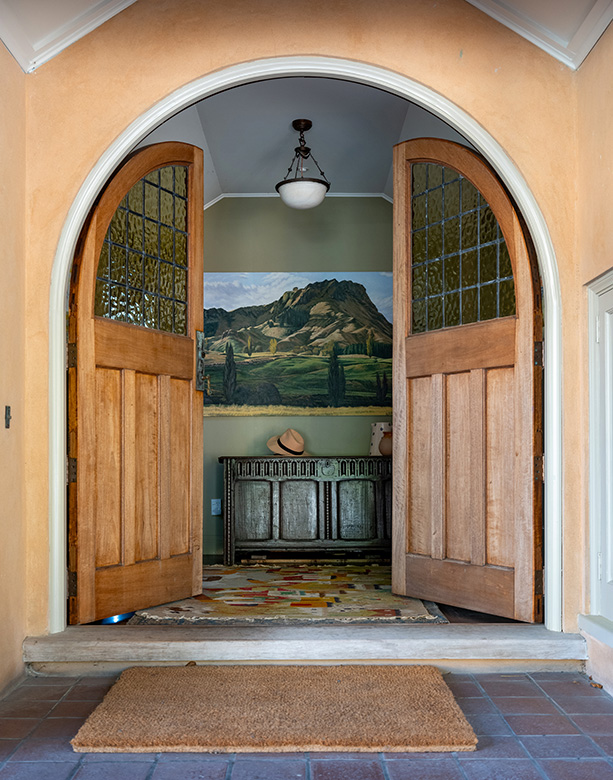
A timber-lined lobby leads to a generous hallway. On one side, a staircase bathed in southern light through metal framed windows leads to the bedrooms floor. On the northern side, wide doors open to a covered veranda from which are superb views over the Heretaunga Plains, Napier, Hastings, mountain ranges, and Hawke Bay.
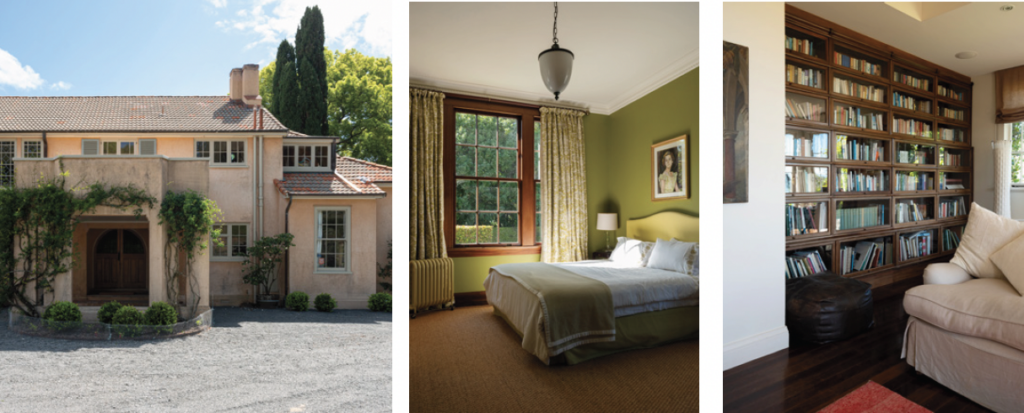
Lizzie Chambers died in 1945, after which Te Mata was occupied by daughter Hazel and her husband Peter Foxley. Their only child died soon after birth.
By 1985 Hazel had transferred ownership of Te Mata to her niece Bea Aitken, and she built a cottage nearby in which she and her housekeeper companion of 60 years, Miss Marjorie McLeod, lived until Hazel’s death in 1992.
Te Mata went to auction and was purchased by Clare Gordon, who was pregnant at the time. Bea Aitken offered that Clare move in before settlement date, so as to give birth in her new home.
Major internal work to the kitchen and services part of the house, designed by Auckland architect, Terry Hitchcock, transformed spaces suitable to a past era of domestic servants to open modern living.
Today, Te Mata is maintained with care, and has an atmosphere of warmth and light, where spaces flow seamlessly and modern art perfectly honours this timeless masterpiece of William Gummer.
Photos: Florence Charvin. More glorious photos in the BayBuzz magazine article.
