

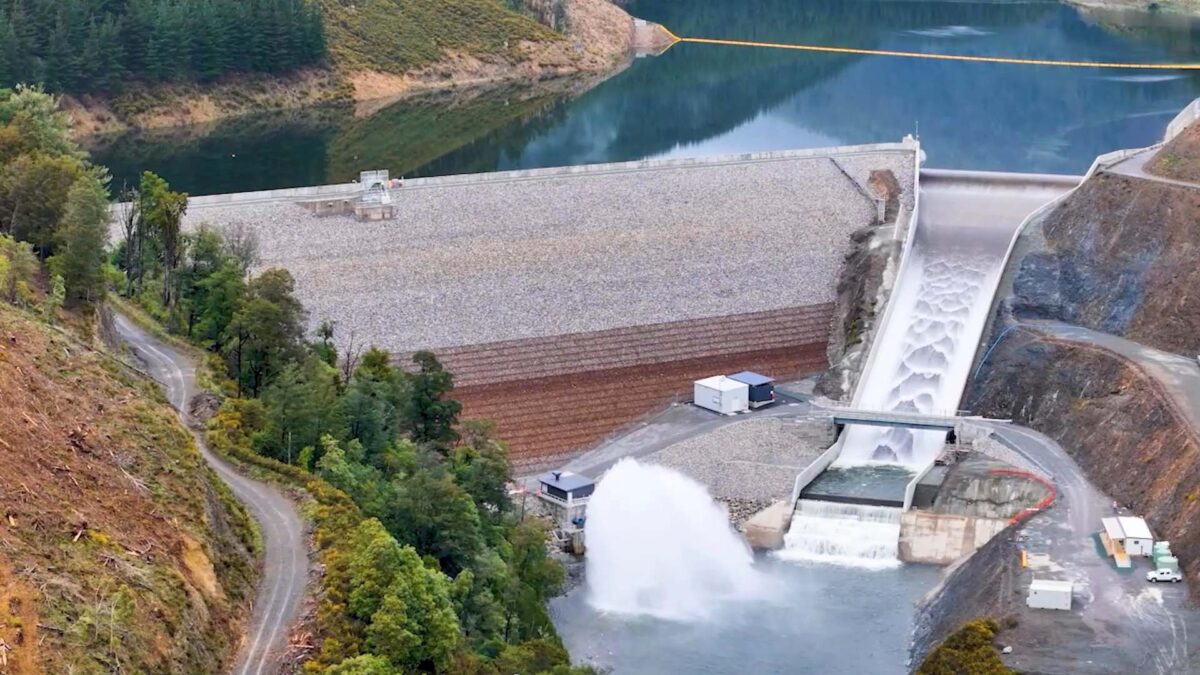
Dam bailouts ahead?
The most recent dam to be commissioned in NZ is the Waimea Dam down in Nelson/Tasman.
As this 26 July article from The Press describes in some detail, this dam, which just became operational in January 2025, is already headed for financial insolvency.
Some lessons here? The Press article should be required reading for would-be dam advocates.
Based on a briefing to government ministers obtained via an Official Information Act request, the article headlined: Council and irrigators seek dam bailout. Why?
Reports The Press: “The briefing by the Nelson Regional Development Agency … reported there was a “real risk” that servicing the dam’s debt would make the cost of water financially untenable for businesses – including the types of high productivity land uses the region was looking to enable.”
“A slow train wreck” said one critical councillor. According to the briefing, $167 million, 80% of the project was loan funded directly or indirectly by Tasman Council. That’s the Council’s looming problem – no headroom to borrow for anything else.
This is a dam whose original cost of $75.9 million blew out to $211 million, with even more required if efforts are undertaken to expand the service area of the scheme. Recall that in the Dam1 folly in our own CHB, the cost of actually getting the water to irrigators’ farmgates was about the same as the construction cost of the dam itself, making its usable cost more like $600 million.
And from the Waimea Dam irrigators’ forlorn perspective, water charges per share in their dam, estimated at $650 annually in 2018 now cost $1081, and are now predicted to hit $1500 by 2028. This leads the briefing report to warn:
“There is a scenario in which, in ten years’ time, irrigator uptake reduces in size … because of water affordability issues. This will significantly constrain the delivery of economic benefits on which the dam’s business case was modelled.”
But that warning doesn’t deter the revival committee for the failed Ruataniwha Dam 1 – Mike Petersen, Sam Robinson, Mike Devonshire and Hugh Ritchie – which also couldn’t make the financial cut ten years ago, from selling the same Kool-aid formula for Dam 2, abetted by up to $3 million in matching funds from the Government’s Regional Investment Fund.
It gets worse, they actually regard the Waimea Dam as the poster child for their project. Last week they made this worrisome announcement:
“… we are very excited to confirm that Mike Scott, who recently finished up as CEO of Waimea Water, after successfully designing, constructing and commissioning this dam, has agreed to come in and lead our work … Mike Scott can help the region by providing some valuable insights from the Waimea Dam project that will apply to us here.”
What’s successful about building a dam at nearly triple its projected cost, with more cost to come, that’s becoming unaffordable to its users?
Talk about hoping to learn from mistakes! Seems like hiring the helmsman of the Titanic.
So, is the Waimea Dam a model to envy or a white elephant?
Whether it’s responding to pleading for a bailout of the Waimea Dam this time, or for taxpayer investment in a Ruataniwha (or Heretaunga) Dam in the future, the Coalition Government should honour its sacred mantra … User Pays!
Meantime, another reason for HBRC to put water savings before water storage.

Ruataniwha was a dog from the start – the only difference now is that the size of the dog has increased markedly and the proponents have hired a new dog whisperer whose success is measured by how much his previous dog grew and continues to grow. Some people just don’t know when to quit – they’d rather bankrupt the locals than admit failure
I agree with Grant, that the “Ruataniwha Dam was a dog from the start”, and I proved it with a detailed Submission – presented years ago at a Hearing in the Waipawa Hall. I’m not against the storage of water, but I am against the consequential blockage of gravel by a dam on a braided river where reinstating gravel flows is not an option. This significant source of gravel, via the Makaroro River, has become a necessary component for industry downstream and a vital component for coastal protection when it reaches the river mouth. Fortunately, recognising a bad investment and the certainty of being sued will put this opportunistic project where it belongs.