

[As published in November/December BayBuzz magazine.]
Apparently, if you drive north past the airport, and look between the two navigational pylons to where the hills start to grow, you’ll see a lone tree. It’s called Admiralty Tree, and in another time was used by ship captains as a guide to help them manoeuvre into the harbour.
It’s a nugget passed on to me by Grant Ancell, who volunteers at the Hawke’s Bay Knowledge Bank, and I’ll tuck it away in case it ever comes up at quiz night.
The Knowledge Bank, now chaired by Cynthia Bowers, is a digital archive of local history and was started by James Morgan, an editor of the Hawke’s Bay Herald Tribune, who wanted to make sure the collective memory of Hawke’s Bay wasn’t lost. Remarkably it’s the only such resource in New Zealand. It’s also free. There used to be something similar in the Bay of Plenty, but not anymore.
There’s a name for the Knowledge Bank concept. It’s called hyperlocal, a term often and increasingly used in a business or marketing context. Wikipedia describes the concept as ‘information centred around a well-defined community.’ It’s our own little time capsule in the cloud.
“Well, not really the cloud,” says Linda Bainbridge, who runs the operation at the Stonycroft base, and manages the 82 Knowledge Bank volunteers. She explains an unwritten rule of storing digital data: If you haven’t made three copies it doesn’t really exist. “We’ve got our own server,” Linda proudly shows me, “but we also keep everything on two others for safety.”
‘Everything’, includes, photos, video, oral histories, diaries, papers, literally thousands of documents and terabytes of data … all about Hawke’s Bay.
Linda came to the Knowledge Bank as a volunteer looking to get a bit of a confidence boost – after having been out of the workforce for a decade – and never left. With a management degree from EIT, Linda is paying it forward. Knowledge Bank works with MSD, Workbridge and the Disability Resource Centre to give others the chance to polish their skills. “We’ve got volunteers from all over the place, some retired, some not, and we’ve got a lovely young high school student who helps us with data entry.”
I wonder out loud what sort of person you’d need to be to volunteer at the Knowledge Bank, but Linda is well ahead of me. “You need to be a fan of history, obviously,” she says. Well yes, but it’s more than that, the volunteers all seem to be bound by a curious nature. They’re inquisitive.
It’s easy to go down the rabbit hole too. If, for example, you’re ever wondering what transpired at the luncheon meetings of the Hastings Rotary Club, I’m sure you’ll be pleased to know that on January 25, 1929, Mr WT Harrison gave a chat on Kent, being an account of a recent trip to the old country. Talks about travel were clearly a bit of a feature at these lunches, where, on the 31st of August, this time at the Rialto Tea Rooms, Mr A Kingsford addressed the club on ‘Life in Mexico’. Curiosity is contagious too, as I start to wonder, probably far too much, what was served for lunch.
As if to prove the point about curiosity, Linda gets a little too excited about looking through a 1929 issue of a tourist guide to Hastings. “Do you know how many monkeys we had in the zoo back then?” She asks. To be honest I didn’t even know we had a zoo, let alone monkeys.
It’s here though, in the minutiae of life, that we get a glimpse of our near past and how we’ve behaved. But in all the details, you can’t help but wonder, why? Who would be interested in all this? “Oh, you’d be surprised,” Linda tells me. “We had a detective come in once. He was looking to prove someone was in the Bay at a particular time.” Detectives and genealogists aside, the resource has been used to solve all sorts of mysteries, like property disputes for instance.
Claire Donkin, another volunteer, is busy transcribing a farmer’s diary. There’s 53 of them including 20 or 30 years’ worth of shearing tables. It makes for pretty dry reading with entries like ‘took the family to Wairoa’ and ‘finished harrowing turnips in cabbage tree paddock’. The neat incursive writing would be a struggle for anyone under thirty to decipher according to Claire. Again, the question is why? “It’s pretty boring to be honest,” says Claire. “But over time you get to understand land use and climate patterns and how they change.” Even in their parched state, the diaries add colour and nuance that data can’t. Nothing boring in that.
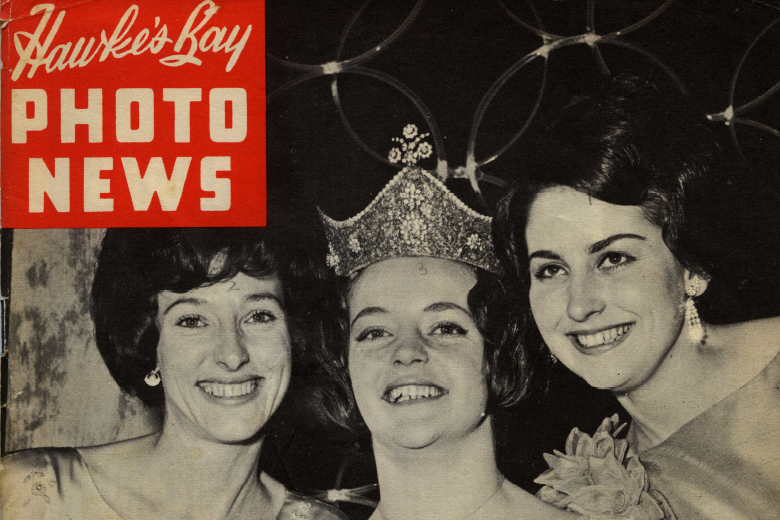
Unlike a museum, the Knowledge Bank information is collected without judgement. The criteria for entry is governed more by the budget which is always tight. They capture images, say a magazine page like this, with a digital camera. Each click of the shutter, Linda explains, triggers a process that can take about two or three hours, by several people, as each document is patiently transcribed, cleaned, and uploaded to the website.
It’s a time consuming process that always requires more money to capture and store the data, and many more volunteer hours to process it. The Knowledge Bank needs more of both. But it’s interesting work for a curious mind. Where else would you be able to discover how many streetlights Hastings had in 1929?
Or the name of that tree on the hill behind the navigation pylons.
You can check out the latest Knowledge Bank newsletters here.

… and browse the KnowledgeBank website at https://knowledgebank.org.nz/
A great organisation and one in need of funding and definitely many more volunteers. It’s a good place to work and socialise so give it some thought folks – if you don’t have the time to work (although work from home can be an option – just phone to find out how) think about a donation to advance the work being done. At last count there’s not far off 2 million items of Hawke’s Bay history on line thanks to Knowledge Bank’s work