


[As published in January/February BayBuzz magazine.]
Neill Gordon
A community builder who imagines creative ways for strangers to meet
Barbed wire or barbecues?
Once Neill Gordon rested easy as tangata Tiriti, assured progress was making glacial pace towards fulfilling promises made to our indigenous people. A local organised effort to recruit white supremacists, led by a National Front member in our midst, burst his bubble and prompted him to action. This February, at Waitangi, Tangata Tiriti Aotearoa, was born.
‘Tangata Tiriti are annoyed because now they have to speak up. People have to get off the fence on the only plausible side. We signed a deal. We have to honour it. When you trample on the mana of Te Tiriti you’re trampling on everyone’s mana. Tangata whenua obviously, but tangata Tiriti too,’ he contends. ‘To celebrate being pākehā you have to look back at our history, the promises made in 1840 broken over the past 180 years, and confront that we’ve spent 180 years averting our eyes. We came, we signed, we stuffed up. Now let’s sort it out.’
He blames a failure of education, noting teaching our history in schools has only been compulsory since 2022. ‘The same people flailing their tiny dinosaur arms against Te Tiriti struggle with the idea that everyone isn’t white and heterosexual – an assimilationist mindset. We should all be the same – like them,’ he observes. ‘It’s an emotional commitment to ignorance.’
His solution, ‘kotahitanga…working together towards a common goal, celebrating our diversity, our differences. Because of its small size, demographics, significant Māori population, strong iwi leaders, the practicality of its people, Hawke’s Bay can lead the way, show the country how unity works, that we’re a team. We’re already leading – look at the magnificent Toitū te Reo, world first Māori language and culture festival, attended by 7,000. Consider our councils’ support for Māori wards. We’ve had co-governance over the Hastings wastewater treatment plant for 20 years. It works. It’s good for everyone.’
His is one of many Tangata Tiriti groups mushrooming in response to current governmental policies, standing on the shoulders of those whose mahi spans decades, supercharged by ‘the kōhanga generation’. The hikoi chant ka whawhai tonu mātau – we will fight on – became ka ora tonu mātau – we will live on, indicative of a willingness to persist.
Rather than being ‘radical or subversive’, he sees the movement as ‘happy honest patriotism,’ honouring our history while safeguarding our nation’s future. ‘The conversations we have ahead of us – Te Tiriti, Māori wards – offer huge opportunities for community building,’ he proffers. ‘Countries with an awkward history do themselves a favour by confronting it – by looking at it and talking about it.
In Aotearoa we hobble along with this stone in our gumboot. How long should you walk with a stone in your shoe? No distance at all. This lump in the carpet, there are bodies under there. I understand why people avoid looking at it – it’s tragic – but suppressing it is weak and dishonest. It’s not going away,’ he maintains, ‘the 200th anniversary of the treaty is in 2040. What do people want, barbed wire or barbecues? Definitely barbecues.’
*****
Vincent Michaelsen
Proprietor of Vinci’s Pizza and chair of Napier City Business
More street buzz with pop-up experiences
Vinci’s Pizza is iconic in Napier, not just for serving the finest New York slice in town, but for its vibe. Its tables spill out onto Hastings Street, enlivening the environment. Out back, the courtyard is frequently filled with special events – a DJ inviting dancers, a wine launch, a beer dispensing bicycle.

This is entirely by the design of owner and chair of Napier City Business Inc, Vincent Michaelsen, who believes the key to a thriving city is to fill its streets with people. ‘You never say a city is vibrant because there’s stuff going on behind closed doors. It’s because people are out there, publicly, enjoying themselves,’ he muses.
‘The city has a very anti food truck, anti stall approach. Local businesses view food trucks as stealing their revenue. I accept food trucks can be trashy, they’re not necessarily the best physical thing for the job,’ posits Michaelsen. Unlike business owners with a zero sum, deficit mindset, he welcomes competition, believing a rising tide lifts all boats. Creating shared spaces where people want to be attracts traffic in volumes that benefit everyone.
He borrows his vision from Europe, where lively city life is baked into the culture. He dreams of a series of kiosks, council built, in cute uniformity with style as well as function in mind. Fledgling businesses could rent them – on providing a robust business plan, subject to curation. For some, tenure could be permanent – ‘there are so many good little ideas that will only work in a very small setting,’ he professes, ‘a hot dog stand can only sell so many hot dogs.’ Others could be subject to rotation – seasonally, or even shorter terms for pop-up offerings. For some the space could function as a ‘business incubator,’ a chance to work out systems and processes on a small scale as a stepping stone into larger leased premises. Some could be multi-use, such as, ‘a bar that opens only Friday and Saturday nights. I don’t see why we need to lock people inside to drink alcohol.’ He envisions, ‘thriving micro businesses, and people in the street enjoying themselves.’
NCBI received feedback about antisocial behaviour from some Clive Square tenants, which Michaelsen sees as a natural consequence of a city which locks life behind both physical walls and paywalls. ‘We have these locations where nothing is happening, something is going to fill the void,’ he believes. ‘Sometimes work has been busy but I walk down the street and there’s no one. We don’t inhabit the city like it could be inhabited,’ he ventures. He would love to see a beer garden and hot dog stand in Clive Square; Marine Parade, Emerson Street and Market Street alive with mini businesses, keeping people in the streets.
So far his indirect pitches to NCC have fallen into the ‘too hard basket,’ but with the tenacity of a successful business owner and community builder he won’t let it go. Michaelsen states, ‘Council has access to the land. They could make it happen.’
*****
Kevin Murphy
NCC events organiser and a champion of musicians
A dedicated music hub
Kevin Murphy’s passion for, and faith in local music permeates his many roles, from coordinating Napier City Council’s some thirty annual events, to creating a database for musicians, venues and industry professionals with Hawke’s Bay Music Hub. Developing the regional scene and the musicians who populate it is the end goal of the sum of his various projects. ‘Music is such a big part of everybody’s lives – it maps out memories. Events and music go hand in hand with creating memories, capturing moments,’ he asserts.

Like sport, he sees the scene as a pyramid – with a mass of primary kids butchering the recorder at its base, whittled down to those whose music pays for their bread at the apex. ‘It’s a fairly niche environment at the top,’ he admits. ‘It’s a really hard profession. Most take second jobs to survive.’ Backline Charitable Trust’s aim is to push local musicians into the point of the pyramid, to catapult them onto the national stage.
They recently announced the fourth volume of Under the Sun – a compilation of fresh local music pressed on a record and distributed throughout the industry nationally. Murphy’s purpose is to ‘shine a light on our Hawke’s Bay artists. It’s pretty unique. It’s not something many could do for themselves.’ Once in the ears of touring musicians and promoters, they hope featured artists will be picked up for gigs, projecting them to a still larger audience.
Murphy’s dreams to give regional musicians a leg up take concrete form.
He sees a need for locally available producers, particularly since Thomas Oliver left his Treehouse studio for warmer shores. ‘In the past couple of years we’ve really seen the impact he’s had on recording artists,’ he observes.
Access to a recording studio is a boon for any artist. There are a handful in the region, including those at EIT and Paisley Stage; but while we have recording technicians, the lack of affordable, available production personnel holds artists back from the next level. Murphy laments the loss of local artists who go to big city studios for their final mix. He wants to source and fund guest producers to work with a number of artists right here in Hawke’s Bay.
He would love to create a dedicated music hub, in bricks and mortar to mirror the one he has already made online. He sees a gap for a dedicated indoor gig venue – not a bar or theatre or winery or stadium – with a capacity of around a thousand, that could incorporate space for recording and production, and foster a collective of suppliers to the industry.
For now, Murphy is making hay while the sun shines. As well as the record, and a constant stream of summer events, he’s launching a series of activations to enliven Napier’s Soundshell, harkening back to its heyday, when INXS filled it in the summer of ‘82. He hopes to put local musicians on stage, making names for themselves, while locals and visitors dance in the streets, making memories.
*****
Beth Elstone
Her company, Littlestone, creates memorable events
Use new spaces, new ways
Beth Elstone knows how to throw a party. But to the average event attendee she is invisible, by design. ‘I’m so behind the scenes. The beauty of my job is that no one sees what I do,’ she notes.
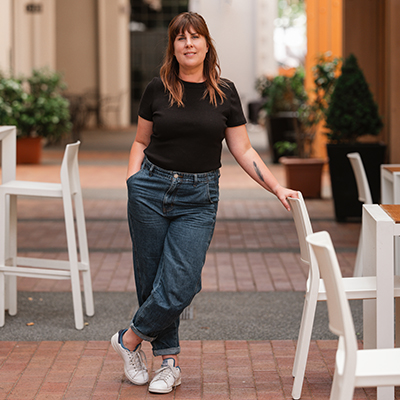
Coming down from the high of her latest baby – the inaugural Collins Street Festival – she’s hit the ground running in preparation for Napier’s milestone 150th Christmas Parade, Fiesta and Concert. Silly season takes on a whole new meaning for those whose business is fun.
Her event management company, Littlestone’s, list of achievements shows, with a brief scroll, her inconspicuous fingerprints over an impressive portfolio on both local and national stages. She’s dipped her fingers in basketball, BMX and surf festivals, as well as music – her bread and butter. Behemoths like Art Deco, Church Road Concerts and Sail GP sit beside acoustic gigs from emerging artists.
Managing local success story, Arahi, opened Elstone’s eyes to the potential for ‘unique experiences, pushing outside what everyone else is doing.’ Together they collaborated with artists, dancers and theatre practitioners, blurring boundaries to make magic.
Working with promoters at established venues is something she can do in her infrequent sleep. To her they feel ‘a bit cookie cutter. People are after more interesting experiences – activating spaces in a way that is rich with music and art. It’s not just about what you’re going to any more, it’s about the feelings it brings,’ she declares.
Elstone’s dream, one she has achieved with Collins Street, is to ‘try to use spaces that haven’t been used,’ in new and diverse ways, ‘not telling people everything so they show up and there’s a few surprises. It adds a little cherry on the top.’
Collins Street took over the Ahuriri lane adjacent to The Urban Winery and The National Distillery, whose wares featured in the festival’s pop-up bars. Guests were surprised by the transformation of the location – one they were used to being used as a car park and loading dock. Stalls sold records and curated vintage clothing. Instead of piped music in the intervals between bands, Undergrand’s creamy white baby grand piano invited at random the many collected musicians to fill the space with joyful impromptu melody, as diverse as the crowd.
‘It was a crazy idea but we managed to pull it off,’ she says with a smile earned from having autonomy over her product. It’s an idea she hopes to expand as it grows, over multiple days with a range of offerings – acoustic music on the waterfront, a dance party on the beach – her imagination is rife with possibility to realise the potential of the environment and the community.
At its core, Elstone’s work is gift giving. Her motivation is the people who experience what she creates. Though much of her time is spent curating and managing artists, ‘the audience is the best thing about the event,’ she attests, ‘I believe if you put the audience at the heart of everything the artists will have the best time.’
Photos: Florence Charvin

Amazing people with such good ideas!
How frustrating they are just ideas!
few whoppers in there.
amazing people great stories