

[As published in May/June 2026 BayBuzz magazine.]
Unless you’ve been living under a rock, you’ll know New Zealand, and indeed the rest of the world, is grappling with an energy crisis.
Like many other commodities driven by the decisions made by others on the world stage, the price of oil is something we have next to no control over. And, also like the rest of the world, it’s not just transport that is reliant on the availability and price of oil. It’s our food production, manufacturing and distribution systems, our export industries, and our local plastics industry (think building products and food packaging).
Suddenly our reliance on fossil fuels isn’t just about climate change; it’s about national resilience.
It’s a mistake to think the economic fallout from current geopolitical events is a once-off occurrence that we simply need to ride out for a few months before getting back to ‘normal’. What the current crisis is laying bare, in real time, is that energy resilience needs to be on the agenda as strategy, not crisis management.
Why it matters
The first and most obvious impact for New Zealanders is the cost of filling the car up. The average price of petrol (at the time of writing) has risen some 35%, while the cost of diesel has seen an eye-watering 85% jump.
Food production is highly reliant on diesel, and diesel-powered trucks form the backbone of the country’s supply chain, so the cost of fuel affects the price of goods too – a double whammy for New Zealand consumers. This can also push up inflation and interest rates – a potential triple whammy.
Then there is the almost unimaginable (but possible) scenario in which the country gets to extremely low fuel levels and we start to think fondly of the days when we could freely access a pump. This is a possibility at present but doesn’t have to be a threat in the future.
Where to start
The path forward is multi-pronged. The biggest and most impactful in the long term is pursuing energy resilience. We won’t be a fossil fuel-free society for some years to come, but there are steps we can take to greatly reduce our fossil fuel reliance, and the exposure we have to price shocks.
CEO of not-for-profit organisation Rewiring Aotearoa, Mike Casey, started out by electrifying his cherry orchard production, before expanding his ambition to the whole country. The organisation has produced an ‘Electrification Policy Manifesto’ for electrifying the country’s machinery that produces our goods, transports them – and us – around, and powers our homes and businesses.
It lays out a five-point approach: develop a compelling electrification vision, empower New Zealanders to electrify, cut red tape, reward those who make the shift, and invest in accelerated electrification.
Their research has found 84% of machines – that’s everything from cars and motorbikes to heating and cooling – can be electrified through readily available alternatives. Around 10%, such as trucks and buses, “need some effort”, and the remaining 6%, which include very large trucks, excavators, airplanes and the like, are more difficult to tackle right now.
Government’s role
What’s needed is a vision and clear policy signals from government that puts the country on a path to reducing fossil fuel reliance.
For example, if policies prioritise roads then the result will be more vehicles. If they prioritise public transport, walking and cycling infrastructure, and 20-minute city urban planning, then our reliance on our cars and fossil fuel falls.
Unfortunately, the focus has been on cars with the kibosh put on a raft of projects designed to get people using public transport, biking or walking.
Over the last decade KiwiRail has looked at projects to complete electrification of key routes in the North Island, but projected costs led to them being abandoned. These included freight from Auckland to Wellington and the ‘golden triangle’ between Auckland, Tauranga, and Hamilton.
It’s clear that the government’s focus needs to shift. The Roads of National Significance Programme is one example of a lot of money potentially being directed into an altogether car-centric outcome. The programme recently came under strong scrutiny in the Infrastructure Commission’s National Infrastructure Plan.
It pointed out the programme, which will require tens of billions in additional revenue, lacked detailed business cases and would require a 70% increase in road user charges. The government has until June to formally respond.
Humans are notoriously bad at considering risks that aren’t immediately in front of us. But that’s the role of government, to enact policy that takes a longer-term view. It just takes the political will to ‘read the room’ and adapt policy to create a more energy secure future.
The role of renewable energy
What we are lucky to have is a wealth of natural resources – not the oily variety, but renewables (wind, solar, geothermal). We can decouple a large amount of our energy reliance on international sources, but it’s going to take vision and long-term thinking, as well as clear policy and pricing signals from government that will enable action from industry.
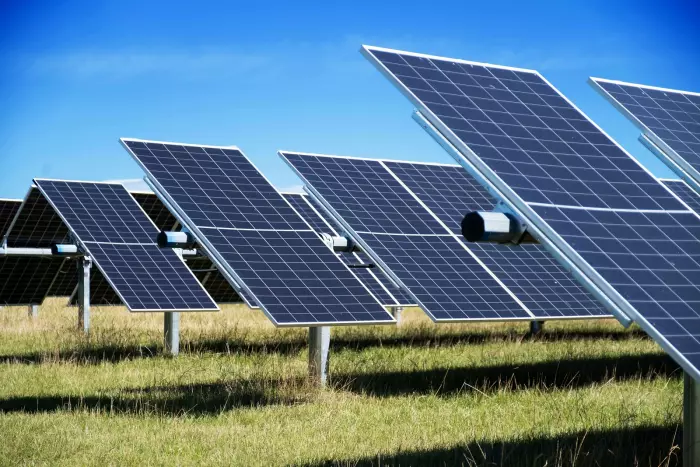
Solar is an area of huge potential for powering homes and businesses but needs government support to get the kind of uptake which can make a meaningful difference. Australia, for example, has achieved the highest solar uptake per capita in the world – an estimated 39% of Australian homes now have solar panels – many through government support
And it’s not just the sunny countries which have taken to solar. The next nine spaces which top the list of solar uptake per capita are in Europe – places like the Netherlands, Germany, and Belgium. Not exactly countries you choose to visit because of their sunshine hours.
For some context, New Zealand sits well below the world average, in the mid-fifties on the list – just below South Africa and just above Mali and El Salvador.
It’s not that New Zealanders aren’t keen on electrification. According to Rewiring Aotearoa around half of households and two-thirds of farmers are “frustrated enthusiasts” or “need more knowledge” when it comes to electrification. As Rewiring Aotearoa CEO Mike Casey points out, “A perceived barrier is indeed still a barrier and our country needs direction from the top.”
Some larger scale solar projects are underway, including two near Ongaonga in Central Hawke’s Bay, and another at Hawke’s Bay Airport, but we need more renewable energy projects to become truly resilient.
What individuals can do
New Zealanders have long had a love affair with cars. Per capita we’re one of the highest owners of private vehicles. We love the freedom they provide, and the country’s geography, relatively low urban density, and underdeveloped public transport system makes them essential for many.
We also have a strong affinity for big vehicles – especially utes and SUVs. The Ford Ranger, Toyota Hilux, RAV4, Mitsubishi Triton and the like have dominated the top seller list year after year.
It’s all good and well when a two-tonne vehicle is loaded with people and gear and heads into rugged terrain but is arguably overkill for driving five minutes to the dairy for bread and milk.
Recent research on vehicle use found that a third of double-cab ute travel was for, “shopping, social activities, personal appointments, or drop-offs.” It also found 88% of ute trips were driver-only. I’m certain the stats will be no different for other cars too.
The bottom line is we need to think about how we use resources to get ourselves around. EVs are one part of the solution, but we obviously can’t all suddenly head off to the nearest showroom and buy one.
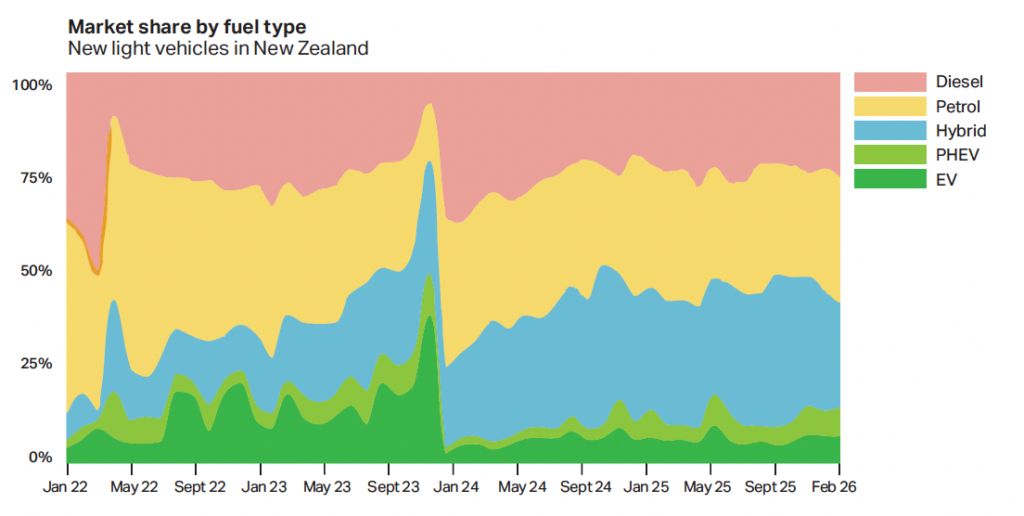
While the choice of vehicle you buy and how you use it is a personal decision, there is no doubt it can be heavily influenced by policy. Undoubtedly the most consequential in recent years was the scrapping of the clean car discount, which saw the EV and plug-in hybrid market fall off a cliff.
Fast forward to the present and sky-high fuel costs are once again seeing buyers flock to buy EVs, with dealers reporting they are selling vehicles before they are even shipped to New Zealand.
While this is shifting more people to emissions-free driving, a cost-of-fuel crisis shouldn’t be the trigger. Buying a car is normally a considered process, but a red-hot market causes prices to spike, and people to make rushed, sometimes ill-informed decisions.
It also doesn’t foster the ongoing increase in electrified transport that is needed because once fuel prices stabilise the major driver for EV uptake will vanish. Policy decisions which incentivise more low and emissions-free vehicles, in tandem with developing renewable energy systems to charge them, will create a far more stable market.
Ultimately, we should be looking to use energy more efficiently. For this to happen, public transport needs to be more readily accessible, convenient, and normalised. Here, again, government policy is vital.
There are undoubtedly challenges to achieving a future in which we are better shielded from the price of oil, but the technology and will does exist.
At the end of the day the cost of doing something today may seem high, but as we are learning right now, the cost of doing nothing is greater.
For fuel saving tips check out EECA’s ‘Stretch every tank’.
Dom works at 3R, which designs, implements and manages product stewardship schemes for individual businesses or industry-wide groups. They also help businesses take a fresh look at their waste to first minimise and then recover what would otherwise be wasted.


All very good but, as other articles have noted, the cost of electrification relies on a huge amount of carbon to get the raw materials with an increase to global warming because of the uplift in mining for said raw materials. Admittedly the end result may be better – but it may be 20 years or more before the result outweighs the increased carbon effects used to achieve the benefits. Cause and effect rules! But there again something has to happen and maybe the bad stuff needs to occur so that the good stuff can change the world eventually?