


The brief was to find out if anything had come from the $650,000 in government funding, allocated for a seed drying facility at Otane. BayBuzz first reported on this last September here.
Turns out quite a lot has happened.
The deal saw money from Kānoa – the government’s regional development and investment unit – go to the CHB District Council (CHBDC) on behalf of local seed company Kaikora Enterprises.
That was announced in September and, by Christmas, Simon White of Kaikora Enterprises was drying 50 tonnes of grass seed and onion seed for another local farmer. “Only we had no power at Christmas, so I hooked up a generator,’’ White told BayBuzz. The electricity was eventually installed and, by the end of the season, about 700 tonnes of grain and seed had been dried for distribution.
Representatives of Kānoa and the CHBDC joined BayBuzz in Otane to tour the custom-made facility and learn a bit about why drying seeds is important and how projects such as this one benefit the whole district.
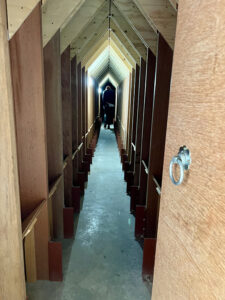
Prior to having this on his doorstep White, an arable and sheep and beef farmer, was having to batch-harvest and dry the seeds he grows under contract for the likes of South Pacific Seeds and PGG Wrightson. Now, he and others can do a full harvest, safe in the knowledge it can be dried almost instantaneously.
“It’s not just growing a seed. For what we do, we have to get 90 to 99% germination. So, if we sell a seed to you, you want it to germinate,’’ said White. “So we might harvest, say, 500 kilos of seed, but that’ll get cleaned and we’ll end up with 100 kilos, but it’s got to be 95 % to 99% germination.
“If we don’t have that drying, the seeds basically build bacteria, rot and you won’t have anything. Some seeds are harvested at 20% moisture. If we left it for a day, it would just go mouldy.’’ And if you’re having to truck that seed to a drying facility in Manawatu, as was the case before this one was built, the chances of that seed deteriorating were quite high.
That’s something the CHBDC became acutely aware of.
Its economic development manager, Sasha D’Ath is forever on the lookout for ways to help people generate income and jobs to benefit the district.
Beyond the environmental impact of that travel, she quickly realised the lack of such a facility in CHB was impacting the income of growers like White. “This seed drying facility is part of a wider community organisation that’s probably going to be generating in the vicinity of $10 million just in Central Hawke’s Bay and Hawke’s Bay,’’ White said.
Those kinds of numbers appealed to Kānoa’s principal adviser for Hawke’s Bay, Cameron Osmond, after he was told of the opportunity by a contact at the Ministry for Primary Industries.
“It’s really important for us to look at the broader benefits across the district and the council seemed like the right partner to organise that,’’ Osmond said. “So it comes from our regional strategic partnership fund allocation and, really, what we’re looking for is bringing some catalyst-type of investments like this into the area where we can actually, not just grow the existing businesses, but stretch out some of the gains to the broader community as well.’’
It’s hoped this initiative will help convince others that arable farming is a profitable and sustainable option for them too. “It’s exceptionally good [for the environment] because it creates diversity and we haven’t got a high input of chemicals or anything like that,’’ said White.
“The real key functionality of any agricultural industry is what you’re doing to the soil. It doesn’t matter what’s happening on top of the soil. If you’re creating healthy soil you’re creating biology, you’re creating a healthy life down there and that on its own will eliminate all the environmental issues.’’
He wouldn’t have been able to do this without the support of the CHBDC and Kānoa and couldn’t be happier with the initial results.
“This council is amazing from our point of view because they’ve been really supportive, not just of this facility, but of what we’re trying to create throughout the entire community in terms of growing and diversifying things, helping industry,’’ said White. “Central Hawke’s Bay has a huge amount of agriculture so for them to be supporting things like this is awesome.’’
Public Interest Journalism funded through NZ On Air
