

[As published in May/June BayBuzz magazine.]
Our region’s Climate Action Joint Committee (CAJC), representing Hawke’s Bay’s five councils and with iwi representation, held its most recent meeting in March, with the next gathering scheduled for May.
The Committee is charged with plotting a climate mitigation and adaptation course for the region.
Several matters of note were tabled at the March session.
Future budget for climate planning
The work of the CAJC is supported entirely by the five councils in a cost sharing arrangement – 26% of budget from Hastings, Napier and regional Councils, 11% from CHB and Wairoa Councils. This cash is supplemented by various council staff having support roles for the Committee’s work.
With new 3-Year Long Term Plans looming, the Committee has recommended to its constituent councils a budget of $690,000 over the next three fiscal years (through FY2026-27). It is now up to the individual councils to commit the cash in their plans. With the mayors and HBRC chair on board, that outcome seems secure, barring backbench opposition from rank and file councillors.
So, what will $230,000 per year buy in the way of climate action?
Mostly more research – $480,000 is allocated for a comprehensive climate change risk assessment for the region. Another $80,000 for a web portal and community engagement that would further educate about our local climate risks.
At a ‘macro’ level, we’re flooded with information and predictions from everyone from NIWA to NASA to the UN about more severe weather, drier and hotter conditions, threats to human and animal welfare, biodiversity impacts and other risks and consequences associated with climate change.
But we are lacking more localised and precise data to understand how these impacts might actually play out in our own back yard. Of course Cyclone Gabrielle showed us some of the impacts catchment by catchment, community by community, across our full range of ecosystems … and underscored the need to know more and anticipate better.
Here’s how the staff advisers to CAJC put it: “…there is a critical need to better understand the exposure of Hawke’s Bay communities and critical lifeline assets (e.g. 3-Waters infrastructure, land transport assets etc) to climate change risk. This is particularly important to ensure that Councils can build their maturity to incorporate climate change risk into decisionmaking and activity and asset management planning in the future.
“…a measure of success for Councils could be that a GIS layer reflecting climate-related risks (e.g. flooding, landslides, coastal erosion etc) in relation to critical assets is available to Councils in 2026 to inform Asset Management Plans in time for the next round of Long Term Plans due in 2027.
“This climate risk assessment would likely involve acquiring data to build an understanding of climate-related risk across the region, as well as modelling this risk to communities and infrastructure assets and potentially offering options on how to mitigate/manage these risks.”
And: “As we progress into greater climate destabilisation and increased hazard probability, it will be necessary to provide regular updates to hazard and risk projections so that communities and mana whenua can utilise this to inform their own decision making.”
To which I would add: It’s about time.
Napier’s natural hazards
Because it needs to update its District Plan periodically, Napier City Council is a bit further down the path of identifying its natural hazards, and has consulted recently with the community on the challenges ahead.
With better hazard data and mapping now available, it is incumbent on the Council to manage growth and building in the city to optimise resilience and to consider the risk levels the community is willing to tolerate.
NCC’s consultation provides a good preview of the kinds of concrete choices councils and communities will need to make as they get serious about climate change. The ‘fast-tracked’ iwi-led Riverbend proposal to build 600+ residential units alongside the suburb of Maraenui might be a good place to press the ‘hold’ button.
As NCC’s consultation document indicated: “In our future planning for where the city will grow, the presence of multiple hazards will likely result in an area not being considered appropriate for development.” Some would say that horse is out of the gate in Napier, but better late than never to adopt such an approach.
An option that would enable raising mandatory floor heights higher than currently set to better withstand coastal or stormwater flooding is a good example of the measures posed during the consultation – in this case, higher building costs but less risk.
Submissions are being considered, with the Council aiming to notify a natural hazards variation for official consultation in June/July.
HB’s current emissions
To date the CAJC has done a good job of identifying the greenhouse gas emissions profile of Hawke’s Bay, as these charts indicate. But slow off the mark in producing a strategy to deal with the challenge.
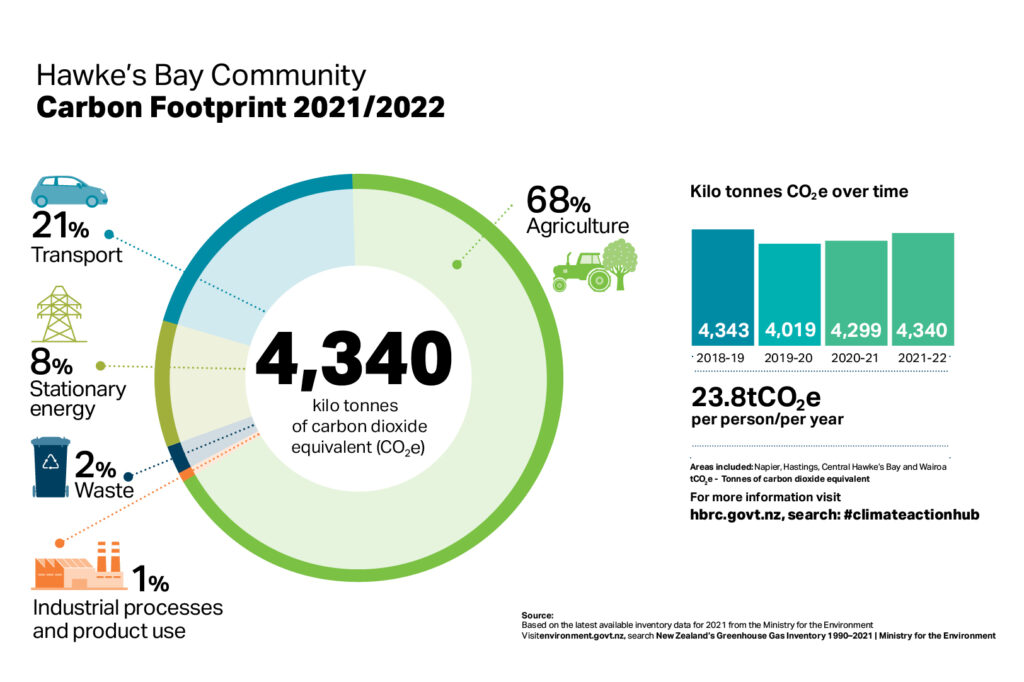
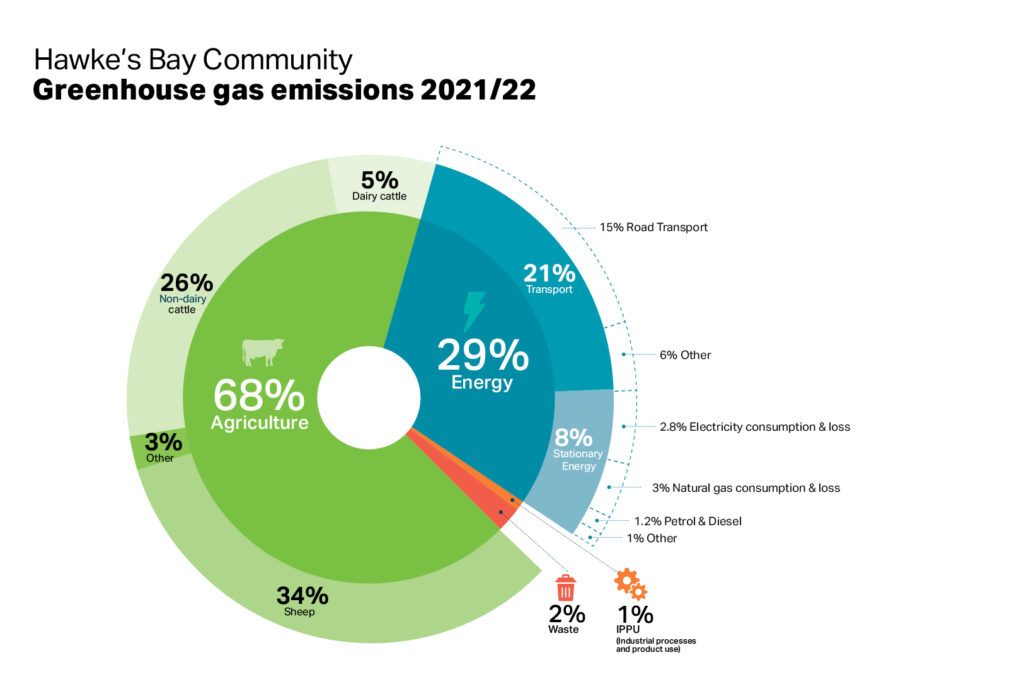
Over the last four years (data ending 2021-22 financial year), HB greenhouse gas emissions show minimal change.
According to the staff report to CAJC: “In the financial year of 2021-2022 Hawke’s Bay region’s gross greenhouse gas emissions were 4,340 kilotonnes carbon dioxide equivalent (kt CO2-e). The agriculture sector (68%) and energy sector (transport and stationary energy, 29%) were the two largest contributors to gross emissions. Net emissions, once sequestration from forestry was accounted for, were 1,489 kt CO2-e.”
So, effectively 66% of our emissions were offset by growing pine trees (with some contribution from native bush). But the goal must be to reduce emissions and adapt to changing conditions, not simply make up a tidy ‘net zero’ balance sheet, as the NZ Climate Commission has warned at the national level. While forest sequestration has its place, more trees to offset more emissions is not an answer to global warming.
HB’s emissions are driven by farm animals and our transport system (cars and trucks). With both of these, the ‘big picture’ and trend line is determined by the Government – mainly its policies regarding pastoral farming’s role in reducing livestock emissions and its approach to lowering car/truck emissions.
But even in that context, there are local actions that can be taken with local benefits.
Action Plan
Unfortunately, we’re still barely scratching the surface.
A ‘Climate Action Plan’ was presented at the March CAJC meeting. It could best be described as wistful. A lament rather than a sorely needed call to action.
The Plan prepared by councils’ staff covered six ‘domains’ – biodiversity, primary industry, transport, freshwater, urban/housing, and waste.
In the key areas where mitigation is involved, agriculture and transport, the Plan wrings its hands over the difficulties of overcoming competing objectives. For example:
Transport
“Staff considered that a key risk in transport is the competing goals between transport resiliency, transport efficiency, cost and safety, while also reducing emissions, which is no longer a priority area for the coalition-led government.”
The staff paper pretty much assumes that in the foreseeable future, the only regional transport policy will be … rebuild the roads we have. Which has nothing to do with addressing climate change.
The most concrete ‘opportunities’ identified in the Plan were:
• Advocating for and celebrating alternative modes of transport including regional rail. [But what kind of regional rail?]
• Regional green hydrogen development
This second point is an interesting proposition mentioned in the draft Regional Transport Plan (to be considered by HBRC in June). After noting that 27% of HB’s transport emissions come from heavy trucks, the Plan suggests: “The potential of hydrogen fuel in Hawke’s Bay presents a material opportunity to reduce carbon emissions while maintaining operational efficiencies and supporting future growth aspirations.”
But no mention in the Climate Plan of how 4-laning the Expressway, which the draft Transport Plan endorses, fits in! Nor does the word ‘bus’ appear.
Primary sector
“The primary sector is a major contributor to the Hawke’s Bay economy, in terms of its economic contribution through export earnings, employment and contribution to the social fabric of the community. Therefore, climate action is targeting adaptation as opposed to elimination strategies.”
The most concrete ‘opportunities’ identified here:
• An integrated approach to catchment and community management – erosion control, wetland construction, biodiversity.
• Increased land use diversification – planting trees, forest farming, integrated systems, new horticultural systems that adapt to a changing climate, land for life etc.
There are indeed some rich concepts embedded in some of those phrases, but no sign that the climate team recognises them or would actually advocate for them.
For example, the region’s Plan could be to educate on and incentivise a singular focus on soil health, which involves embracing different land management practices. How would that relate to climate change strategy?
In an interview with HBRC Chair Hinewai Ormsby, she put it succinctly (speaking at the time just about her council): “We need to hold our soil and water in place … it’s as plain as that.”
What this comment recognises is that better managed soil (whatever is grown or grazed on it):
• Is less erodable – an obvious productivity benefit in normal times and an insurance policy in severe weather (the destructive power of water in Cyclone Gabrielle’s flooding was magnified immensely by the soil/silt carried in it);
• Retains significantly more water, as healthier soil acts as a sponge – again a benefit at all times (addiing resilience in dry times and holding/slowing more water in severe weather;
• Stores more carbon – in fact healthy soils can sequester more carbon than trees, effectively forever.
• Requires less (or no) synthetic fertilisers (given the sourcing, a climate benefit) and better retains the nutrients in the soil (whether synthetic or natural) – a gravy benefit for the health of our freshwaters.
And there’s no mystery about the land management practices to accomplish these interrelated benefits. Our most innovative farmers right here in Hawke’s Bay are accomplishing this now, recognising that it’s economically beneficial to do so. We just need more of them.
It would be in the country’s interest to have national/regional policies and incentives that accelerated this conversion process. But it will happen in any event as generational change occurs in the sector.
Keep our soil and water in place. One could argue that should be the mission statement driving our regional climate strategy.


There is now a raft of international studies that show for trucking the future is batteries not hydrogen. Hydrogen powered land transport is a delay tactic by the fossil fuel industry. It is much better to use electricity produced by solar or wind directly in transport rather than go through the energy wasteful process of making hydrogen. And if you can get some freight off trucks, like logs, so much better. It’s lower emissions and trains do not create potholes.