


Climate Minister Simon Watts left for Brazil last week, apparently to apologise at the UN’s global climate conference (COP) for NZ’s backsliding on climate change mitigation policy.
Why waste taxpayer money on such an embarrassing junket? He could have sent his regrets by e-mail.
Oddly, as reported by NBR, Watts, referring to smaller countries that cause 40% of global emissions, has said of NZ’s responsibility: “We may be a small part, but the cumulative effect of that group does represent 40% and we need to ensure that we’re contributing our fair share as part of that, and that’s what New Zealand has done and continues to do.”
Really?
Since the Coalition Government took the reins on climate policy, it has (and these are just the highlights):
- Weakened methane reduction targets (NZ’s major emissions problem) to the point where the country cannot meet international legal commitments (Paris Agreement, EU and UK trade agreements), while also reversing plans to price emissions from agriculture;
- Repealed the oil and gas development ban and now offering $200m to entice reluctant development;
- Weakened the climate-related financial disclosure regime;
- Ended electric vehicle subsidies (as well as weakening vehicle emissions standards);
- Failed to even closely meet its own commitment to substantially increase public EV charging stations;
- Ended subsidies for converting coal and gas boilers to reduce industrial emissions;
- Eliminated the Climate Emergency Respond Fund;
- And most recently has gutted key provisions of the Zero Carbon Act, achieved originally with multi-party consensus, significantly degrading the role of the Clmate Change Commission, which has become a ‘nuisance’ by repeatedly challenging the efficacy of Government climate policies and emission reduction targets.
Meantime global fossil fuel emissions and temperatures continue to grow.
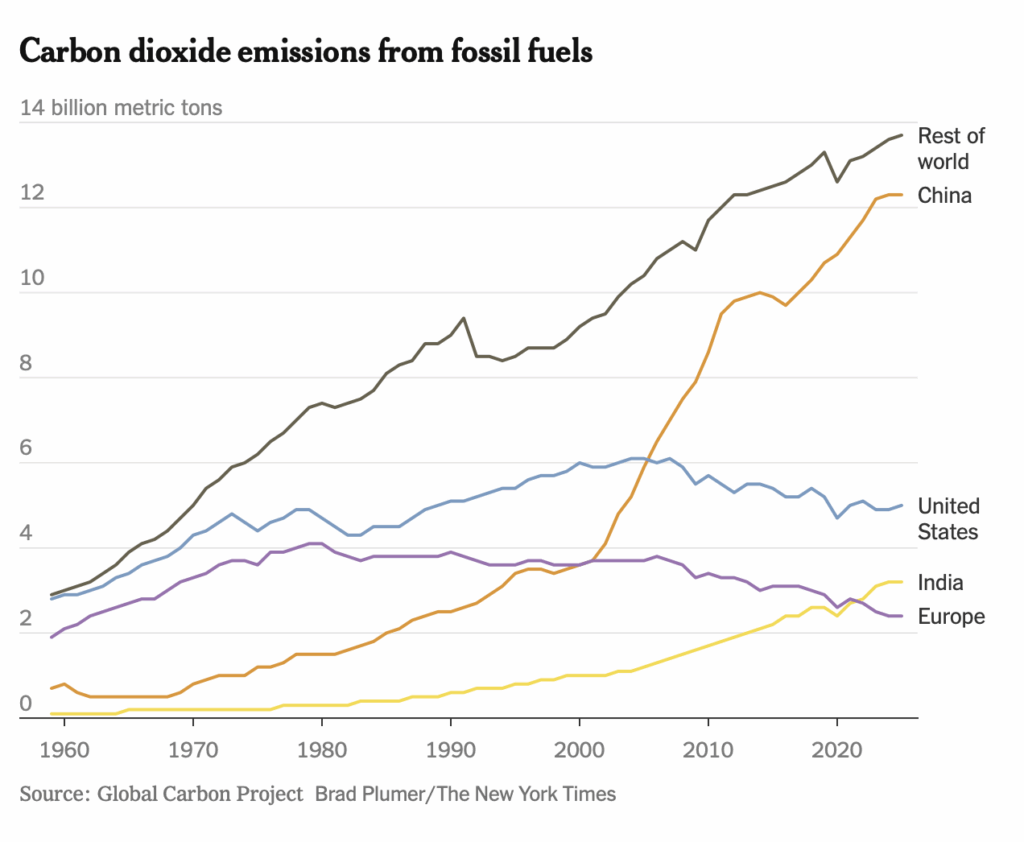

The UN says that official commitments made by nations will fall far short of limiting temperature rise to 1.5°Cdegrees as targeted by the seminal 2015 Paris Agreement. Scientists have written off that goal entirely. Last year was the warmest year on record and the first year in which average global temperatures clearly exceeded the 1.5°C target.
To remain on track, emissions would have needed to peak by the end of this year, and be nearly halved by 2030, compared to 2019 levels. If nations do as they currently promise in their updated climate action plans (NDCs – Nationally Determined Contributions), the planet will warm 2.5°C to 2.9°C degrees.

Any good news?
Yet even that represents ‘progress’. Ten years ago, before the Paris Agreement, the world was on a path to be about 4.0°C degrees warmer.
For the first time ever, renewable energy has become the primary source of electricity around the world, now at 34%, surpassing coal at 33%, which is declining. Globally, solar power has been the largest source of new electricity for the last three years. At the same time, however, blossoming A.I. with its humongous power needs is beginning to seriously drive electricity use.
Worldwide, one in five cars sold was electric. Good news for emissions in the transportation sector, even as rebounding international air travel is increasing emissions.
The UN reports that 35 countries have seen a consistent decrease in their emissions over the past decade, compared to 21 in the decade before.
I guess we should clutch at any slivers of good news on the climate front we can grab!
Here in NZ, polling indicates 82% wanted more information on climate hazards and 86% and 87% wanted local councils and central government respectively to lead that planning.
It will be interesting to see what our new councils decide to do about HB’s roundly criticised and moribund Climate Action Joint Committee.

Every poll worldwide say the population are happy to save the planet but not prepared to pay for it
Given the 3 biggest polluters aren’t part of Paris an even bigger load falls on the rest
Let’s do an analysis of what climate policies ,including the oil and gas ban, has cost each individual in NZ and ask them if they wish to keep paying.
I’ve a funny feeling the answer will be a resounding no
Ps I forgot the 25-30 billion dollars we have to pay if we don’t meet targets by 2030.
Going to be an interesting sell to the NZ public in a cost of living crisis
This government is basically “Trump Lite” – half their utterances are the same that Trump’s lackies have been spouting for some considerable time. Our lot are doing everything possible to lower any guidelines for climate issues, as well as weakening our overall infrastructure by lambasting health professionals, teacher, FENZ staff, etc etc. I’m feeling very sorry for my grandkids – they are going to inherit a shambles of a world governed by an elite group of selfservers and their adherents. Maybe we should have a governmental system that holds MP’s legally and financially responsible for their decisions
I fully agree that an email would have sufficed. The whole COP30 meeting could have been held using ZOOM or Teams, like most conferences in my environmental field are. RemTech Europe broadcast to every country in the world with over 50.000 attendees (at no cost to them) probably the best example.
On a more technical note: Natural temperature increase leads the rise of CO2. Therefore the focus on CO2, albeit a simple culprit, may not be solving a rather complicated issue.