

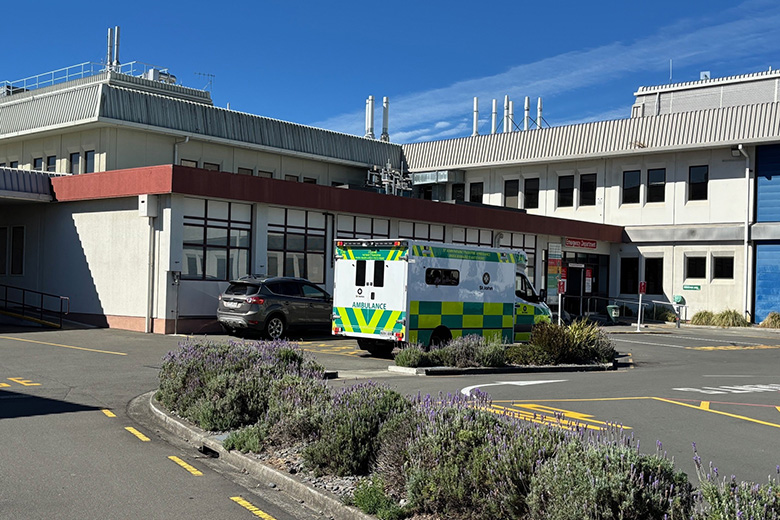
This headline might be confusing, since Hawke’s Bay no longer has a DHB (District Health Board). We now have Health New Zealand with a Hawke’s Bay frontier outpost.
Nevertheless, whenever accountability issues regarding our regional hospital’s performance (or non-performance) arise, I use shorthand DHB for symbolic and nostalgic reasons – there used to be enormously more local accountability and transparency, starting with someone local to talk to! From the chairman on down.
Last week I sent an inquiry to our ‘DHB’ regarding so-called ‘Code Reds’.
Why? Because The Post had mentioned that Hawke’s Bay’s hospital had recorded 162 code reds in 2024.
A code red is the final step in a traffic-light escalation system, triggered when demand overwhelms available staff and beds (the trigger is breaching 135% of capacity). It can mean delayed medication, patients sleeping on trolleys, postponed procedures and even an increased risk of death if patients wait longer than five hours.
I wanted the 2025 figures and asked for an explanation of what was being done to mitigate the situation. And so the dance began.
Out of habit (and admittedly, stubbornness) I sent my request to local Comms staff at the hospital, even though I’ve been directed in recent times by those folks to send such inquiries to Wellington … the locals are powerless to respond.
But this time I was informed that the local Comms roles no longer even existed – one person gone and the other given a new assignment.
So, I dutifully sent my request on to [email protected].
They responded with a non-response, which I was told to attribute to Health New Zealand Group Director Operations Hawke’s Bay David Warrington. He was appointed to that role in August 2024, as BayBuzz dutifully reported here.
My request for 2025 update data on code reds was denied, with this explanation: “As the escalation system is a real-time operational tool in a highly dynamic environment and can change multiple times in a single day, granular Code Red data is not routinely released, as it can be easily misinterpreted outside its clinical and operational context.”
“Granular”? I didn’t ask for hour-by-hour data … I simply wanted to know if 2025 showed any improvement over 2024’s 162 days of red alerts. How hard can furnishing that number be?!
As for what steps were/are being taken to improve the situation, Mr Warrington’s Wellington ghost writer served up this bureaucratic gobbledygook:
A Code Red “triggers agreed actions to support patient flow, staffing and access to beds. It does not indicate that care is unsafe or services are closed.”
I would challenge DHB to serve up a HB Hospital ED frontliner who would insist: “It does not indicate that care is unsafe…” Would anyone like to come forward?
The response continued: “Since 2024, the hospital has continued to strengthen its Acute Hospital Flow Programme of Work (Hui te Marama Hui te Ora), regularly reviewing its escalation plan and using early-warning tools to respond quickly to pressure and de-escalate demand while maintaining safe, quality care.”
The public is owed more specificity regarding exactly how “safe, quality care” is maintained when the ED is operating at serious over-capacity – not just occasionally, but 162 days in 2024, maybe more in 2025.
None of this is to say the HB clinical staff is in any way at fault. Too few beds and too few staff is not their call, any more than they are responsible for the systemic drivers of escalating ED use. The clinical teams are simply left to cope with the unhealthy situation as best they can.
Their reality is dictated by Wellington bureaucrats and Government politicians.

The front line workers (doctors, nurses, cleaners, etc) are some of the best people in the world. Watching them go about their day diligent and caring is great. The bureaucrats and Wellington trolls are the absolute opposite – as shown all they can do is use lots of “buzzwords” that mean SFA. Our health system is broken, and they don’t care – neither do our politicians. The only reason it all still operates is the huge undying care and attention by the front line people working under huge stress.