

[As published in Summer 2025/26 BayBuzz magazine.]
We all use it and are totally dependent upon it. Electricity is fundamental to modern life.
Absorbed in this topic is Uttam Floray. His day job is Senior Programme Lead at Toitū Envirocare, time sparing, he’s devoted to Rewiring Aotearoa and its offshoot Electrifying Hawke’s Bay.
We meet for coffee and scope.
Lighting, heating, cooling, cooking, phones, social media, gaming, gambling, banking, vehicles. Think schools, hospitals, factories, the Port, traffic lights.
Increase in demand is seriously challenging the price of electricity.
In October 2025, Stats NZ reported an electricity price increase of 11.3%, the highest annual increase in 36 years.
The price of electricity increases when demand is greatest. Colder the winter, greater the cost to consumers. That’s how pricing is structured. Higher the demand, higher the price.
And with surging demand from hungry users AI, Crypto, and Robotics, our electricity needs are estimated to double by 2050.
Be assured, prices won’t be falling anytime soon.
Government policy for the electricity sector announced in October seemed inadequate in supporting future supply. Their major proposal is to import liquid gas in tankers and build a new LPG power plant in Taranaki.
Economic Development Minister Shane Jones champions burning coal, and exploring for oil and gas, even though no new feasible fields have been found in twenty-five years.
In contradiction is the 2015 Paris Agreement target of 100% renewable electricity generation by 2030. Today we are around 80%.
Electrify everything
Whakahiko te ao – Electrify Everything – is the call of Rewiring Aotearoa, helping households, businesses, industries and farms, lower their carbon emissions, and ultimately save money on energy bills.

Uttam Foray points to thousands of households having to transition from gas supply as the Maui field runs out.
Achieving the 100% renewable goal, growing supply, and averting critical electricity deficit in winter, is a massive challenge for the industry.
Critical shortage occurs when hydro lake water storage levels are low and demand is high. Hydro accounts for around 60% of the country’s generation. Now, when hydro-electric supply is depleted, the massive Huntly Power Station, built in Robert Muldoon’s think big era, burns coal to supplement the grid and is capable of 1000MW.
In Hawke’s Bay we had the 155MW diesel-fuelled Whirinaki peaker plant built in 2004, which could be fired up in 30 minutes to produce electricity in times of shortage, consuming up to 4 million litres of diesel over a 92-hour period.
Unsurprisingly the plant is now deemed environmentally unacceptable and too costly to operate.
Making the shift from burning fossil fuels, massive investment in renewable supply projects have been and are being made, some in Hawke’s Bay. Solar, wind, geothermal, hydro, and bio-energy generation initiatives all contribute. Hopefully they can fill the gap.
Solar is the leading contender as fastest and cheapest, offering systems from small scale domestic roof tops to massive industrial generation covering hundreds of hectares.
Solar produces direct current DC, the rest are alternating current AC. Only knowing AC/DC as a seventies Sydney rock band I seek help from experts in all things electric at the Faraday Museum of Technology in Napier.
Faraday Museum of Technology
Simplistically the difference between AC and DC is that the former has greater resistance and is more easily converted to higher and lower voltages.
Sharyn Phillips tells me there was fierce competition between electricity pioneers Thomas Edison (DC) and Nikola Tesla (AC)
Sharyn has been Faraday Museum of Technology manager since 2019. Her passion shines. She considers Tesla a genius. Born at midnight during a lightening storm on 10th July 1856 he predicted wireless communication – mobile phones, and the internet. His portrait greets visitors at the museum entrance, and a Tesla coil generating electricity is currently being installed. Sharyn says the only other in the country is at Alan Gibb’s sculpture park in Northland.
Both Tesla and Edison were deeply influenced by the work of Michael Faraday (1791-1867) who developed the first electric motor and generator, laying the foundation for their work.
The building the museum occupies was built in 1913 as the Napier Municipal Power Station. The street was named after Michael Faraday.
Originally housing small diesel engines generating DC, they mainly powered Napier’s trams, one track climbing Shakespeare Road to Ahuriri, but the grid soon needed upgrading. Growth of Napier’s population was so rapid by the time a giant 600 horsepower Fullagar engine arrived from England in 1924 it was inadequate to meet demand.
By then hydro-electricity had become the preferred method of generation and Tesla’s conversion of DC to AC through transformers was universally adopted.
HB’s first hydro-electricity
The beginning of hydro in Hawke’s Bay is Mokepeka Power Station built by John Chambers in 1892 and credited with being the oldest continually operating power plant in the world.
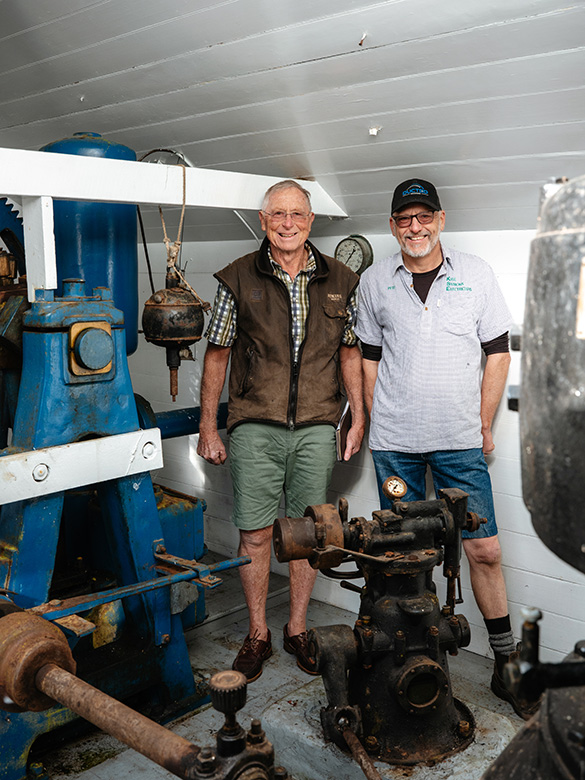
This is proven when electrician Pete Judd assisted by Mokepeka Station owner Craig Hickson demonstrate. I’m asked to pass a hammer to tap a stubborn fitting. Pete tweaks. Craig pulls a lever, wheels turn, and the ceiling lights shine.
Pete tells me he brings EIT students here and they’re blown away to see electricity being made. So am I.
A narrow trough of water, diverted from the Maraetotara River, falls three meters down a shaft onto blades that turn the turbine.
Pete says a component of the turbine is a disc of African hardwood sourced by John Chambers, who also travelled to London to acquire the dynamo, made surplus in the upgrade of St. Pancras Station.
Craig Hickson is committed to maintaining this gem of hydro-electric history and Pete Judd knows the design and operation as if he installed it himself.
Commercial hydro-electricity
The first commercial hydro power station in Hawke’s Bay was built downstream of Mokepeka in 1922. It was decommissioned in 1944 after multiple lightning strikes.
The popular Maraetotara falls swimming spot is the storage pond for the power station below.
None of our region’s major rivers are suitable for hydro, and the Hawke’s Bay Electric Power Board, established in 1924 to serve both Hastings and Napier, depended on electricity from Mangahao station near Shannon.
Then in 1929, Hawke’s Bay’s largest hydro scheme was established utilising water ducted from Lake Waikaremoana to turn the turbines. By 1948 three stations had been built producing 138KW. The scheme was Government funded and owned until 1999. Today it is in the hands of Genesis Energy.
Nearby, 26 kilometres north-east of Wairoa, is the Waihi dam and power station built in 1989. Two 2.5KW turbines generate enough energy to power 1,400 homes. Eastland Generation are owners. Resource consents expire in 2026 and they have applied for fast-track approval to re-new.
More recently, 2013, Manawa Energy built two hydro stations on the Esk River producing 4KW. Damaged in Cyclone Gabriel both plants have now been restored to full capacity.
Hydro-electricity has been the backbone of the country’s generation, and still is, but further large-scale schemes are limited by site availability, opposition, and cost.
The proposed Lake Onslow pumped hydro scheme in Otago, estimated to produce up to 1,500MW and costing $16 billion, was scrapped by the current government in December 2023. Recently a private consortium announced their intention to develop the scheme.
A similar project on Lake Pūkaki in Canterbury is still being considered at a cost of $8 billion.
Hydro-electricity is still viable and don’t be surprised if pumped hydro appears in the re-engaged Ruataniwha Dam project to widen its appeal. Centralines, the CHB power company, has committed $100,000 so far. Its Chairman Fenton Wilson is a big dam fan.
Bio-energy
Pan Pac Forest Products has a 36MW wood-waste fired boiler producing steam used for timber and pulp drying processes, and for turning a turbine, producing around 12% of the mill’s electricity needs.
Replicating such generation at scale could clear milled forests of slash, so damaging in heavy rain events, and produce electricity. But as Uttam Floray points out, the major inhibitor, is the cost of collecting and transporting the timber waste to the point of process.
Nevertheless, a recent study by EECA looking at Hawke’s Bay’s 44 largest natural gas users found that biomass would be the most economic solution in each of the businesses reviewed, if users and suppliers collaborated on the infrastructure.
And Hastings-based Carbona and Genesis Energy have an MOU to produce torrefied wood pellets with the potential to replace coal with 300,000 tonnes of biomass fuel at Huntly Power Station. Carbona says a smaller scale plant would indeed be viable.
In 2014 Hastings District Council teamed with LMS Energy in building a 1MW boiler powered by bio-gas extracted from the Omaranui land fill.
Somewhat experimental, the project does signal the potential of bio-gas from landfills.
More cost-effective solutions are wind and solar, especially solar.
Wind
The first windmills were built in 9th Century Persia for pumping water and grinding grain.
I know this courtesy of an AI app whose memory is housed in a vast data centre, somewhere, gobbling up huge volumes of electricity to function.
I ask AI about the first windmill to generate electricity. In three seconds AI tells me it was in Scotland in 1887 by Professor James Blyth who used it to power his holiday home.
I catch myself saying thank you to artificial intelligence.
When next I connect with my AI app I’m greeted with Good morning Mark.
This is getting personal. Is AI non-binary? Is it her/him/they/them?
I choose Ally, as in, my ally in research.
Ally tells me the biggest wind farm in the country is Turitea, constructed on the ridge lines of the Tararua Ranges near Palmerston North, and owned by Mercury Energy. Sixty turbines generate 222KW.
A close second with 41 turbines generating 178KW is Harapaki Wind Farm on the Maungaharuru Range in northern Hawke’s Bay splendidly visible on the road to Taupō. Owned by Meridian Energy, the project was completed in July 2024, costing $448m.
AIly tells me the life span of windmills is thirty years. How they are decommissioned and disposed of is a concern.
Currently the most cost-efficient form of electricity generation is solar.
Solar
Leading solar power installer in Hawke’s Bay, Aaron Duncan, recently visited a vast, mostly automated factory in Chendu, China, one of seven owned by the same company. He says that factory alone produced more solar panels in a week than installed in New Zealand in a year.
Aaron asked his guide why they didn’t build the factory closer to a port for more efficient export access. Guangzhou is over 1000kms away. Her answer was their product was all for the domestic market.
China leads in solar, not only producing the most components for international consumption, but also housing the two largest solar power plants in the world.
AIly tells me Gonghe Talatan Solar Park in Qinghai has a capacity of around 8,000MW, and Xinjiang Solar Park has 5,000MW capacity from an 80,000 hectare footprint. Their combined 13,000MW output is greater than this country’s entire current electricity generation capacity of around 10,000MW, says AIly.
Our largest solar farm is in Lauriston, Canterbury, covering 93 hectares and generating 63MW, enough to power 13,000 households.
And there are more, some much larger, in development.
One is close to the northern Hawke’s Bay boundary with Taupō District. A partnership between Nova Energy, part of the family-owned Todd Corporation, and Meridian Energy is planned on the Rangitaiki Plains near the State Highway 5. Nine hundred thousand solar panels covering 1000 hectares, generating 400mw, and costing $750m, the scheme, when completed in 2027, will generate enough electricity to power 100,000 homes.
The airport
A timely press release from Hawke’s Bay Airport announces installation of over six hundred rooftop solar panels at a cost of around $450,000 estimated to produce 44% of the terminal’s electricity needs.
Furthermore, a proposal has been lodged for fast-track approval to build an 85-hectare solar farm on the airport fringe. Partnered with Manawa Energy the project has a capacity of 40MW and will connect into Unison’s local network. The submission states the output is enough to power more than 10,000 households which is significant given there are approximately 60,000 households in Hawke’s Bay.
Being adjacent to the Ahuriri Estuary, habitat to over 70 species of waterbirds, the project should require Regional Council permission under the Wildlife Act 1953.
Concern has been raised by the Ahuriri Estuary Protection Society. Overseas experience has seen birds mistake shining panels for water. Imagine being a bar-tailed godwit flying 11,000 kilometres non-stop from Alaska over ten days to end up smashing into glass.
Ongaonga
Other Hawke’s Bay solar farm initiatives are centred in Ongaonga, 16kms west of Waipukurau, and Wairoa.
Eastern Generation have applied for fast-track approval for a 9MW solar project covering 17.5 hectares, connecting to the First Light Network distribution lines, serving Wairoa and surrounds.
Ongaonga has been chosen by three solar farm developers. ‘Ongaonga’ can mean to be appalled and disgusted, which well describes the opinion of some submitters to the resource consent lodged by Helios Energy.
The proposal, costing $150m, covering 239 hectares, installing over 200,000 panels, 26 inverters, a Battery Energy Storage System (BESS), and Substation, producing around 100MW, is to be connected to the national transmission grid via the Waipawa Substation on Ongaonga Road. In its submission Helios claims the project will generate enough electricity to power approximately 29,000 homes.
Opposition to the consent centred around over 50 hectares of the site being highly productive land LUC 1&2 soils, destruction of the rural visual landscape, noise from BESS and the inverters, danger of BESS lithium batteries catching fire and emitting dangerous levels of toxic fumes, and stress on the grid from overloading. With a lifespan of around 30 years, rendering, disposal, and ground contamination was a grave concern of several submitters.
As happens in Consent Hearings of foregone conclusion, experts for the applicants reply, Council officers concur, and the Independent Commissioner grants consent.
Two more solar farms are planned nearby. Currently the land is mostly used for grazing sheep.
When I ask Uttam Floray about loss of productive grazing land, he sends me a link to a US study which points to benefits of grazing sheep with solar: shelter from hot sun, grass growth under panels, and improved quality wool clip.
Solar is definitely the prime source of new generation, both industrial scale and residential.
I ask Ally how much industrial solar is under development. They quote Transpower: 1,646MW across nine projects nationwide (as of September 2025) 3,000MW by 2030, and it notes ten projects were submitted under the Fast Track Approval Bill in 2024/25.
Residential solar
Country wide, 349MW of residential solar power was sold back to the grid as of June 2025, of which 66MW (19%) was installed in the previous twelve months. Data from the Electricity Authority courtesy of Ally.
Supportive, in October, Minister for Building and Construction, Chris Penk, announced changes to the Building Act that Council consent be no longer required for roof mounted solar.
Aaron Duncan observes that a lot of new installers have entered the solar business recently, attributing growth to the construction sector downturn, as tradies seek alternative forms of revenue.
Uttam Floray says a focus of Rewiring Aotearoa is to make residential solar more available by being more affordable. They lobby Government and Local Authorities to offer financial support for households whether by grants or subsidised loans.
If double glazing and full insulation is a requirement of the Building Code for new residential builds, why not mandatory solar, some used in the home, surplus fed back to the grid?
Win win. Reduced power bills for consumers. Resilience for the grid.
Maybe no political party is imaginative enough to see the opportunity to empower households with their own electricity, or perhaps they are too enamoured with the income Government receives from its shares in power companies.
Power and politics
In 2024 the Government earned $556m in tax and $425m in dividends from its 51% shareholding in energy companies Meridian, Mercury, and Genesis. The gentailers (generation-retail) were partly privatised by the Key government starting in 2013.
Together with Contact Energy, fully privatised in 1999, the big four gentailers account for around 85% of both the retail electricity market, and generation.
The Coalition Government’s Energy Package announced 1st October 2025 does little to address the monopolistic nature of the gentailers.
A recent response from Jenny Shipley, Prime Minister when the gentailers were created to drive competition, lays the blame on consumers. If people changed power companies, the gentailers would be more competitive, she asserted.
Small retailers have entered the market and in Hawke’s Bay there are over ten independent providers including Powershop, Ecotricity, Electric Kiwi, Octopus, and Nau Mai rā.
All the new entrants have special deals to entice customers and Jenny Shipley is correct. If more households and businesses shopped around price competition would benefit. Check out Powerswitch. (powerswitch.org.nz)
As for supporting new generation the Energy Package was underwhelming, offering no major changes to the structure of the electricity industry.
Delivering a Liquefied Natural Gas import facility to be up and running by 2028 seems as retrograde as committing $200m for co-investment in gas fields yet to be discovered.
More positive, on 30th September 2025, Finance Minister Nicola Willis, wrote to partners Genesis, Mercury, and Meridian, saying the Government would look favourably on requests for Crown investment in generation capacity.
Structure
Up until 1987 electricity generation was entirely undertaken by the State. Distribution and retailing was the responsibility of local electric power boards.
In the decade following, several structural changes were made, culminating in the Electricity Industry Reform Act 1998, which split the Electricity Corporation into competing state-owned enterprises – the gentailers. The reforms also required the (then) 35 local power companies to separate ownership of their electricity lines and electricity supply businesses. Government-owned Transpower (1994) is responsible for the maintenance and transmission of the electric power grid, including the DC Cook Strait cable.
Unison Group General Manager Customer, Commercial and Regulatory Jason Larkin tells me electricity is delivered by Transpower from North and South to substations at Redclyffe, Whakatū and Fernhill.
Larkin describes Transpower as the electricity motorway with Networks being off-ramps routing supply to customers: Unison to Napier, Hastings and surrounds, Centralines to consumers in Central Hawkes Bay, Eastland Network to Wairoa, and Scanpower serves Southern Hawke’s Bay. He says Networks collaborate well to ensure smooth transition and have shared infra-structure projects.
Income for the Networks mostly comes from lines charges, part of the power bill, currently around 27% for households. Unison Networks increase in 2025/26 was 23%. This was a historical catch-up set by the Commerce Commission after review of capital requirements for maintenance and future infrastructure needs across all networks.
The wholesale price of electricity is set by the real-time balance between the electricity available and the electricity being used. Every 30 minutes generators offer a price for their electricity, and the highest becomes the price for that period. There’s an App following the market in real time. (app.em6.co.nz)
Overseeing all aspects of the industry is the Te Mana Hiko – the Electricity Authority, with functions of monitoring compliance, promoting competition and efficiency, ensuring adequate supply, and consumer protection.
Hungry beasts
It’s probable the powers that be are under-estimating the growth in demand for electricity as AI and Robotic technology surges.
The data centres housing massive computers are hungry beasts. In Auckland a group of hyper scale data centres, Amazon, Datacom, AWS, and Microsoft, are collectively expected to consume 200MW at peak usage. Microsoft alone has a 10-year deal with Contact Energy’s Te Huka 3 geothermal station which has a capacity of 51.4MW.
AI future development and potential is probably beyond our imagination, like the cell phone twenty-five years ago, who would have thought?
As for crypto currency? I ask Ally, who tells me the global crypto network’s daily demand is over 19,000MW, double the country’s entire output. A single crypto transaction consumes more energy than needed to power 6 houses for a day.
In 2022 a Bitcoin mining operation using 2MW was established at the Lake Monowai Power Station in Southland.
Ally can find no others here. Call me old fashioned, but if I were the Minister of Energy, I’d make sure it stayed that way.
The future
For some the Holy Grail of abundant clean energy is nuclear fusion, the same energy that powers the sun, not to be confused with fission currently employed in nuclear reactors, with many downsides.
I ask Jason Larkin his opinion. With a Bachelor of Engineering – Chemicals and Materials, he answers as a scientist, that there are major problems in physics to be solved, but he looks to how solar technology evolved massively since the 1980’s, and how battery storage is still being developed to its potential.
Meantime, while the private sector and Networks build new electricity generation and supply with haste, let’s hope Government steps up to the challenge as well.


Subsidies for household solar would be a step in the right direction – but would any Government allow this if they lost some income from the power companies dividends? So that’s probably way down the list of possibilities!
Very informative article.
Looks like some of the AI and Bitcoin companies are snagging their own electricity providers, leaving NZ industry and households with future shortages.
Surely a political headache if household solar production is not encouraged.
Great article! Waikaremoana, Waihi and Esk are all MW scale (not kW) and the SH5 solar farm is aiming for stage 1 (200MW) complete in 2027, full completion is 2030.
Also – 349MW was the capacity of residential solar connected to the grid by June 2025, not a measure of solar power sold back to the grid. And the EA publishes updates monthly so can quote 409 MW of residential solar installed by the end of 2025 and 87 MW in the last 12 months. emi.ea.govt.nz/r/cgxu0
Some of us have had solar ‘for ever and a day”…my investment has been paid back for quite a while now so I count my ‘pennies’ every month.