

[As published in March/April BayBuzz magazine.]
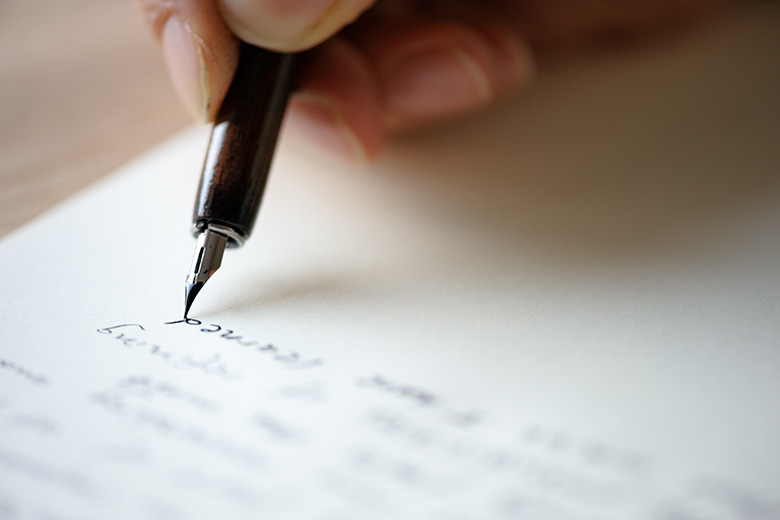
I’m finally getting around to penning the annual family brag to the rellies, full of the exploits of my offspring and issued to all and sundry in copperplate on onion skin so as to squeeze as much boasting as possible into an airmail envelope. Nothing says ‘I’m the best’ better than a hand-done billet doux.
Handwritten notes were once de rigueur, but now we tap out a text, or, worse, pingback a heart emoji and that’s that. But the letter’s more satisfying to write and so much lovelier to receive if it features your idiomatic flourishments, embellishments and personal diacritic placements. Who hasn’t hugged an old recipe of Nana’s simply because it has “3 eggs, 2 cups flour” written out in her own, unique griffonage.
Most of us under 70 have pretty appalling chicken scratch. We’re out of practice. Even those of us who wrote with fountain pens at school can’t remember our stems from our strokes. Our tails are truncated, our bowls asymmetrical. Mr Wagstaff who taught me scrivening in Standard 4 would be having paroxysms!
In an attempt to reclaim my autography I am reteaching myself longhand. (In a similar vein, I forced myself to relearn long division a few years ago as a kind of cerebral self-flagellation.)
Perfect penmanship starts with pen and paper, so I spend an hour at Humanities thumbing Rhodia and fondling the Lamy collection. Then to posture and position: I get my back cracked so I can sit up straight and apply the Official Occupational Therapists’ Guide to the Appropriate Pose for Penning:
Feet flat on the floor, knees at a 90 degree angle, forearms resting on desk, paper stabilised with non-dominant hand (which is also supporting body weight), paper tilted up to the right (or up to the left for sinistrals), neck and shoulders relaxed.
As with everything, there are specific methods for acquiring chirographic acuity. The Spencerian System became the official hand of civil servants in the 1800s, replaced by the ‘simpler’ Palmer Method – plain, fast and flowing – used in schools and held up as a way to ‘reform delinquents’. It was the Zaner-Bloser Method that – in the 1950s – began to introduce block printing alongside cursive.
At this point, focusing on technique takes all my brain space and my mind is empty of anything to actually say. I flick through socials searching for inspiration.
#RockMyHandwriting opens a whole tin of peaches. It’s literally a “challenge designed to help you (me in this case) tidy up your (ibid) handwriting”. I dive in randomly. August 14th: “favourite word in another language”. I scrawl pamplemousse across my crisp-white page. It gives a satisfying flow, juxtaposing ascenders and ligatures, having some fun with apertures. But there’s quite a distance between one single grapefruit and a whole long letter.
April 25th’s prompt is “Advice”, so I carefully calligraph “Doing something imperfectly is better than not doing it at all”. December 3rd tells me to do ABC drills. I fill a page with the alphabet and wonder if I can get away with sending people handwriting samplers instead of actual information. Not everything has to mean something. If it’s beautiful but vacuous, recipients will love it.
But perhaps the opposite is true. It’s not how you write really, it’s what you write, right?
Emily Post posits that the perfect missive to get by post will reflect the writer in character and composition:
“The letter we all love to receive is one that carries so much of the writer’s personality that she seems to be sitting beside us, looking at us directly and talking just as she really would, could she have come on a magic carpet, instead of sending her proxy in ink-made characters on mere paper.”
A letter should carry good news and bad, respond to questions from previous correspondence and pose new ones. It should be an exchange of ideas, like a good conversation. Gosh that sounds like a lot of hard work. I can barely loop together my own ideas let alone enquire as to the whereabouts of other people’s.
Filling the page feels daunting, never mind making it legible (and meaningful and poignant and whatnot). Maybe a postcard would do, with four perfect words and a carefully crafted valediction. Afterall, Victor Hugo got away with the “shortest letter ever written” when he wrote to his publisher regarding pick-up of his novel Les Mis. Simply, he penned ‘?’. The reply? ‘!’.
I write: All good here! You?
I practice my salutations a few times to ensure the swatch on my majuscule balances the flourish on my descender, then I sign-off.
I consider “Very sincerely yours”, “Cordially, Affectionately, Fondly”, “As always and as ever”, “Ngā mihi mō ngā tau kei mua i te aroaro”, then my back cricks and my hand cramps.
I scrawl xxx and leave it at that.
