

A week ago a BayBuzz scoop ‘previewed’ the new water storage scheme being developed by HBRC to augment water supply for users – residential, industrial, agricultural – drawing upon the Heretaunga aquifer. [See: Battle of HB dams begins]
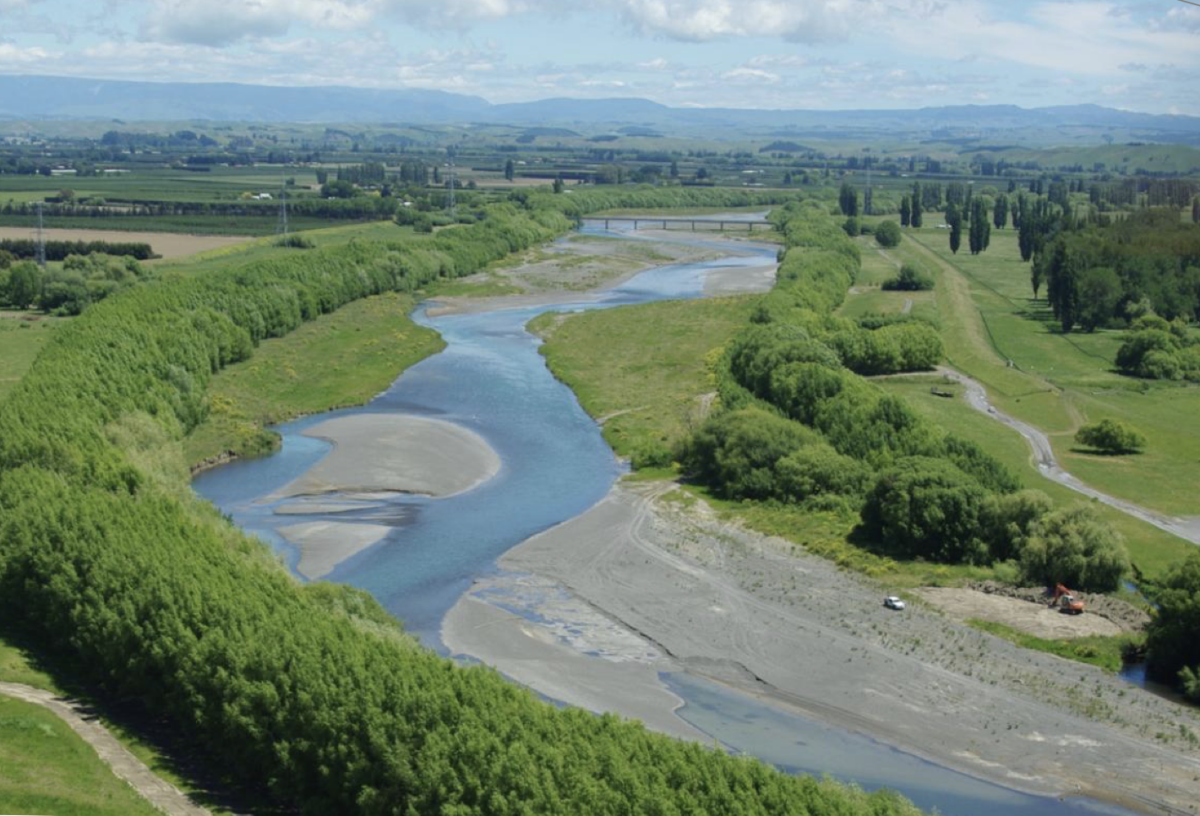
Now HBRC has officially announced the plan, which envisions a $225 million dam on a tributary of the Ngaruroro River that would store 27 million cubic meters (cubes) of water for release back into the waterway during dry parts of the year to help recharge the Heretaunga aquifer and offset water extraction.
As described by HBRC Chair Hinewai Ormsby: “As part of our ongoing Water Security Programme, HBRC is focused on how we can better protect our waterways while supporting the future of our economy. There is now a vital role for carefully designed water storage at the right scale and in the right location … Water storage must be one part of a multi-faceted approach, including a constant commitment to maximising efficiency and water conservation.”
HBRC has commissioned and driven the project feasibility work to date, but says the next stage will be guided by a new entity “to ensure independence and the right commercial skills and experience”. This governance entity “will bring together iwi and mana whenua partners, irrigators, representatives of commercial and municipal water users and community stakeholders to lead the project with a strong development focus.”
Other regional leaders – Mayor Sandra Hazlehurst, Acting Napier Mayor Annette Brosnan and Ngāti Kahungunu Chair Bayden Barber – gave verbal support to the further investigation without expressly endorsing the scheme at this point.
Standing in contrast to this Heretaunga scheme is the fast-tracked proposal to revive the Ruataniwha Dam in Central Hawke’s Bay, a structure that aimed to store 100 million cubes at a cost (in 2015 pricing) of over $300 million to build, with a similar additional amount required to get the water to farm properties.
I note Chair Ormsby’s use of the phrase “right scale and right place” in describing the HBRC-driven proposal. While advocates of the two projects are loathe to criticise each other’s water storage solution, at least in public, it’s hard to imagine the region needs or could afford two major storage dams. Especially given that the much-touted Regional Water Assessment completed three years ago forecasts a mid-range water gap of 25 million cubes by 2040 for the entire region.
Leading the opposition to Ruataniwha Dam 2 is the Wise Water Use HB advocacy group, until now focussed on the CHB proposal. In a media release they say “plans for a 27 Mm3 dam on a tributary of the Ngāruroro River are another nail in the coffin for the Ruataniwha Dam v.2.”
“Wise Water Use HB reserves comment on the merits of the proposed Whanawhana dam until more details are released; however, we see it as the lesser of two evils if a dam is to be built in Hawke’s Bay.
“Wise Water Use HB does not endorse any large-scale dam that will disrupt a river’s ecosystem without first running the test as to whether our precious water resource is being used in the most environmentally sustainable and economically efficient way,” says spokesperson Trevor Le Lievre.
Other comments on the Heretaunga scheme from the group:
“It does not require pillaging our conservation estate for the required land … as with Ruatanihwa v.2.”
“…almost a quarter of the size … so less environmental impact”
“Nor does the Whanawhana proposal appear to be promoting land use intensification, but will rather keep the Heretaunga catchment productive in the face of the justifiable water restrictions that will come into force under the TANK management plan.”
But adding this criticism: “A glaring omission from the proposed governance entity is the inclusion of any environmental groups.”
The Government is now in the position of giving financial support to two (competing?) dams in Hawke’s Bay – a prior loan to HBRC and a grant requiring local matching to the Tukituki Water Storage Project.
BayBuzz understands that Regional Development Minister Shane Jones has been briefed recently on the Heretaunga scheme, and of course he championed fast-track status for the Ruantaniwha Dam 2. Word on the street is that neither project should expect construction funding from the Government … ‘user pays’ is the message.

No worries here. Maori knowledge will see us through
Let’s hope both dams go ahead so water security is guaranteed if not both regions will not be able to grow.
The future will look brighter with water storage.
The much-touted Regional Water Assessment also offered a third scenario which projects a REDUCTION in demand by 3.1Mm3 by 2060 based on the assumptions for improved water efficiency.
It has been disingenuous of our councils, government, and media not to have included this scenario in any discussion that is based on the findings of the Regional Water Assessment report.
Perhaps using water wisely is in the to hard basket for them but my guess is that it would be shit loads cheaper than building dams.
Criticism about the lack of environmental groups in the proposed Heretaunga governance entity is wide of the mark on at least two counts.
Firstly, the governance entity is intended to ensure the project is controlled by those who contribute and/or benefit from the scheme – ie. irrigators, iwi/tangata whenua & the municipalities. The prime directive here is user/exacerbater pays. Note that HBRC will step back to a simple regulator role.
Secondly, environment/taiao is now firmly the focus of iwi/tangata whenua/mana whenua. So any concerns that somehow the enviroment is missing out in the governance structure would be misplaced.
That is not to say that environment groups should not have input into Heretaunga water storage. Their views and experience are valuable & complement indigenous knowledge.
While I’m at it, a quick comment on water use efficiency and the Regional Water Assessment. The midrange scenario predicting a deficit of 25mM3 by 2040 already includes the assumption of a 1% per annum efficiency improvement, so over the 20 or so years of the study that adds up to large water savings. But I agree that water use efficiency is one of the cheapest ways to find more water. For example, it is widely accepted that municiple water metering saves 20% in the year of installation & savings continue to grow thereafter. No doubt agricultural efficiency would improve substantially too if we moved to volumetric charging. And it a widely-held view amongst irrigators that irrigation bans are counterproductive, as they encourage wastage through ‘just-in-case’ irrigation rather than ‘just-in-time’. So avoiding the risk of irrigation bans through subscription to Heretaunga Water Storage should by itself improve water use efficiency.
Xan, completely agree on your comment re volumetric charging. It has always struck me as absurd that water when underground is “free” (ie except for consenting/drilling costs, is free to take) but as soon as it’s above ground, it has value (witness consents to take being frequently traded, often for large sums). There are already a number of ways charging could be justifiably applied to use – such as a per cumec charge for monitoring – without necessarily changing the “free at source” legal standing; all it takes is some tangential thinking and the political will to enable it. Perhaps you/HBRC might lead that charge?