

BayBuzz recently reported on ten-year health infrastructure plans for Hawke’s Bay announced by the Government, which included a number of specific near-term fixes (e.g., ‘ED and Intensive Care uplift’) and a reference to “hospital redevelopment” in the longer term (2030-2034).
“Hospital redevelopment” could be anything from incremental band-aids to a brand-new fit-for-purpose 21stCentury hospital.
So, in that context, a recent article in the New Zealand Medical Journal, titled ‘Poor planning: hospital design guidelines fundamentally flawed’, caught my attention.
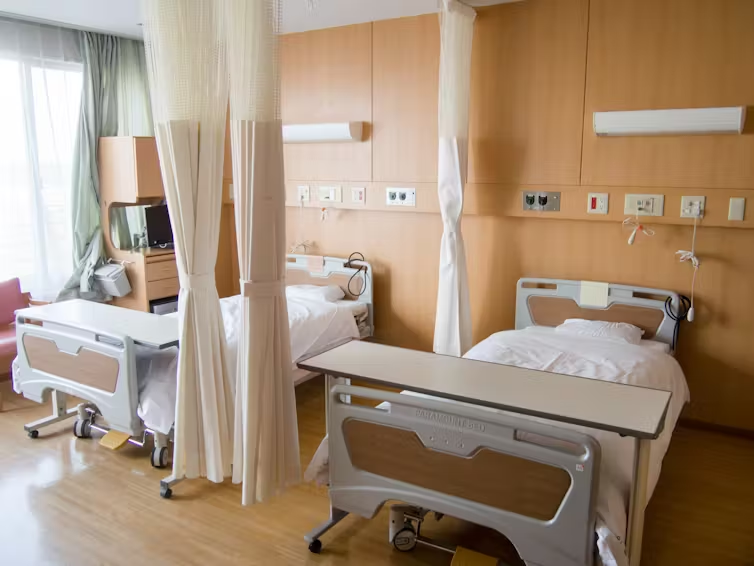
To my surprise, the article zeroes in on one very specific issue – the case for single occupancy hospital rooms. As I learned, this is far more important than you might think.
In the ‘modern’ health care world – UK, France, US, Canada, The Netherlands, Norway and others – single occupancy rooms are becoming the norm, mandated for new construction.
But not in New Zealand. Current design guidelines (Australasian Health Facility Guidelines) leave it to local jurisdictions. Consequently, NZ public hospitals have only a small proportion of total beds as single rooms, with the majority provided in multi-bed rooms.
Big deal?
Emphatically ‘Yes!’ says this article.
“Shared rooms compromise clinical standards, breach patients right and privacy law and undermine cultural safety,” say the authors.
Effective infection prevention and control is significantly more challenging with shared rooms, with NZ practitioners frequently unable to meet basic care guidelines for control, for example, of respiratory and gastrointestinal viruses.
You’ve heard some version of: ‘If you don’t want to get sick, stay out of the hospital’. No wonder.
With our ageing population, delirium and dementia conditions managed in hospitals, already high, will rise further. Proper care of these patients, which involves control of light, noise and sleep, is seriously compromised in shared room settings. And managing other risk. The authors comment: “No person should have to share a room with a patient who is agitated, aggressive or sexually inappropriate. Given the high rates of delirium and dementia, this is far from assured in our hospitals.”
The article also debunks the argument that single-room care is cost-prohibitive. The authors give evidence that: “Single occupancy design may cost more initially, but this will be easily recouped over time. US research predicted only a 5.3% increase, with costs expected to be recouped within a year, while United Kingdom (UK) research predicted a similar small 5% increase.”
Here is the article if you’d like to learn more.
Curiosity aroused, I sent a request to HB Hospital (which of course got routed to Wellington) asking the simple question: What proportion of HB Hospital rooms are single-bed versus multi-bed?
Given the clinical care issues just described, one would think our hospital could readily replay. But no, they can’t. They told me how many total beds (Adult inpatient – 245, Maternity – 12, Mental health – 23), but somehow can know that without knowing their configuration.
Moreover, Health NZ told me they were unlikely to respond further since that would require “substantial manual collation”.
So, who knows how your stay or visit to HB Hospital might at risk because of this issue. Or to what your confined patient friend or relative might be exposed to.
Or even whether these are issues that the HB Hospital takes seriously – either now, or in future planning.
Next week, our May/June BayBuzz magazine hits the streets’, with a major feature on the ‘division of labour’ between HB Hospital and our two private hospitals — Royston and Kaweka. Don’t miss it!

Your comment on single rooms is justified. 4 bed rooms hardly a metre between,no toilet. In the wards one toilet one bathroom in the corridors. Recently a lady experienced a mental health patient next to her. That person refusing treatment ,screaming abuse right next to her. Eventually with police abd security was removed.
5 years wait firmirebeds, populationincreasing , is not enough. Recently went to ED the seating looks lovely but after 4 hours sitting on hard plastic chairs, was worse than the aulment I was attending ED for. Surely a comfortable chair design knowing that ED time wait a minimum of 4 hours. I take this opportunity to say Napuer needs hospital beds, in fact we need a hospital knowing this city is exposed to catastrophic events. Put a smaller facility back on the hill out if tsunami reach. The kand now iwned by NCC growing grass . Eventually a water tower. How could this be with a view to die for.
In Australua a hospital gas to be.providrd for every 35000 people. Napier gas 67000 plus Wairoa. All we have here us a iverpriced coty medical doctors, no beds and after hour cate with no dr. But 2 nurses one could give prescription. Again I heard this isn’t happening. Napier deserves better heakth abd hispital care.
I have had shared beds in hospital several times as have friends and family
Members .Each time it was fine. Other patients were friendly or kept themselves to themselves and when my elderly
Mum had a long stint recently she made some good friends with the neighbouring patients .. good and bad potentially!
Our health system has been screwed by successive Governments over decades of “bandaid” attention – the front line staff at the hospitals (doctors and nurses) are second to none – hardworking and caring and generally cheerful and supportive – but the bureaucracy is like quicksand – sucking up money and time while uttering platitudes and all the while supported by our politicians. Second rate facilities with first rate nurses and doctors. Time Government started to attend to the basics and forgot the “nice to haves” and the monuments to themselves.
Having been admitted urgently into a respiratory ward at HBDHB which was three beds I found the lack of privacy very hard. The patient in the bed next to me was told the day before I was discharged that she was terminal. The Dr told her this in a very loud voice so myself and the other patient in the ward heard everything. Very upsetting. The other elderly patient had a very nasty visitor who abused her verbally until I was able to get the attention of the staff to intervene. All of this is not helpful when you are within hearing range. Very upsetting.
Really informative and insightful article. I was ED with my son four years ago why the doctors discussed with an elderly man in the cubible next door how he had in effect ‘run out of options’ and had less then a month or two to live. The crazy thing is the poor doctors that have to break that type of gut wrenching news to a patient have nothing but the curtain to pull around which of course does not provide any audio privacy. In my case I felt sorry for the elderly man at the complete lack of dignity and for myself I felt it incredibly awkward to hear a complete stranger being given the worst news possible with complete stranger unable to avoid hearing the news, made worse by the fact the gentlemen was very hard of hearing so the poor Doctor was half yelling in order to be heard.
It is very distressing to hear someone getting the worst possible news. Why could the hospitals not provide a room where patients could be moved to if they are going to havetgat sirt of information. Give them some dignity.
YES!! having spent a lot of time in our Hospital, privacy was a non event, one night I was a visitor, and a lady in the bed next to my wife, decided that we should cease discussing the topic that we were involved with, how dammed rude!!!
My single bed room was a quarantine room, and 6 months after staying in this room for a week during hot weather with the aircon on, I got a hospital superbug (MRSA). It was trapped in my frontal sinuses until I was able to release it. Taken a couple of years of intensive homeopathic treatment (and one round of antibiotics) to overcome. Single rooms yes, but please clean the air con!
Would Mana Ahuriri consider building a new hospital instead of the alternative https://www.napier.govt.nz/our-council/plans-strategies-reports/napiers-district-plan/proposed-district-plan/hearings-portal/hearing-stream-6/ This could benefit both the community and whanau in Napier.