

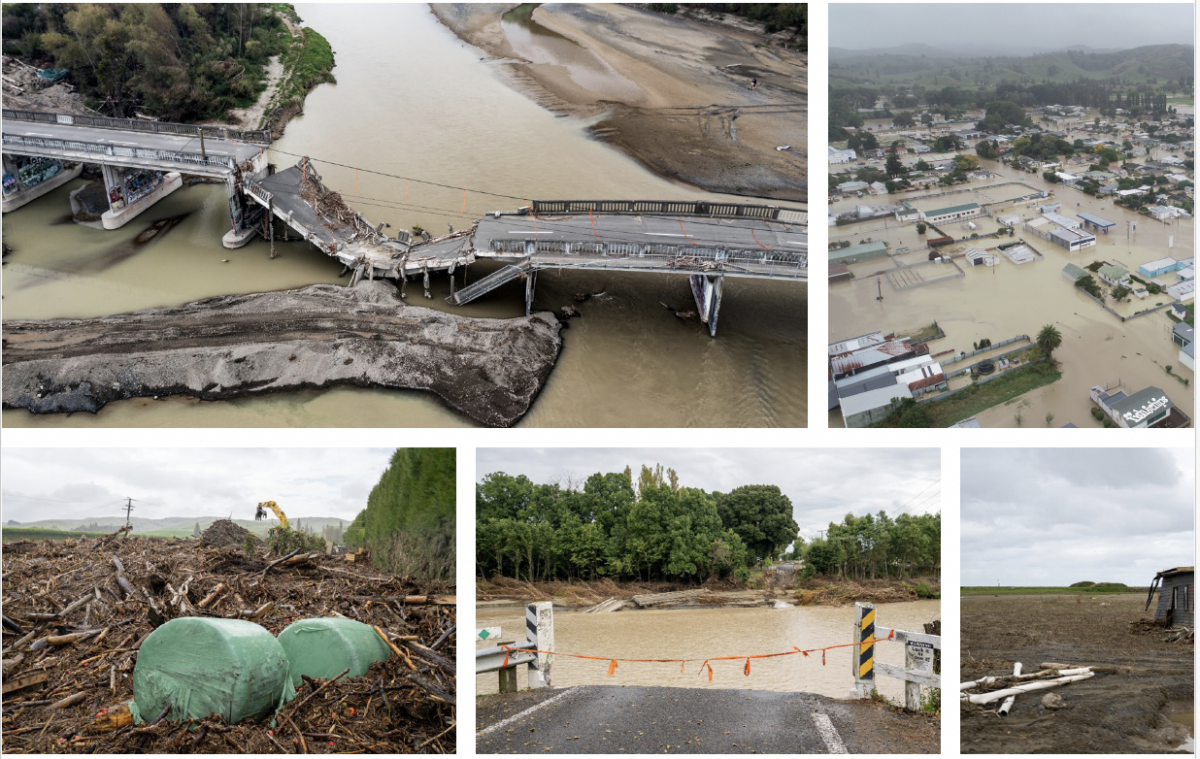
A series of very informative briefing presentations for our new councils have been prepared by key entities. So far we have reported on two of these – first, an HBRC report of its actions taken in response to independent inquiries that critiqued its performance in connection with Cyclone Gabrielle (here); and second, a HB CDEM report on its steps to improve the region’s emergency management capabilities (here).
This article summarises a Briefing for our new councils prepared by the HB Regional Recovery Agency (HBRRA) regarding its activities in coordinating the region’s overall recovery effort, including negotiating central government funding support for HB recovery.
HBRRA was funded by the Crown and was accountable to HB’s five councils and Māori leaders through the Matariki Governance Group. Working with councils, HBRRA developed a strategic approach and plan, identified and prioritized recovery projects, pursued government funding, and coordinated implementation.
Key priority areas included the following, and the Briefing describes the specific actions taken by councils, iwi and other players, and the expenses involved to date:
- Resilient state highway connections and addressing lifeline vulnerabilities
- Restoring cyclone damaged local roads and bridges – critical in the farm/forest/orchard gate to port and processing part of the transport network
- Restoring critical rail connections
- Building flood protection improvements and new initiatives co-funded under the North Island Weather Events Hawke’s Bay Crown Funding Agreement
- Conducting Scheme Reviews of existing flood protection schemes and any required upgrade works (later covered in the Hawke’s Bay Independent Flood Review and the Reimagining Flood Resilience project)
- Increased resilience across electricity, gas and telecommunications infrastructure
- Housing repairs and initiatives to address cyclone displacement and inequalities, as well as grow housing system resilience
- Supporting whānau and community wellbeing
- Primary sector support
- Environmental restoration initiatives
Now what?
Work will be required to support unfinished elements of the region’s recovery programme beyond 31 March 2026, when HBRRA’s funding ceases. Our new councils must decide quickly how this work will be led going forward.
The Briefing identifies key areas of activity likely to require support:
- Supporting the Programme Governance Group under the NIWE Hawke’s Bay Crown Funding Agreement and undertaking the high-level programme management role set out in the agreement
- Stewarding the region’s relationship with Government in respect of recovery and resilience programmes (Ministers, DIA, other agencies)
- Coordination of sector workstreams such as the Infrastructure Recovery Working Group (a group of senior infrastructure officials from across agencies with responsibility for infrastructure/lifeline networks and assets in or servicing the region)
- Support for implementation programmes as required, particularly with Government advocacy and issue management, including: flood protection, transport infrastructure, marae and housing/papakāinga redevelopment
- Support for the Housing Recovery Plan and the Housing Leadership Group, strategy and programme
- Targeted advocacy on increasing resilience investment in the Telecom sector. Here the report is critical: “…further attention will need to be directed at the Telecommunication sector, a largely privately held infrastructure sector, where it is not clear what resilience investment has been planned or made to date.”
Also forthcoming from HBRRA is a ‘Lessons Learned Review’ to be completed in early 2026.
“The aim of this exercise is to examine what worked well in recovery and what could have gone better, recording positive elements and lessons that can be taken from the recovery experience … Losing the recovery experience and capability gained would be a major setback for the region. Capturing and retaining this knowledge should be prioritised alongside the CDEM transformation work.”
One voice
Importantly, the Briefing notes:
“Aside from specific recovery and resilience issues, a key takeaway from the recovery process has been the effectiveness of the region having a joined-up voice to Government and coordination over the regional programme of recovery work. This has reached across councils, and PSGEs where appropriate, and has been coordinated by the RRA. The joined-up approach taken has delivered significant results in terms of Government funding, regulatory and policy support, and has been praised on a number of occasions by the Prime Minister.
“As noted above, the RRA will conclude operations at the end of March 2026. Council leaders and Matariki Governance Group, through its review of REDA and regional priorities, have been considering options for retaining the capability developed in the RRA to advance shared regional priorities, retain recovery readiness and complete outstanding regional recovery work. This work needs to be brought to a conclusion rapidly if capability is to be retained.”
Amen!
The full report: Briefing to Incoming Council … Cyclone Gabrielle Recovery
