

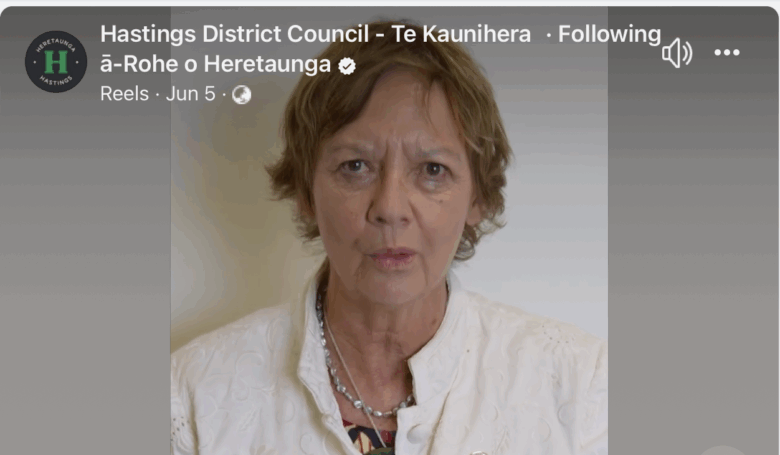
In a courageous but somewhat risky move, the Hastings District Council is featuring a set of brief videos that explain the rationale for having Māori seats and the benefits HDC has derived since introducing them in 2022.
HDC treats this as merely sharing its experience to date and getting some accurate information about the seats before the public.
The videos are posted currently on the HDC Facebook page, where they will remain until 30 June. This timing reflects that the election season is deemed to officially begin on 1 July, which is when candidates can first officially declare their candidacies.
You’ll recall that HDC – like CHBDC, NCC and HBRC – are all required to conduct referenda on Māori wards as part of the 2025 local body elections.
The ‘talking head’ videos released so far feature Councillors Tania Kerr, Ana Apatu and Wendy Schollum. You can view them here until 30 June.
Tania Kerr: https://www.facebook.com/share/r/1791P1wmJh/
Ana Apatu: https://www.facebook.com/share/r/1AbhV53nGG/
Wendy Schollum: https://www.facebook.com/share/r/16K21RgMyh/
Additional videos will feature Mayor Sandra Hazlehurst and Isabell Crawshaw, Chair of HDC’s Rural Community Board.
ACT, which has strongly advocated for the referenda on Māori seats, has complained that the videos represent improper electioneering on the part of the council and improper use of ratepayer funded communications channels.
HDC counters they are not telling anyone how to vote, they are simply confirming that the existing seats have worked to the community’s benefit … and doing so before the campaign season begins. The videos were ‘homemade’, produced with a videophone by a HDC comms staffer.
What’s your view?

Know who to boot in October.
Sandra doing a Jacinda won’t solve the problem but it is a good start.
Youth, seats, unelected Maori reps with voting rights are a gerrymander which along with Maori seats need to be removed to restore democracy
Ask all the candidates their position on the above and vote accordingly
All councillors need to state there preferred option before we vote in October
Any more for the bin?
Sandra – resigned, Tania – resigned, Isabella – works at Centralines giving ratepayers $ away, Ana – resigned from Hawke’s Bay District Health Board after adding to the shambles and is currently milking $ from Hawke’s Bay Helicopter Trust as well as the ratepayers, Wendy likes to tell us we threaten her online but doesn’t like to meet face to face with the public to hear hard truths. Yep, the actual workers are working for the $ you pay them. These ones are making videos pushing an agenda on your dime and dividing the country more. Thanks team.
Councillors nationwide tend to be a fairly conservative and community-minded bunch. The reason councils like Hastings unanimously support Māori Wards is because they work. They’re absolutely democratic – one person one vote – and reflect the basic principle of democracy, which is fair representation. In Napier there have been just 3 Māori councillors in 150 years and in Hastings just a handful. Some people think that’s just dandy and others see it for what it is – a broken system that requires an easy fix. But beyond that, councils who have experience of Māori Wards, say it not only improves decision making but it saves money. Whakatane District Council for example, says it saves hundreds of thousands a year because the consultation with mana whenua required by law happens properly, efficiently and effectively.
The multi-generational ‘mokopuna decisions’ approach that Māori councillors bring to the table benefits all.
Democracy is many things – First Past the Post, MMP, an unelected born-to-rule head of state . . . There was a time when only land-owning blokes had the vote, which was democracy at the time but later recognised as wildly undemocratic. Tweaks to the system aiming to achieve the underlying goal – fair representation – are par for the course. Māori Wards strengthen democracy.
Absolutely. Diversity of skill base. Empathy for a minority co sovereign. Understanding of a minority co sovereign. Pride in partnership. Reinforcing democratic priviledge. Embracing the cultural environment with multiple perspectives.
Not democratic when people can’t vote for them. I’d also say it’s divisive.
No problem with the videos – they’re a good counter to the frankly “racist” based comments coming out of ACT. At least the councillors are inclusive in their comments – where ACT are very definitely “exclusive” with their screams that Maori have all these wonderful benefits not available to “white” New Zealanders – which makes one wonder why Maori are at the bottom of the heap with horrendous records in health, education, criminality and homelessness. I’d rather believe our councillors than the bleatings of the ACT faithful who skate around racism and support of big business in lieu of support of the majority of NZrs – and I will vote for those supporting Maori wards just as I would vote for those supporting rural wards.
Here, here!
Those who argue against Maori Wards are the usual ill-informed (ignorant) racists who rant from their positions of white privilege and don’t have a clue the difference between equity and equality.
Using the phrase “white privilege” and labelling people as “ill informed, ignorant, racists, based on their skin colour is a pretty ignorant, racist thing to say. Just saying.
I think ACT should stay in their lane. The referenda are a huge waste of money designed to let rednecks have a disproportionate say. The Māori wards have been a success and local councils do not need the 8% party interfering in how they run local democracy.
Reality check
The voters have had no say on Maori wards and now they will
Its called democracy
Just to double-check your “reality check” Matthew: In 2021 Hastings District Council undertook an extensive community engagement to gauge support for introducing a Māori ward. Respondents to the consultation were 76% in favour, and this was followed by a representation review, resulting in the Takitimu ward being established ahead of the 2022 local body election. The council elected by voters in 2022 then decided unanimously to retain the ward because it strengthens our democracy and work so well. Wellington didn’t like the democratic outcome here, so is trying to over-ride it.
If youre right the Maori Wards stay
If youre wrong they’ll go
The ratepayers, not the councillors will have decided
Lmao
As usual I’d like to hear the full spectrum of arguments but we won’t. These days people are too scared to speak frankly unless you have easily digestible views. Contrarians stay silent, for fear of being called Nazis.
Institutions give us lessons in ‘right thinking’. It’s not the death of democracy but a debilitating malaise.
Exactly right, Paul. Local government is definitely in a class of their own, they are ‘right’, the rest of us are wrong. Proud to say I’ll be voting no to Maori wards, we are all New Zealanders and all immigrants at the end of the day. The sooner the woe is me people realise that and work for their money like everyone else, the less reliant on the system we will all be and the things we collectively spend our rates and tax $ on can be for the benefit of us all. P.s. bye bye to the outgoing Councillors supporting this, October is only a few months away.
Grant, one of the current Maori Wards Councillors at HDC is as racist as they come. When her decision is threatened, she pulls the ‘wahine’ card and says Maori are better at everything. Pretty sure her comments contributed to her stepping down from her previous political endeavours. Democracy means everyone gets a vote, HDC are skewing that by using their ratepayers $ to push an agenda, that is clear to see. We all have sn opinion and are free to voice that, but it should be on our own time at our own expense. Otherwise it’s purely political. I see a few of them have resigned, maybe looking for iwi chair roles mmm? Look forward to the referendum and the real view of New Zealanders.
I really don’t care if a Maori Ward Councillor is “racist as they come” – applying that principle Seymour is “racist as they come” with his 8% vote having a huge say in what goes on in this country and his continual bleating about Maori – surely that’s also racist? If a Councillor holds a viewpoint and expresses it isn’t that their democratic right? Yet when it’s said she’s racist! Obviously democracy and the right to an opinion is only one way in your world – I don’t care – you have the right to a biased outlook and so does she – and I support both sides – just don’t abuse each other – have a considered debate about it without the disagreeable buzz words – you may all find that you have some common ground? I’m sick to death of the abuse in our political debate in Parliament, Local Councils, and even on this platform – time this bloody country grew up and acted like adults to move forward together – keep it up and we’ll start looking like Trumpland
Lol, Grant, you can call people racist but others can’t? The difference is they are. Racist – characterised by or showing prejudice, discrimination, or antagonism against a person or people on the basis of their membership of a particular racial or ethnic group, typically one that is a minority or marginalised. I’m a colonist coz I’m white right? Ha! You’re right though, if we forgave the past that has nothing to do with us now, stopped the ‘I should get more than others’ and we all got along imagine what we’d achieve. Until then, I’m just a ‘whitey’.
Calling people ‘racist’ and ‘rednecks’ because they don’t agree with your own view/opinion isn’t really going to help the discussion, is it. Not that hard to understand I reckon.
Continuing in parliament, thanks for speaking up Erica: The Māori Party treat that place with contempt, they always have and they did again yesterday.”
“They didn’t say sorry, they didn’t turn up.”
Te Pāti Māori treats Parliament “like it’s a stage for their social media videos to spread their division”.
These HDC representatives are the same. It isn’t a discussion, it’s a stage for their social media videos to spread their division, it’s an opinion on the ratepayers dime.
Racism is not the same as disagreeing with race-based political structures, and it’s time we stop conflating the two.
Raising questions about Māori-only seats or asking why only Māori can vote for those seats is not racism. It’s a legitimate concern about democratic equality and universal representation. We should be able to debate policies that create separate electoral tracks without being accused of intolerance.
The core question here is this: Why should one group have exclusive access to vote for certain seats based on ancestry? If the goal is inclusion and better representation, surely we should be striving for structures that bring people together, not divide them along ethnic lines.
Yes, it’s important that Māori voices are heard. But that can be, and in many cases already is, achieved through community engagement, inclusive policymaking, and ensuring councils genuinely reflect the diversity of the communities they serve. We should all be focused on outcomes, not optics.
If the Māori seats have been effective, let’s talk openly about how. But that conversation must allow for honest questions and concerns not silence people with accusations of racism for simply wanting a fair system where everyone’s vote counts equally.
Finally, as we head into the 2025 elections and referenda on Māori wards, it’s crucial that councils like HDC don’t blur the line between informing and advocating. Ratepayer-funded platforms should not be used to shape public opinion just before a vote on this very issue. Transparency, yes — persuasion, no.
Let’s have the conversation — respectfully, constructively, and without fear of being wrongly labelled.
Finally, as we head into the 2025 elections and referenda on Māori wards, it’s crucial that councils like HDC don’t blur the line between informing and advocating. Ratepayer-funded platforms should not be used to shape public opinion just before a vote on this very issue. Transparency, yes — persuasion, no.
Let’s have the conversation — respectfully, constructively, and without fear of being wrongly labelled.
Agree, Greg, thank you.