

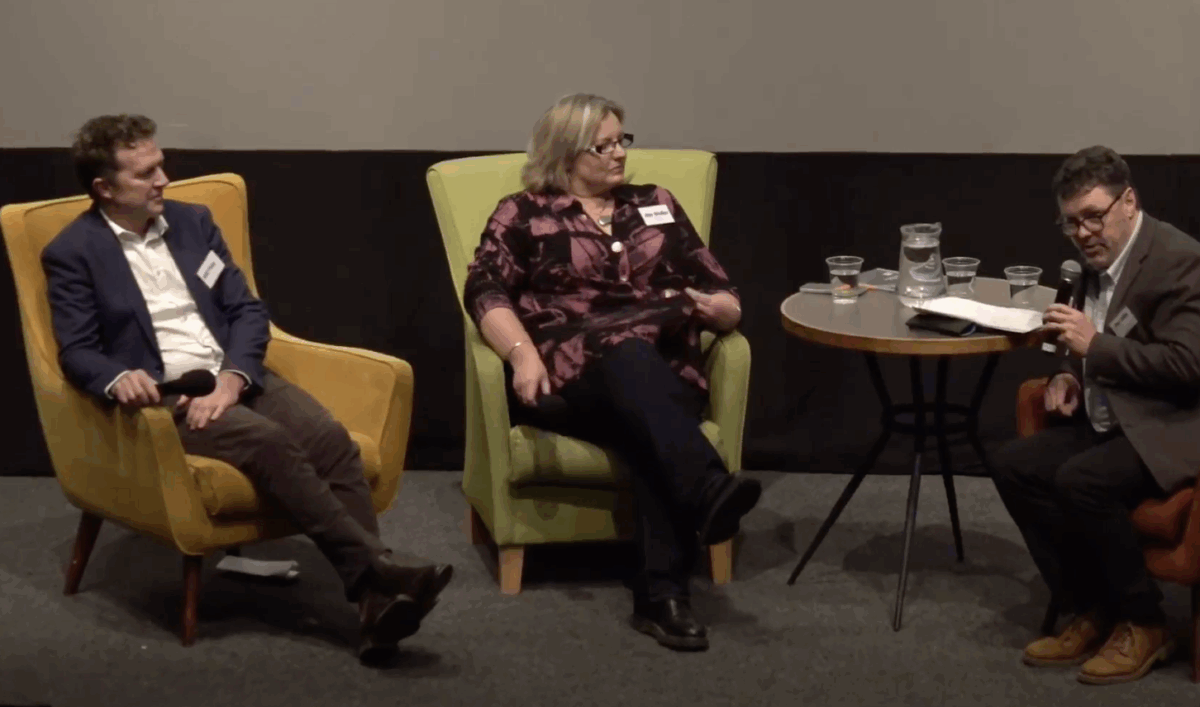
A mayoral discussion in Central Hawkes Bay last night, hosted by Newsroom Pro managing editor Jonathan Milne, shows sharp differences of opinion on key policy issues in the Mayoral campaign.
In particular, the two candidates, incumbent Alex Walker and challenger Will Foley (a local farmer and current Regional Councillor) parted ways on issues such as Māori Wards, the new regional water entity, rate capping and council amalgamations.
The event – held at the Waipukurau’s Civic Theatre – was put on by the CHBDC, Central FM, Waipukurau Rotary Club and Business and Professional Women CHB. It began with short punchy pitches from 18 council candidates, before a 75 minute Mayoral discussion.
Milne’s facilitation was friendly but probing, and on several occasions he challenged responses from the two candidates.
Foley has been on Regional Council for two terms, but has not been involved in the district council before. In a video introduction on the CHBDC website, he said he had decided to run because people in the community had asked him to.
Walker has been mayor of CHBDC for three terms and led through Covid and Cyclone Gabrielle. She spoke with the confidence of an experienced leader and exhibited a touch of swagger. Years in the job and probably good training from LGNZ, which she referenced during the discussion, have clearly developed her very direct and clear communication style. She was in full campaign mode!
Foley was clearly nervous but held his ground and gained confidence as the discussion progressed. He did not hesitate to firmly disagree with Walker on a number of occasions. His speaking style was softer and less formal. Noticeably, he used a lot less words overall than Walker to make his points.
In his opening statement, Foley spoke of a lack of connection between council and the public and a lack of thriving among constituents. In his outreach and door-knocking he said, “Everyone is saying the same thing”.
Walker began with a short welcome in Te Reo before recounting her successes as Mayor, touting growth and recovery from disasters as key examples. She said the region needed a “strong and experienced leader” to continue building on those successes and addressing infrastructure challenges.
Throughout the discussion, she consistently drove home the reality that the biggest issue facing the district was affording $1 billion dollars of infrastructure assets with only 8000 rateable units. Regardless, she said the district was an attractive place to live.
Key areas of disagreement
On the question of Māori Wards, Walker said she would “absolutely vote to retain” them. “This is going to create a space for us to be way stronger in solving our problems together and creating a a really strong future.”
Milne asked if the referendum would cost ratepayers extra or be absorbed into the cost of the electoral campaign, she admitted it would cost extra, but said that was what the community had asked for.
Foley wouldn’t commit to support for Māori Wards at this stage and said he was still taking the time to listen to the community. He noted he supported them at the Regional Council level. Walker called him out for not being decisive on the issue. Voters needed to know what leaders and candidates stood for, she said, and reaffirmed her “unapologetic” support.
On the issue of Rates Caps, Foley said he was in favour. “I relate it back to income inflation … If you keep increasing a cost such as rates higher than the rate of your wage inflation, maths tells you eventually it will catch up. So that just can’t continue.” He said controls around future council spending might be the answer, and consulting on big capital projects would be important.
Walker challenged the perception that councils were wasting money on vanity projects. “More than 90% of the rates we collect are on the pipes, the pumps, the potholes … when you think about the underinvestment we are trying to deal with … and if you have got to fund depreciation … it [the perception] certainly doesn’t make sense.”
Foley asked what ratepayers get from money spent on organisations like fees and contributions to LGNZ [Local Government NZ], HB Tourism, Climate Joint Action Committee and the HB Economic Development agency. “We really need to look at the value all those external fundings are providing our ratepayers back here at a grassroots level, because I think a lot of people would argue that they aren’t.”
Milne then put it to Walker – is it time to quit LGNZ?
Walker said the value proposition was powerful, and likened it to being a member of Federated Farmers or Beef & Lamb. “There is oodles of value of being a member of that organisation”, but could not say how much it cost ratepayers.
On the question of the new big joint water entity, Walker noted that with water services already costing $3,500 per household, it was necessary to move forward with it.
Foley said he did not support it and noted that there was a lot of excluded information the public did not have access to. His observation was that creating new entities, employing more people and creating new governance boards did not really produce results for ratepayers. Regional Councils were a regional entity, he said, and as a councillor in that organisation he was more aware of the differences between districts than ever.
Walker said the modelling for the new entity was available in various places and the delivery plan would be on the council website shortly. The options for what the council could do on their own were limited, she said, and the council and advisors had not been able to come up with a better way to do it for the size of the ratepayer base. In the absence of any other ideas, “I absolutely back myself as one of three, as the [council] shareholders of this new entity, to set this up really strongly for Hawke’s Bay,” she said.
Amalgamation was not something that Foley agreed with. “It’s trying to improve the voice around the table and currently at the regional council it’s one voice against 11. And when I say the most important thing for our flood resilience is to get gravel out of the rivers, they all laugh at me, because they don’t understand!”
Walker said it was not an “all in, or all out” proposition. She used to be for it, but after her experience during Cyclone Gabrielle, it had disabused her of the notion that it was a good idea. “If we had not had the leadership and autonomy to respond and look after our people and do what we needed to do in that situation, we would still be waiting for Napier to turn up to help us in Porangahou.” She supported inter-council-collaborations on an individual basis. For example, shared water services and shared consenting.
Plenty more was discussed and overall the discussion was a revealing opportunity for ratepayers to learn the differences between the two candidates. The recording of the event is available here on the Council’s Facebook page.

Alex Walker should , in my opinion, have laid the cost of the referendum on Maori Wards squarely on Central Government for forcing it on us; sure we gave the Council the mandate to set up such Wards and we are only “revisiting ” the subject because this government saw mileage in kicking anything Maori in the guts. It’s only people on the Maori Roll who will vote for those candidates and it will not cost us ratepayers anything more as the ” pie” is just spread more thinly. And our Treaty partners get to have a small say in what goes on; any unfairness in that is they are only being offered one seat.