

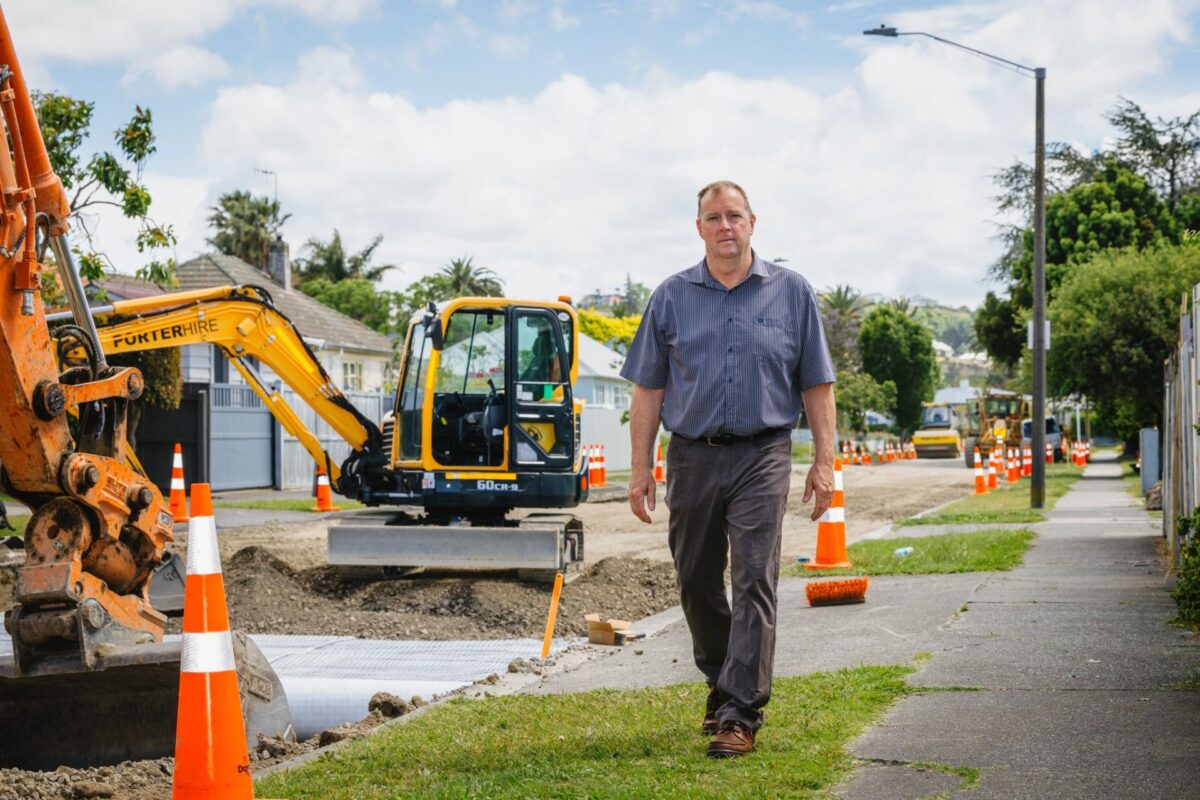
When Napier Mayor Richard McGrath gets sick of doing the “big boy stuff” in his office, he grabs his basketball and heads across the road to shoot some hoops and chat with whoever he comes across.
“That’s my happy place. Listening to what our community has to say,” McGrath said.
It’s been eight months since McGrath was elected as mayor of the city, beating incumbent Kirsten Wise by 3422 votes and fellow councillor Nigel Simpson by 6196.
It’s fair to say things haven’t been all smooth sailing, as previously reported.
As McGrath sits in Cape View House, the temporary office home of many NCC staff, we ask him – does he feel like he can be the mayor he wanted to be with such a fractured council?
“We are not terribly fractured,” he insists. We’re getting better. I think it was just a hangover from the last council and the shock change, because it was a shock.”
He said it had been a while since he’d even thought about it because “we’re rocking and rolling how we should be”.
He said everyone was voted in for different reasons, and councillors all had their own agenda to push. “Life would be easy if I had 11 councillors who all followed the party line,” he says. “I don’t want that.”
He said he had no problem with councillors voting against him because that was what democracy was all about. “I’ve been that person in the past, the only one voting against projects I didn’t support. As long as it’s not for spite, and I don’t think we’re seeing that around our table.”
McGrath said being a mayor was a bit like living in a very unique world.
“There’s a lot of hard stuff that you have to do, but I don’t mind that. If you’re not prepared to do it, you shouldn’t be sitting in the seat. And there’s some boring stuff, but there are also cool things like getting invited to community events, whether that’s Relay for Life, Hawke’s Bay volunteering, or the opening of a business, because it shows progress or the community using what’s on hand.”
He said the hardest part of his job was being locked in the office. “It does my head in, and we’re going to have to find some solutions to that.” His worst fear was not spending enough time in the community talking with the people about “their city, not my city, their city”.
He said in hindsight, he might have approached some things differently when he became mayor, but it would not have changed any decisions guided by his values or by what he believed the community wanted when it elected him.
The thing he was most proud of so far was being able to follow through on some of the campaign promises, such as reassessing the Waka Hub and the Ahuriri Regional Park.
“I went out before election time and asked what was important to people, and it was loud and clear they wanted council to get back to basics and stop doing things that didn’t need to be done in our current situation, especially with the cost of living and now with the fuel crisis on top of that.”
Amalgamation
McGrath has plenty to say on amalgamation.
“If you go back to the referendum in 2015, I was absolutely against it and I still am.”
He says it’s not the solution to the problems and that it hasn’t worked for Auckland.
“It creates a whole lot of transition costs and upheaval. For some reason, the government doesn’t seem to like working with councils. “They say it’s too hard with 68 of them. But I’d argue 90% of our work doesn’t involve them.”
He said he felt as if they were being backed into a corner, and while the Government says it’s voluntary, “it really isn’t”. The only voluntary side is you can jump off the cliff or we’ll push you.”
In McGrath’s opinion, there are other options for Hawke’s Bay’s amalgamation, rather than a single unitary council that includes Napier, Hastings, Central Hawke’s Bay, and Wairoa.
“I’m passionate about this city, and I’m not here to give it away.
“We have a few options. There’s the unitary option, which would basically be like a regional council. But that’s the model that failed us and is sort of the catalyst for the change. Why would you have the same model that left Wairoa out during the cyclone?”
McGrath’s idea is for Napier and Wairoa to merge in the north and Hastings and CHB in the south, using the river as the boundary. We already have shared services, and those would remain. But it would be essential to ensure Wairoa and Central Hawke’s Bay were not stripped of frontline staff or equipment.
“When things turn to custard, you don’t want to discover there are no diggers on the ground and no one there to lead the response.
“We haven’t got over the hospital yet,” he said of the closure of Napier Hospital in 1998.
He said the council was still talking with the community and no decisions had been made yet.
He said the Government reforms were a struggle for all councils.
Asked if he would stand to be a potential regional mayor in 2028, McGrath said he hadn’t thought that far down the track. “I’m just trying to do what’s right for Napier now.”
He said being the mayor of Napier was everything he thought it would be, but hoped it wouldn’t be.
“It’s potentially the greatest job in the world. I absolutely love Napier, and I’ve put a lot of time and effort into it, whether it be in the early days of volunteering and helping out where I can. It’s a fantastic city, but when you’ve got people, personalities and politics, it’s never easy.”
He said there would always be tension between councils and residents, and that’s why there was a consultation process, so everyone could have their say.
“There are a lot of people struggling, so we have to balance that and not stop dead as a town. We don’t want to become a ghost town.”
He said the community had “screamed out for change” by electing him. He’s now doing everything he can to deliver it.
LDR is local body journalism co-funded by RNZ and NZ On Air.

