

[As published in July/August BayBuzz magazine.]
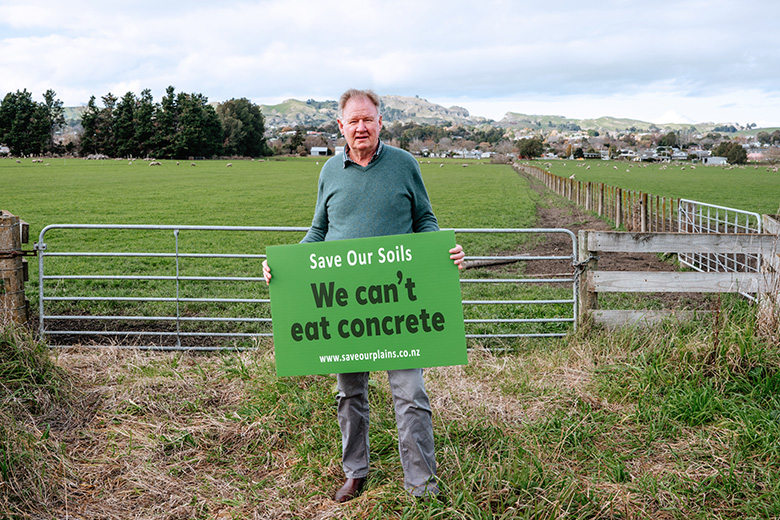
From his cottage high in the Havelock hills Richard Gaddum enjoys panoramic views over the Heretaunga Plains. For over fifty years, year after year, he has witnessed urban creep consuming more and more fertile land.
He despairs at the loss.
Since 2000 alone, gone are nearly 1,000 hectares of the three highest soil types, land that could be growing fruits and vegetables.
So passionate is Richard Gaddum about preserving the fertile soils that in 2019 he co-founded lobby group Save the Plains with concerned others; Mike Donnelly, John Bostock, and Paul Paynter.
Looking to the view we can see the mass that is urban Hastings is centred slap in the middle of super fertile Heretaunga.
Why?
The railway
We drink tea and speculate.
What if?
What if the railway had been routed differently. There were competing factions.
In the early 1870’s Henry Tiffen formed roads and subdivided sections in Greenmeadows anticipating his option being preferred: Ahuriri-Taradale-Omahu-Pakipaki. In Havelock North majority land owner John Chambers objected to a Pakipaki-Havelock-Clive-Ahuriri route.
What if Havelock North had been the railway hub and main city in Hawke’s Bay instead of Hastings?
Richard Gaddum would probably be fighting to draw the urban boundary half way up Heretaunga Street, and meeting town planner Mark Clews in Havelock at the Heretaunga District Council.
Before the railway line, before the European settlers came, the Heretaunga Plains were a vast patchwork of wetlands with clumps of bush on higher ground, mostly Kahikatea, white pine.
For Māori the wetlands were a vital food resource.
Winners in the 1870’s railway tussle were the settlers who drained the wetlands made so fertile through millions of years of sedimentary layering.
Losers were Māori dispossessed of their lands by means mostly foul.
The first large subdivision on prime soils was in 1879 from Thomas Tanner’s Riverslea estate, cut into 240 quarter acre sections (1100m2). Others quickly followed, and the pattern of encroachment on productive land began.
Of course there was so much land back then soil fertility was not a development consideration.
Warnings begin
By the 1950’s there was broad recognition Hastings must temper expansion into productive land.
In 1958, a report by Wellington town planning consultants Gabites and Beard, commissioned by Hawke’s Bay Master Builders, stated “urbanisation of good farm land should be avoided at all costs,” and that unrestrained peripheral subdivision ‘could be almost suicidal.’
Among their recommendations were “consolidation within existing residential zones, redevelopment of obsolescent housing areas, and development of a new satellite suburb to accommodate 4,000 to 6,000 people on land west of the city of very low natural soil fertility.” Flaxmere.
The first Flaxmere houses were well designed, and built of high quality materials, a popular suburb to buy and settle.
Later, greedy developers built crap fibrolite houses for sale and rental, and degraded the suburb.
Then Lyndhurst
In the history of fierce opposition to prime land loss came the Lyndhurst subdivision of 1995.
Richard Gaddum suggests I talk to Mike Donnelly. He was a Hastings District Councillor and voted for residential subdivision of 70 hectares of the very best soils.
“Biggest mistake of my life,” Mike says.
Demand for housing was high. He was persuaded by the planning officers’ recommendations Lyndhurst was the most efficient option for connection to services. “The vote was 8 to 7.”
Newspaper articles at the time mirror the same sentiments expressed by the Gabites and Beard report, and by the Save the Plains group today.
Chairman of the Hawke’s Bay Fruit Growers Federation, David Mardon, told the Herald Tribune, “These soils are too valuable to fritter away. They are in short supply world wide,” and prophetically he said, “We don’t know what product down the line could be grown here.”
Today’s Future Development Strategy
Richard Gaddum has taken up the mantle of those before who fought to preserve the precious Heretaunga soils.
He tells me about the latest planning move, the Future Development Strategy (FDS), recently adopted.

FDS is a central Government requirement for Councils to project housing need and identify land suitable for development over the next 30 years. FDS replaces HPUDS – Heretaunga Urban Development Strategy – a collaboration between Hastings and Napier prepared by the Councils in 2010 and updated in 2017.
Overseeing the FDS process is a Joint Committee from the three councils – Hastings, Napier and Regional – and three Iwi authorities – Maungaharuru Tangitū Trust, Mana Ahuriri Trust and Tamatea Pōkai Whenua.
Barker and Associates, urban planning specialists, wrote the Draft report. They say 16,320 dwellings are needed in the next 30 years: 6,700 in Napier. 9,620 in Hastings.
138 submissions were received, each one evaluated in detail by Council planners.
9 April 2025
Hearings were held over three days in HDC chambers before five Commissioners, charged with recommending who’s included, or excluded, from the FDS.
None live in Hawke’s Bay.
First up is Andrew D’Arth, fourth generation fruit grower on the Heretaunga Plains.
“You have ten minutes.”
He’s one of many requesting a rural property abutting the urban boundary be tagged for residential. ‘Reverse sensitivity’ is an oft repeated issue.
Next to present, by zoom, is Oliver Boyd for Summerset Retirement Villages. He tells the panel his company are the largest home builders in the country after Fletchers. He asks the panel to provide Greenfield sites of around ten hectares. Particularly he wants 9 hectares adjacent to Summerset in Ada Street, Hastings, included in the FDS. The land is Class 1.
Rick Barker is next speaking on behalf of Peter Beaven.
He implores the panel to be bold and for the sake of “future food security” disallow any more encroachment on “amongst the most productive land on the planet … 4,000 hectares lost since the 1950’s.” He tells of living in Mahora years before and digging a hole for a fence post. “Four feet deep and still top soil.” He says it “felt like a crime” to build on such soils.
Following is land development specialist Matthew Holder, allocated over an hour, as he represents many submitters.
He starts with 95 hectares at Waimarama owned by the Chesterman family. The land was “identified in HPUDS as a future growth area,” but excluded from the FDS.
Holder argues that not including Rural Residential developments makes the planning process “arse about face”. He tells the panel, “Your job is identifying potential growth areas” and is “an opportunity to identify at the macro level.” Otherwise they’re just “kicking the can down the road.”
His next client, the Strawberry Patch at 76 Havelock Road, whose 11.6ha of Class 1 soils, Holder says, “is an ideal candidate” for inclusion in the FDS as the site is close to Havelock and would be ideal for sports facilities or Retirement housing. He suggests the Eastern side of Havelock Road is already compromised with “Howard Street, the Cranford Hospice site, a camp ground, and restaurant.”
Holder points the Panel to “3.6 NPSUD allows highly productive land to be developed … not an absolute.”
Moving on.
Landowners James Fyfe and Greg Cornes, aligned with David Colville’s Heretaunga Connection Project, offer reasons their land should be rezoned – close to existing services and transport routes, small holdings increasingly less viable, economies of scale, and demand for small industrial sites close to the city.
The Project, joining Flaxmere and Hastings, envisages up to 2,000 houses, plus commercial and industrial, on over 500 hectares, much on prime soils.
From Napier, Marist Holdings puts up 9 hectares of stoney unproductive land on Church Road capable of supporting 100 dwellings. Mission CEO Peter Holley tells the Panel the land has never been cropped or planted in grapes.
The Hawke’s Bay jockey club and other landowners in Wall Road nominate their properties. Close to existing services and flat land easy to develop are a plus. 11.3 hectares of Class 1&2 soils is a major negative.
On the outskirts of Flaxmere in Portsmouth Road, 59 hectares of poor soils capable of housing over 600 dwellings are offered by Mavern Collective.
Neither of the above properties are in HPUDS.
Two submitters speak to residential development along Raymond Road close to Haumoana School.
One group proposes a subdivision radiating one kilometre from the school. The spokesperson evokes words attributed to architect John Scott who died in 1992.
A couple from Maraekakaho present the merits of their town being an ideal residential hub, and a Pakipaki lifestyle block owner asks minimum lot size be reduced to 1000m2. (Currently 8000m2)
Two of the most contentious candidates for inclusion in the FDS are a 600 section development in Riverbend Road, Napier, and 54 hectares of top grade soils adjoining the Iona subdivision in Middle Road, Havelock North.
Iona developers, CDL, request inclusion. They are supported by Bupa Care, the Village Baptist Church, and multiple land owners from Middle, Gilpin and Te Aute Roads requesting their holdings be included.
First of CDL’s 600 site Iona subdivision, 47 sections, are construction ready. Section prices range from $399,000 for 415m2 to $610,000 for 780m2. The first house builds are underway.
Obviously CDL want to link another subdivision to Iona by stretching down to Te Aute Road, over 500 more sections, already partially serviced. Profit for them. Loss is the productive land.
The proposed Riverbend subdivision is a complex joint venture between developer David Colville and Ngāti Kahungunu. The site is prone to flooding and although Napier City Council supports, the Regional Council does not.
Solicitor for the developers argues the site should be included because so much work and cost has been expended, and there’s a memorandum of understanding with Napier City Council.
When the Panel ask the opinion of Barker and Associates Rachel Morgan she agrees, adding it was a “matter of natural justice” that the site be included in the FDS.
A timely submission comes from the Insurance Council.
Sean Fullan cautions that Insurers are more and more taking flood risk into account in supplying cover. “One in one hundred year” flood mitigation is required in new subdivisions.
The prospect of flood insurance being withheld would impact mortgage agreements with lenders. Local authorities taking up the risk would be unpopular with ratepayers.
Mana Ahuriri Trust presents its case for 1,000 residences on Onehunga Road in Bay View. Most of Ahuriri Station is low lying and prone to flooding. The needs of the airport must be considered. Planning for development of housing and commercial are in the early stages.
Last up is barrister James Winchester and two others on behalf of Mr Apple wanting 33 hectares of Class 1 land at Whakatu rezoned for wet industry.
In his thirty years of experience Mr Winchester says, “This is a particularly poor exercise and example of Council attempting to comply with statutory functions.” He’s at a loss why “HPUDS was irrationally dispensed with,” and his criticism of Council officers and the FDS process is blistering.
Now we wait.
9 May 2025
The Commissioners report back.

Richard Gaddum is furious.
They have approved 323 hectares of highly productive land be included in the FDS.
He says, “The whole process was predetermined from the outset, with little or no notice being taken of points made in the written submissions, and also from the evidence presented at the hearings. It was all a complete waste of time and money, although the Council will say that they followed due process under the Local Government Act.
“It is so disappointing that no decisions and reasons are given on why more fertile soils needed to be covered by concrete and asphalt.
“I had high hopes that the Commissioners would be brave enough to come out with a reset on how we manage our growth moving forward. Instead, we just get the same old rhetoric of planning decisions that successive Councils have done over many decades by promoting urban sprawl with no regard for our best soils.
“And the worst feature is that the Commissioners have endorsed this deplorable behaviour.”
Lost opportunity
Excluding rural residential subdivisions from the FDS is one of the most contentious issues of the process.
It does seem a lost opportunity to endorse and support building in the hills, on marginally productive land, more so, as Hawke’s Bay has an exceptional model of rural satellite suburban development showing the way: Mission Hills in Poraiti.
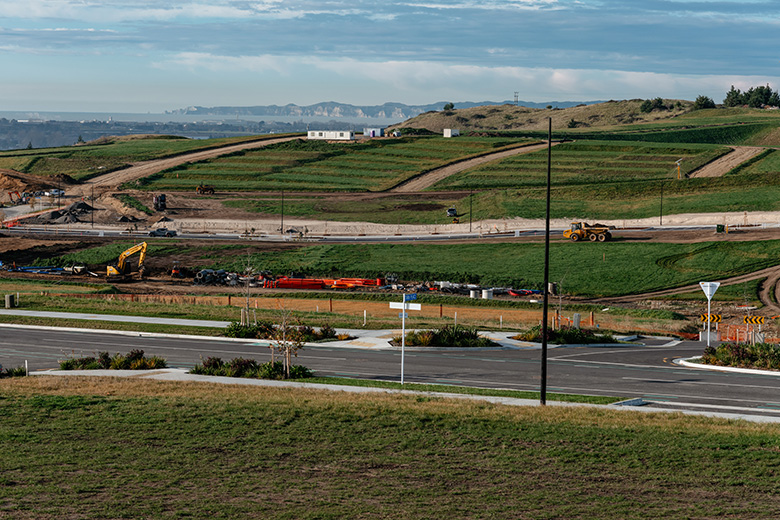
The Mission Special Character Zone was created by a private plan change submitted to Napier City Council in 2017 by Marist Holdings.
The plan included transforming 207 hectares of hill country behind Mission Estate Winery into a residential subdivision of 600 sections.
In 2021, with the plan change approved, the property was bought by a consortium of investors including Havelock North based Wallace Development Company.
The infrastructure works are mind blowing in scale; massive site forming earthworks, roading, footpaths, cycleways, storm water ponding in sink holes, power and water underground, waste water connected to Napier system, and extensive planting of hill sides and road edges.
Today the first houses are under construction. Summerset are to build a retirement village. A small commercial hub – cafe, bar, restaurant, pizzeria, fish ’n chips, and a mini-supermarket are planned.
The master plan allows for higher density cluster housing but most sites are for stand alone dwellings, Stage One ranging from $450,000 for 450m2 to $850,000 for 1000+m2.
This compares to Napier’s Parklands on flat ground at $345,000 for 400m2 to $450,000 for 603m2.
Suburbs on hill country are more expensive, but if there’s a market and developers are prepared to take the risk, the sooner they’re encouraged by being included in the FDS the better.
19 May 2025
The FDS Joint Committee meet in Hastings.
Mayor Wise of Napier moves the Commissioners report be adopted.
Hastings Councillor Alwyn Corban calls for the Middle Road and Wall Road sites to be excluded, because they’re on highly productive land, and not required to meet demand under the FDS.
The amendment is lost.
Martin Williams from the Regional Council moves an amendment that the Riverbend Road site be excluded due to its significant flooding risk.
The amendment is carried.
An unhappy Kirsten Wise moves the report be accepted with the Riverbend Road amendment.
The motion is carried.
She and Napier Joint Committee member Ronda Chrystal vote against.
Later in the day Richard Gaddum sends an email asking, “Have you seen this from the report?”
“The commissioners felt it was their responsibility to ensure growth is directed in a manner that integrates with infrastructure, maximises sustainability outcomes, and is consistent with long-term planning objectives.”
He says, “This is the same old rhetoric that we have heard from successive Councils for many decades. It’s as if Mark Clews wrote this for them.”
30 May 2025
Mark Clews started work as a planner in Hastings in 1985. It was the City Council then yet to merge with Havelock North Borough Council and Hawke’s Bay County Council (1989). Jim O’Conner was Mayor.
For institutional knowledge of urban planning in Hawke’s Bay, no one knows more than Mark Clews.
We meet at HDC along with fellow planners Craig Scott and Raoul Oosterkamp. Communications Director Nicki Harper, sits in.
For an hour everyone has input and the gist of the planners’ point of view is thus.
The last review of HPUDS was 2017, another was due, instead, the Government mandated FDS was undertaken.
The legislation stipulated the FDS focus on urban areas and that’s why the Joint Committee didn’t include Rural Residential, because although providing housing, rural subdivisions are upper end of the market and don’t provide big numbers.
The vast demand for housing is low/mid market, needs to be affordable and urban located, near schools and transport, hence the inclusion of Greenfields sites in the FDS.
As directed by Commissioners the next planning priority for them is forming a rural residential strategy. No, they’re not going to kick the can down the road.
And for all those landowners whose properties were tagged as potential future development in HPUDS, but not included in FDS, don’t worry, HPUDS is appendixed, still alive, and developers can still apply for plan changes through the normal process.
Long term planning of infrastructure, future proofing, providing enough for expansion, is a major consideration when deciding where to locate new developments.
Havelock North is a good example, where long term infrastructure planning is supporting Brookvale and Arataki expansions, and Iona in Middle Road.
Same with Wall Road. Existing services are nearby. Shame about the soils.
As expected, criticism of planners not taking soil preservation seriously is vigorously rebuffed.
An example is given. The land where the Sir James Wattie retirement village is sited was twice presented for a plan change from rural to residential. Council declined housing being built on the land as did the Environment Court. However, the retirement village proposal was accepted, that need considered to outweigh rural productivity.
As for the inevitability of some sites being re-zoned, like the Strawberry Patch on Havelock Road, the planners say they would strongly oppose an application because of the high value of the soils.
But what about the 54 hectares of prime land abutting Iona subdivision. Why was it excluded then included?
The planners pass the buck. Their job is to advise. Decisions were made by the Joint Committee and Commissioners, and everything still has to be ratified by Councils.
Maraekakaho and Te Awanga seem obvious areas for residential? They weren’t included in the FDS because concentration was on the urban areas.
Also, any further development in Haumoana/Te Awanga needs to be assessed in conjunction with the Coastal Retreat Strategy, currently in the development stage.
And what of the criticism the FDS has no teeth and was a waste of time and money.
They say future planning would be happening regardless, be it HPUDS, FDS, or some other acronym.
The submissions have provided valuable information, public engagement is important, a whole lot more data has been collected, data essential in plan change processes.
And remember, all plan change decisions are ultimately made by Councillors, and when challenged, the Environment Court.
After forty years Mark Clew’s last day is 4th July. Independence Day.
16 June 2025
I ask Richard Gaddum (aka Red) if Florence, BayBuzz’s photographer, can take a photo. He agrees.
He asks if I’ll be attending the upcoming Council meetings discussing the FDS.
I roll my eyes.
Be assured, Red will be there, fighting for the land. He’s already fired off a final missive to councils specifying nine locations where 2,925 ‘un-needed’ houses on 302.4 hectares of the region’s best soils (LUC classes 1, 2, 3) will be authorised by the FDS.
But wait, sweeping in at the last minute is Housing and RMA Reform Minister Chris Bishop, who dropped this pro-development blockbuster on local councils in a recent speech:
“My inbox is filled with story after story of council planners trying to dictate every little aspect of people’s lives,” he said. “If local government doesn’t have the courage to make the right decisions, we will do it for them.”
And his ‘interim’ RMA reforms propose giving him the power to do just that.
When a Minister adopts that posture, what’s the point of attempting to craft a Future Development Strategy?
Councils have reacted with outrage.
Perhaps they now feel Richard Gaddum’s pain.
Extract from Richard Gaddum’s letter to Councillors (LUC = Land Use Capability)
• Middle Rd area of 54ha (640 houses). Mostly LUC 2, that is from HPUDS, is not needed.
• Wall Rd. 11ha (110 houses) and on 85% LUC 1, balance LUC 2 soils, that is from HPUDS, is not needed.
• Kaiapo Rd. 73ha. (430 houses). 70% is LUC 1. 30% LUC 2, that is from HPUDS, is not needed.
• Murdock Rd. 11ha. (120 houses). All LUC 2, that is from HPUDS, is not needed.
• Lyndhurst Rd Extension. 31ha. (280 houses). All LUC 1, that is from HPUDS, is not needed.
• Copeland Rd. 14ha. (140 houses). 60% LUC 1. 40% LUC 2, that is from HPUDS, is not needed.
• The Loop. 23.5ha. (175 houses). LUC 3. Flood hazard zone. From HPUDS and is not needed.
• South Pirimai. 61.6ha. (370 houses). LUC 3. (Productive LUC 3). Flood hazard zone. From HPUDS and is not needed.

As a HB Ratepayer this statement ‘When the Panel ask the opinion of Barker and Associates Rachel Morgan she agrees, adding it was a “matter of natural justice” that the site be included in the FDS.’ Barker and associates, along with a lot of the Councillors in favour of the FDS, have no concept of natural justice for the HB ratepayers and population. Flood prone areas and highly fertile soils should not be further developed, period. Hine, Kirsten and Sandra, continue on this path and the blood that is already on your hands from previous flood events is oft to grow. Well done Richard – I’m all for central government stepping in if it leads to better outcomes, can’t do any worse than the shambles currently in hand and the inbedded systemic corruption throughout our HB Councils. If you tolerate this, then your children will be next.
Ways to cut rates – look at the Conflicts of Interests and hold Councillors and mayors accountable for their more than questionable decision making, even if they are stepping down. Search DOI on the Napier City Council website.
Vote for those who serve the people, not themselves.
HB exists because of the land and the produce that comes from that land. Covering fertile. productive soils with housing is just plain stupid as it reduces the income from the region and lowers the value of the region as a whole. Housing needs a new outlook throughout the region – have the councils looked at encouraging central CBD apartments – all those empty spaces above the shops in town that could become apartments and bring life to the centre of towns; the old buildings sitting vacant – why can’t they be converted into CBD apartments; urban sprawl seems to be the way to go in Napier and Hastings while city buildings sit vacant – landlords must be doing well if they can have empty buildings sitting without tenants – why not convert these and let them do even better.