


For what, should we worry, and what does it mean for Hawke’s Bay?
The NZ Infrastructure Commission has released its recommended 30-year National Infrastructure Plan.
The plan notes that NZ infrastructure spending has been one of the highest among OECD nations, but ranks poorly (#37) in terms of efficiency and asset maintenance. Says the report: “High-level comparisons suggest we get relatively poor ‘bang for buck’ for our spend, meaning fewer kilometres of road, rail or pipe per dollar than many other countries.”
The plan recommends these priorities:
1. Lift hospital investment for an ageing population – Increase investment as a share of GDP to address ageing population demands and maintenance backlogs through clear long-term planning.
2. Complete catch-up on water renewals and restoring affordability – Sector affordability can be restored through national guidance on demand management, resourcing the economic regulator and providing assurance over investment proposals.
3. Implement time-of-use charging and fleetwide road user charges – This is essential for improving the efficiency of our urban road networks, particularly in congested cities.
4. Prioritise and sequence major land transport projects – Restore affordability by timing major road and rapid transit investments based on demonstrated demand and cost benchmarking, while using low-cost and targeted improvements first to lift network performance.
5. Manage assets on the downside – actively plan for declining demand scenarios arising from changing demographics, technology and climate change, and explore asset recycling opportunities within portfolios to maintain value and affordability.
6. Prioritise adequate maintenance and renewals – Central government agencies must prioritise adequate funding to prevent asset deterioration and costly reactive fixes.
7. Identify cost-effective flood resilience infrastructure – Climate change will intensify flooding and impact infrastructure, requiring effective community risk management approaches.
8. Commit to a durable resource management framework – New Zealand needs a durable legislative framework with spatial planning and national standards that can evolve through incremental amendments.
9. Commit to upzoning around key transport corridors – This will lead to more efficient use of water and other networks and maximise the value of transport infrastructure investments.
10. Take a predictable approach to electrification – Achieving electrification and net zero carbon targets requires predictable market rules and policy settings rather than non-commercial government investment in electricity supply.
The report lists some $275 billion of projects currently in the ‘National Infrastructure Pipeline’ (a national dataset tracking some 27,600 initiatives). Two-thirds of this spend is currently unfunded. Fully 40% of the spend would be in Auckland.
Some 44 megaprojects with expected costs of more than $1 billion each make up 52% of the total value. Many of these are transportation related, a weighting much initial commentary is challenging (e.g., by comparison to health-related). The report terms current land transport funding system “unsustainable”, “reflecting investment ambitions that significantly exceed user revenues”. Future HB Expressway users take note – tolls are ineveitable.
By comparison, 96% of projects are under $50 million.
Of the Pipeline projects, $5 billion are in Hawke’s Bay, three major projects are featured in the narrative: Redclyffe Substation (Transpower), Waikare Gorge Realignment (NZTA) and East Clive Wastewater Treatment Plant Upgrade and Outfall Renewal.
In total 457 Hawke’s Bay projects are included in the Pipeline across all sectors, councils and central government agencies, right down to repair of individual slips and cemetery improvements in Wairoa. See here for full listing of the HB wish list.
Overall, the report notes that local government and commercial entities are responsible for over half of NZ’s infrastructure investment.
The report estimates that 60 cents of every future dollar invested will be required simply to rebuild or replace existing aging assets … certainly a lesson HB is learning in terms of our water management systems. To these, add in new infrastructure driven by population and economic growth, demographic change (think: hospitals, medical facilities), technology improvement, resilience to natural hazards, and the need to decarbonise the economy.
Our aging population (and HB is a pacesetter in this regard) presents a dual challenge, with an older population significantly increasing healthcare demand, while there are proportionately fewer workers to pay for it.
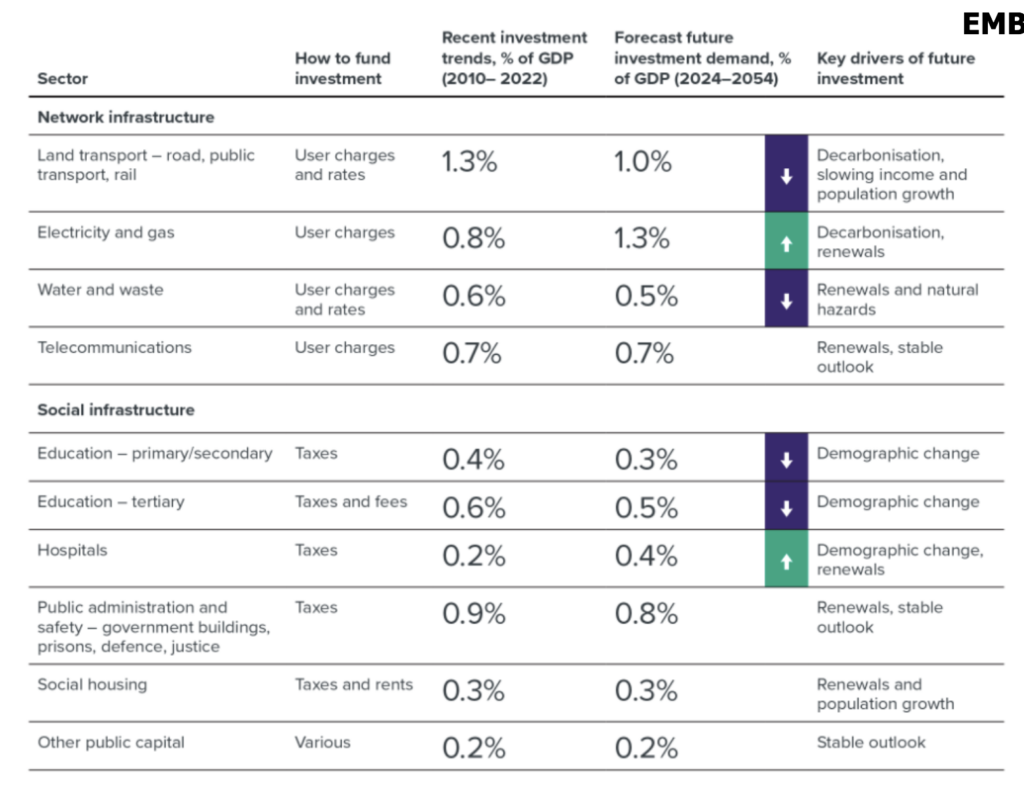
All said, the plan concludes that the annual NZ investment required – rising from just over $20 billion today to more than $40 billion by the 2050s – can be met with a 6% of GDP annual spend over the next 30 years, commenting: “This is within the bounds of what NZ has been willing to invest in the past.”
Which leave me totally confused: Then how did we get into this infrastructure mess in the first place, widely acknowledged to be a key constraint on NZ’s economic productivity?! The story has been all about under-investment. The report’s comfortable assessment of future affordability is totally dependent on the prediction that new drivers of investment need will in fact “slow overall”.
Good luck to my 32 year-old daughter with that intergenerational prediction!

Something NZ is really good at – put off till tomorrow – and now the effects are being indicated in all areas of infrastructure – so now our children and grandchildren will have to pick up the pieces (and the costs) because our generation and those before us just dithered around and decided to procrastinate about making an actual decision (deciding not to do anything is not a valid decision!). Maybe our wonderful government could make a decision to just go ahead and start work instead of waiting for the next government to decide and so on ad infinitum. It has to be done so get off the collective backside and start and forget stupid party politics which is just an anchor on progress.