


[As published in July/August 2026 BayBuzz magazine]
Beyond the business-as-usual matters of finalising budgets and rates and delivering basic services, the chief areas of focus are council reorganisation, consolidation of water services, and water security. In each of these areas, most of the current activity is out of public view.
Amalgamation
Yes, it’s time to bring back the ‘A’ word! Because that’s what will happen. Given the stance of the Government, our elected officials will come up with an A-plan for Hawke’s Bay by 9 August or have one imposed. A new structure will be in place with its elected seats to be contested in October 2028.
Although some laggards amongst the voting public might still be fretting over whether to amalgamate, our current elected mayors and councillors know and accept that the only issue on the table is how.
Even the mayor of Napier, that bastion of parochialism, concedes that change is coming. In a June column for BayBuzz online, Mayor Richard McGrath wrote:
“It is tempting to say that bigger might not mean better, but this kind of talk too early risks closing the door on regional options that could benefit Napier in some areas. There is a lot of analysis and many discussions underway. The Government is driving change in local government regardless and part of our role as elected representatives is to lead the community through that change thoughtfully. We mustn’t fall into becoming entrenched in one particular position before the options and trade-offs are fully understood.”
That’s revolutionary thinking from a Napier mayor, but Napierites can be assured that their mayor hasn’t lost his commitment to localism. As he concluded: “Structures might change and organisations might grow but whatever comes next local voices must not be lost in the process.”
And indeed preserving appropriate local voice, access and decision-making authority is a – if not the – top concern expressed in public consultation the councils have undertaken on reorganisation. It is a ‘condition’ each of HB’s four mayors is committed to. The trick will be how to embed the right level of ‘localism’ in the new structure without compromising the objectives of regional amalgamation.
As for structure, a number of possibilities exist in theory, given that one requirement from the Government is that any plan submitted from a region must cover a majority of the region’s population. For Hawke’s Bay, those options would all need to include Hastings District plus either or both of Napier and CHB, with Wairoa rounding out a four council consolidation. But theoretical options aside, the practical reality is that the Government expects unitary authorities to be born.
So – localism aside – what other key issues will need to be addressed?
[You can re visit the starting positions of our councils on these issues in our Mar/Apr article, Simplifying local government.
Obviously with consolidation comes the actual composition and vote weighting of the resulting unitary body. How many councillors, their electoral boundaries, what lower level decision-making or advisory boards, what consolidation of other council-controlled entities, will councillors’ voting be weighted? A heap of boxes and lines to connect.
Leading to another potentially vexing representation issue – Māori participation. The Government is legislating to bar non-elected members of councils and their committees from voting status. This in addition to HB’s recent referenda that uniformly opposed dedicated Māori seats on our councils, requiring their disestablishment. At the same time, and apart from overall Treaty obligations, other statutes mandate specific Māori participation in various areas, including voting power in the case of HBRC’s Regional Planning Committee. What becomes of all of this – a reversion to ‘advisory’ participation?
Māori leadership at every level across NZ is deeply concerned about where local reorganisation will lead. It may be that this aspect of reform will need to be resolved directly between the Crown and Māori leaders, with new unitary authorities simply following suit.
Adding complication, recall that existing regional councils are to be abolished. But that leaves their key functions – from regional transportation to environmental protection – to be absorbed into and undertaken by the new unitaries.
Assuming environmental protection remains a priority for regional government, how the relevant consenting, monitoring and enforcement roles are housed (with required independence) within the new structure must be sorted. But at least in this regard we have effectively working existing models – like Gisborne – to guide us.
That leaves the issue of rates, assets and debt – ranking right up there with localism amongst the anxious public. Of course, a huge portion of debt and costs will be taken from councils and the new unitary by the offloading about to occur of councils’ water services. I’ll come to this next.
But that offload aside, there’s still the need to re-prioritise, re-price and re-allocate payment for the services the new body will provide and the debt it will inherit and initiate going forward. Plus reorganise the merged (and lowered?) staffs, assets and operations required to deliver the ongoing services the public expects.
Everyone will be watching over the fence suspiciously, worried that they, their community, their very generation might be taken advantage of. It’s not clear we have the level of civic education needed to survive this.
The complexity of all the issues above, which compound each other, means that the amalgamation plan put forward by our mayors will be very high level. We should not expect to see (nor does the Government) on 9 August a detailed blueprint for a new unitary authority. Either the HB process will collapse or our councils will have crossed the Rubicon together and we will see the bare bones of a unitary authority outlined.
With their plan, the councils must to some degree show that it will satisfy these Government assessment criteria:
• Be deliverable by the 2028 local elections
• Support the Government’s new planning system (embedded in other reform legislation)
• Simplify governance
• Achieve economies of scale
• Provide far and effective local representation
If the submitted plan is approved by the Government (they say pre-November election), then the nitty gritty work will really begin.
Water services consolidation
Moving on parallel and faster track is Local Water Done Well, the other local government reorganisation set in motion by the Government.
You’ll recall this initiative involves Hastings, Napier and CHB consolidating into one entity – the Water Services Council-Controlled Organisation (WSCCO) – all planning, financing and delivery of drinking water, stormwater and wastewater services. In fact, the bulk of what these councils do. Wairoa has opted out, but presumably would be absorbed back in if all councils amalgamate.
WSCCO is set to become operational from 1 July 2027, and will deliver these services for a combined population of 144,000, managing approximately 52,000 water connections. The entity is owned 45% each by HDC and NCC, and 10% by CHBDC. This business is expected to make $1.25 billion in capital investments through FY33/34, with a projected operating budget of $173 million and debt of $863 million in that year.
Everything you could possibly want to know about the water systems of these three councils can be found in their combined Water Services Delivery Plan, prepared for the Government in September 2025.
WSCCO is now incorporated and the vital detailed work of organising the transfer of all pertinent staff, assets, liabilities, revenues, consents, contracts, information systems, asset management plans and land from the three councils into the new agency is underway. Councils have budgeted $14.2 million for the transition.
We’re talking about the transfer of around $2.4 billion in assets here.
If you imagine this as amputating the legs off of each council, hard enough surgery itself, the surgeons must then sort out how the rest of the council body survives! Council rates will need to be downsized, the WSCCO will be charging us for water services. Remaining council roles, overheads, space etc need to be re-allocated … maybe even down-sized.
A heap of transitional work for both the new agency and the three councils … while the latter are also preparing for their further consolidation shortly to follow. Consider it a learning experience.
Moreover, apart from these ‘logistical’ details and changes, the three councils yielding to the WSCCO will also need to promptly negotiate amongst themselves the formal ‘Statement of Expectations’ they must deliver collectively to WSCCO regarding the priorities they want to see the agency deliver against. This will be an illuminating test of high stakes political collaboration amongst the councils … a preview of how they will sort the politics of broader amalgamation.
Water security
Of course we cannot talk about water in Hawke’s Bay without talking about water security.
Around Hawke’s Bay, ‘water security’ has different meanings. To some, it means living and growing food within the limits that nature provides. Some stress curbing demand and better managing the available water before seeking to augment or store additional supply (I’m in this camp). Others jump right to water storage as the only guarantee of the region’s agribiz growth and broader prosperity.
Advocates of the latter path capture the spotlight these days, with two competing water storage proposals.
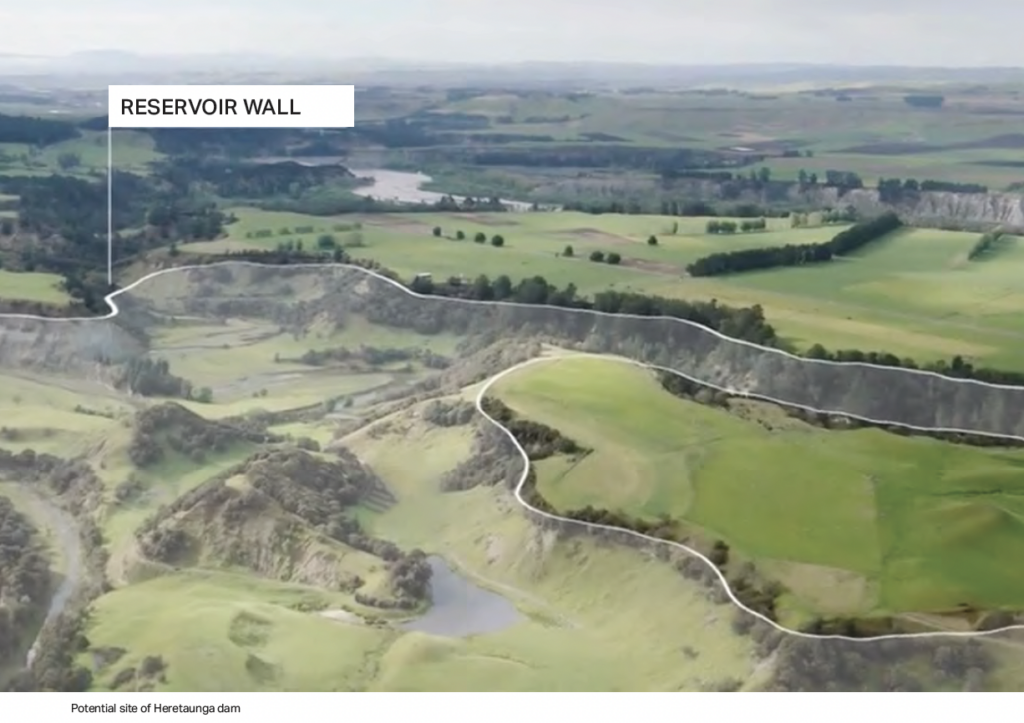
One, the Heretaunga Water Storage Project (HWSP) would dam a tributary of the Ngaruroro River, storing around 27m3 of water and service the population and growers of Heretaunga Plains. As conceptualised, one-third of the stored water would protect current growing practices on the Plains, one-third would be allocated to projected growth, and one-third would serve as a reserve anticipating future climate change and more frequent and/or longer dry spells.
The other, the Tukituki Water Security Project (TWSP) is the resurrected Ruataniwha Dam 2, which would dam the Mākāroro River (thence flowing into the Waipawa, then Tukituki Rivers). Storing about 100m3, its advocates say it can service CHB and also deliver significant water to Heretaunga users.
The HB Regional Council, burned on Ruataniwha Dam 1, has washed its hands of dam building, but allocated $3.6 million to explore the feasibility of a Heretaunga storage scheme, turning that investigation over to the purpose-created Heretaunga Water Storage Limited, whose board includes iwi, grower and council representation (from HDC and NCC). Geotech, cultural, environmental, and financial examination has been underway since early 2025. BayBuzz understands that this group is now ready to file a fast-track application to proceed.
That said, not all potential water users on the Heretaunga Plains are convinced a dam is needed, citing other options like global consents (i.e., basically smart water sharing), irrigation efficiencies, aquifer recharge, and industrial wastewater re-use (or storage). And certainly not needed at any cost. A grower-led group, Heretaunga Sustainable Water, has been investigating the full portfolio of options for enhancing water availability.
A critical driver of these Heretaunga water explorations is the unresolved TANK plan change, still on appeal to the Environment Court, which has capped water allocation in this catchment (permitting no ‘new’ water) and set in motion clawback of current consents.
Meantime, the Tukituki Water Security Project, led by CHB farmer and Scales Corp chair Mike Petersen has secured $21 million in Government funding to establish the feasibility of Ruataniwha Dam 2 (this on top of HBRC’s original $20 million investment in Dam 1’s failed exploration). Dam 2 already has fast-track status, however extension of the original consents given back in 2015 is under High Court challenge from Forest & Bird.
The most attention-grabbing aspect of the new Tukituki scheme is its plan to deliver Mākāroro-sourced water to the Heretaunga Plains (via pipeline from the Mākāroro to the Ngaruroro).
Given that the Regional Council’s Regional Water Assessment (2022), the bible for all water storage advocates, postulated in its most touted scenario a water shortfall of nearly 25m3 of water by 2040 and nearly 33m3 by 2060 for all of Hawke’s Bay, it would appear the Ruataniwha Dam 2’s 100m3 threatens to – dare I say it – flood the region.
Since Dam 1 failed to secure its required number of water purchasers by a wide margin (failing to meet the 46m3 condition set by HBRC), Dam 2 desperately requires a footprint (i.e., user base) much larger than the original ‘command area’!
What must be said about both projects is that neither has yet tabled any current cost estimates for their schemes (including financing scenarios) – and therefore the water prices they would need to charge water users – whether those be irrigators, councils (e.g., drinking water) or industrial users. The Heretaunga project says it will deliver the needed costing and pricing numbers in the last quarter of this year. The Ruataniwha team says it can do so as well.
After all the skirmishing about ecological damage, environmental flows, iwi issues, dam design, gravel in-fill, land swaps, and geotech safety, the fate of either dam (let alone two) will come down to the cost of water and the terms of purchase for water users.
Until those numbers are on the table and survive potential user scrutiny, both dams are blue sky fantasies.
Despite a MOU between the competing projects to play nicely and share information, when the numbers are finally tabled the battle of the dams will really begin.
