

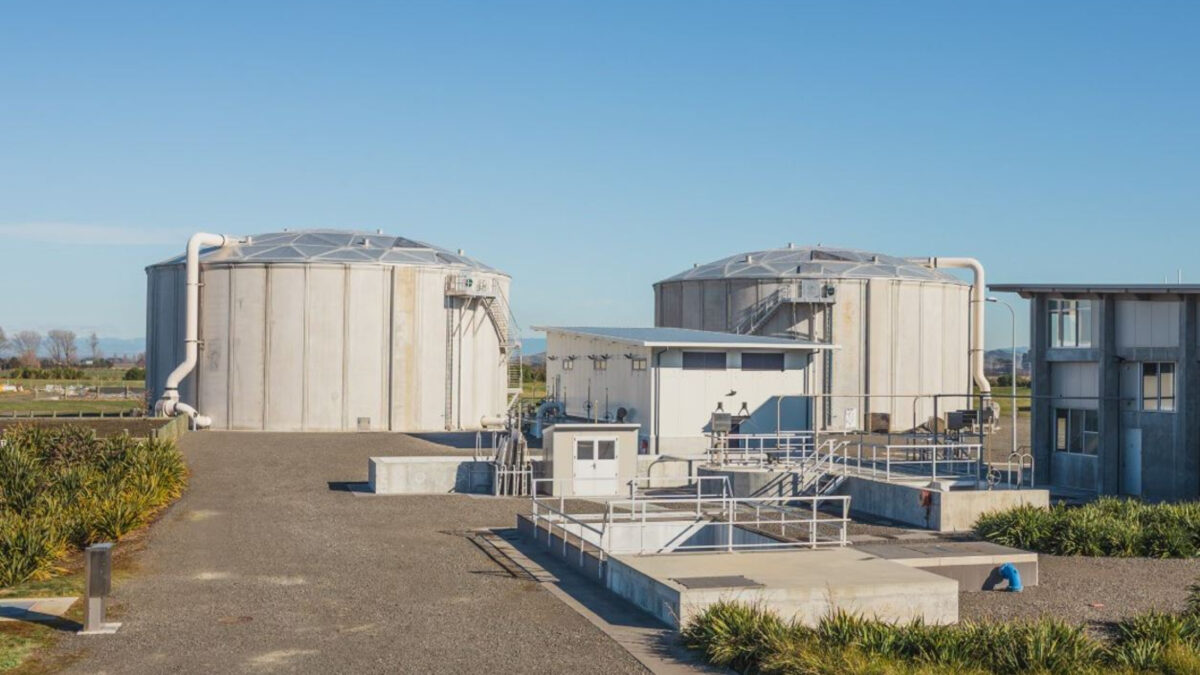
The Napier City Council is conducting a review of its current wastewater management system, looking ahead to the probability that present treatment practices will not satisfy tighter health and environmental standards.
The review includes public consultation, with that window ending 10 August.
Both Napier and Hastings use the same approach – initial screening of incoming wastewater, then biological filtering that breaks down the waste and kills certain pathogens, then UV exposure, then passage over ‘sacred stones’ to pacify Māori cultural concerns, then pumped out to Hawke Bay, where the remaining effluent is expected to diffuse without harming the marine environment, fouling kai or washing up on shore causing human health concerns.
This doesn’t always work! Especially when a cyclone floods the treatment plant or the discharge pipe into the Bay breaks down (as is now the case, presenting NCC a $40 million repair bill).
It seems both Napier and Hastings should be aiming for a higher standard of treatment.
So BayBuzz’s virtual staff at ChatGPT was tasked to assess the situation, comparing HB’s current approach to international best practice. Here is their conclusion:
“Hawke’s Bay’s practice is well behind international best practice and behind NZ’s own environmental aspirations. ‘State of the art’ today means treating wastewater not just as a problem to dispose of, but a resource to recover, with minimal ecological harm and often zero liquid discharge to natural waters.”
I’ll provide more detail below, but it is worth noting that management of HB’s wastewater treatment and discharge will be placed in the hands of the anticipated new regional water entity that our councils are on the verge of recommending to an eagerly-awaiting Government.
Presumably, NCC’s review will become actionable ‘grist’ for the new entity. And also presumably, whatever approach makes sense for Napier would also apply to an upgrade of Hastings’ approach, given their equivalent circumstances. Wastewater treatment for CHB and Wairoa would be an entirely different proposition, given scale and population dispersal issues.
In any event, our ChatGPT staff estimates that for a single system serving a community the size of Napier–Hastings, upgrading to a state-of-the-art wastewater treatment system would likely fall in the range of $150 million to $300 million, depending on the technology and level of treatment desired. Of course the sky’s the limit (or not!) – some systems yield potable water (Perth, Orange County and San Diego California, Windhoek Namibia)!
Here, at no cost, is the assessment as far as we took it (believe me, AI could serve up something far more detailed and technical). I wonder what Beca or Stantec would charge for a desktop analysis?!
Briefing Document: Hawke’s Bay Wastewater Treatment vs. International Best Practice (2025)
This document compares current wastewater treatment practices in Napier and Hastings with internationally recognised best-practice standards in 2025. It is intended to inform discussion on potential upgrades and the environmental, cultural, and public health implications of the current system.
1. Treatment Comparison Table
| Treatment Aspect | Hawke’s Bay (Napier/Hastings) | State-of-the-Art Practice (2025) |
| Primary Treatment | Screening & sedimentation | Same, but enhanced in some systems with microscreening or flotation |
| Secondary (Biological) Treatment | Trickling filters (older, moderate performance) | MBR, MBBR, or IFAS: high-efficiency and compact |
| Nutrient Removal | None (N and P discharged offshore) | Full BNR (biological nutrient removal) or chemical stripping |
| Disinfection | UV disinfection | Advanced UV, ozone, or AOP (Advanced Oxidation Processes) |
| Tertiary Treatment | None | Sand/cloth filters, membrane filtration |
| Microcontaminant Removal | None | Activated carbon, ozonation, nanofiltration |
| Sludge Management | Stabilised sludge applied to land | Anaerobic digestion, phosphorus recovery, energy production |
| Discharge Method | 1.8 km offshore pipe into Hawke Bay | Land-based disposal, wetland polishing, or water reuse preferred |
| Water Reuse | None | Reuse for irrigation, industrial processes, or potable supply |
| Energy Efficiency & Automation | Limited automation | AI-driven optimisation and potential for energy-neutral operation |
| Cultural/Environmental Alignment | Disputed, often in conflict with Te Mana o te Wai | Designed with community and cultural values in mind |
2. Summary Assessment
| Dimension | HB Current System | State-of-the-Art |
| Environmental Impact | ⚠️ Moderate to High | ✅ Low |
| Resilience & Reliability | ⚠️ Moderate | ✅ High |
| Cultural/Public Acceptance | ⚠️ Often contested | ✅ Inclusive by design |
| Long-Term Cost Profile | Lower upfront CAPEX | Higher upfront, lower OPEX over time |
3. Key Observations
- Hawke’s Bay’s use of trickling filters and offshore discharge is increasingly outdated by both technical and cultural standards.
- Advanced systems now treat wastewater as a recoverable resource, aiming for zero discharge and energy neutrality.
- The current system is likely non-compliant with future expectations under Te Mana o te Wai and evolving regulatory standards.
4. Recommendations for Consideration
- Commission feasibility study for MBR or BNR-based upgrade.
- Investigate potential for land-based disposal or wetland polishing systems.
- Explore regional water reuse initiatives for agriculture or industry.
- Engage mana whenua and community early in upgrade planning.
Estimated Capital Costs for Advanced Wastewater Systems (175,000 population)
| System Type | Estimated Cost (NZD) | Notes |
| Conventional Upgrade (BNR + UV) | $100M–$150M | Brings system to modern compliance (nutrient removal, disinfection), no reuse |
| MBR System (Membrane Bioreactor) | $180M–$250M | High-quality effluent, small footprint, suitable for urban areas |
| MBR + Tertiary Polishing + Reuse Ready | $220M–$300M+ | Enables irrigation, indirect potable reuse, future-proofed |
| Land-based Disposal (wetlands or infiltration) | +$20M–$60M (add-on cost) | Often combined with above systems; land availability a factor |
| Ongoing O&M (Operational Costs) | ~$400–700 per household/year | Varies by system, energy needs, reuse potential |

Way past time for this to be looked at seriously by all local bodies. Dare I say, amalgamation is the way to go! Have one body, doing one state of the art system, guarding and improving our water supply/treatment/disposal using best practice to ensure we continue to survive as a species. Allowing this vital resource to continue to deteriorate is basically a suicide option!
In 1984 I formed a lobby group called the HB Clean Sea Coalition when I woke up to the fact Hastings District Council was discharging raw sewage into the sea via a 3 kilometre long waste water pipe and also had a 500m long pipe which could be used in emergencies. Waste turned back up on the beaches regularly. Our objective was to encourage land based waste water disposal and when the council starting building their current plant beside the sea in East Clive I knew we had lost the battle.
Many cities and countries around the world don’t have an opportunity to dispose of their waste into the sea, thank goodness and have built environmentally friendly systems which treat their waste to a very high standard resulting in organic compost and water treated to close to drinking water standards for irrigation of forests. Japan’s systems are excellent land based models which cater for millions of people.
Building waste water treatment systems close to the sea is a cop out and certainly not fail proof.
Around the time of cyclone Bola I worked with a deep sea diver who was sent to check the 3km sewage pipe. He said beyond and around the end of the pipe it was a barren land. No sea life at all. He likened the area to being on the moon. I wonder it that has changed?
Does not address contamination from storm waste water. Other jurisdictions have decided to treat storm waste water as well as sanitary waste water. The annual mass contaminant discharge biochemical oxygen demand in a given urban area of storm waste water is similar to that in the same area for sanitary waste water. We ignore half of the contaminant discharge into the environment. The only way to restore quality of streams estuaries and the sea is to treat the storm waste water. Not included in chat GPT answer. Too bad. Of course cost of this activity would be significantly greater than the amounts shown.
Why stuff around with a water authority. Why not amalgamate all Council services under the umbrella of a Hawke’s Bay super city and get rid of the vision less, no hopers who are screwing ratepayers they are elected to serve.
It’s fun reminiscing about times gone by. Around the time of Ann Redstone’s ‘Clean Sea Coalition’, the council needed a new sewerage system, triggered by govt refusal for another 35 years of putting sieved sewerage into the sea.
I was part of a small group called W.A.S.T.E (Wise Action for Sewerage Treatment and the Environment) who submitted to the process. Discussion was public, and then disappeared behind closed doors. Next we heard the Biological Trickling Filters were happening. HDC won a prize for their ‘innovative’ Tangata Whenua Wastewater Committee. From memory, Tangata Whenua were not in favour of sludge being trucked to landfill, and the Papatuanuku Channel, along with a very basic Biological Trickling Filter System was decided on. Back then we thought it was short of a UV system and clarifier, used in similar systems overseas at the time. Too expensive they said.
Over the years, word of mouth reports from Haumoana surfers talk about the turgid water near the pipe outfall. And I see the earlier letter talking about the wasteland underwater near the outfall pipe. Sad. Out of sight, out of mind.
I’m thankful for the instructions from above that insist on councils lifting their game once more.
The only way forward into the future for Hawke’s Bay is to build UP to the minute proper potable, wastewater treatment, stormwater disposal infrastructure. With No duplication of specialist expertise staff et all.
IS THE AMALGAMATION OF ALL H B COUNCILS INTO ONE UNITARY AUTHORITY.
The petty parochial days of they stole the newspaper and hospital and we got the airport & Port. Need to be gone!
Together, I believe this province can do it.
And what about the wastewater’s contamination with microplastics?
This is the issue no-one seems to be addressing in their plans for future upgrades but which is becoming more and more important now that we realise the extent to which they poison the environment.