

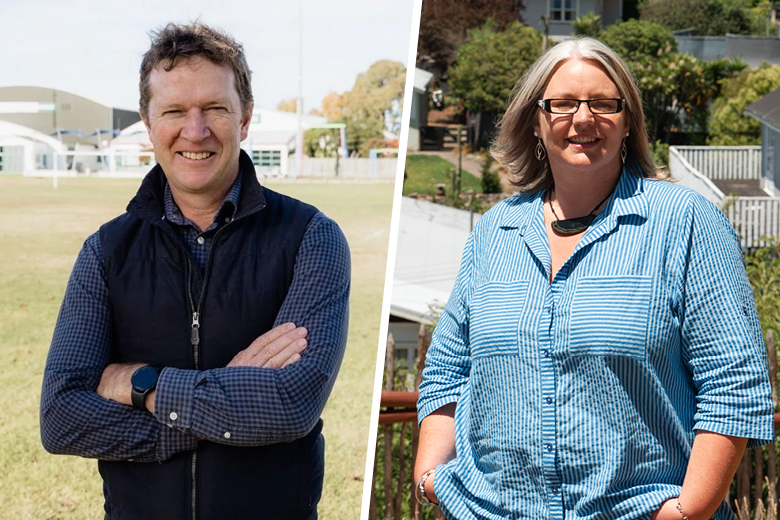
Mayoral challenger for Central Hawkes Bay Will Foley says there is a disconnect between ratepayers and the council.
Initially he thought the biggest issue for this year’s election was going to be rates pressures – roading and three waters – but as he started speaking to people, the bigger message was “to get that connection back”.
Yet, incumbent Alex Walker says the council has spent years crafting together what it means to be a successful district and how it operates as a council, based on the community voice.
“We fronted up to some pretty big challenges about how we grow and develop as a district and operate as a council. My leadership style is to be inclusive and to operate from a community led perspective and we have very clear community voice about what thriving looks like that we gathered a number of years ago. And as we navigated the emergencies [of the last few years], particularly Covid, that value set of what our community want and what success looks like, was really important.”
Despite the district plan announcing ‘Together we Thrive’, Foley argues instead that “no one feels together and no-one is thriving”.
Foley is a sitting regional councillor. He says it’s clear that the district voice and identity can get lost pretty quickly at the regional level, and he thinks that has happened at home too.
“I’ve visited all the retail shops in the streets, and some are saying they have never seen Alex in nine years. People aren’t feeling valued, respected, engaged or listened to. I run my own campaign meetings in the various communities and last night I was out at Porongahou. At the local hall, the committee was saying they wanted a tree cut down on the hall grounds. Council said they would have to manage and control it with their own contractors. But 18 months later it’s still not done, and they are saying ‘do they really care about us out here?’.”
“I have worked with Alex in the six years I have been in my regional councillor role and I know she gives the job 110%. It’s not about what she is doing wrong, it’s more about what I might be able to do better. But as I have gotten into the campaign and talked to more and more people, they are certainly bringing to my attention about how things can be better.”
Water infrastructure
The biggest example of the disconnect that he cites is the consultation that was put out for Local Water Done Well, which projected the cost to ratepayers rising from $2,500 to $7000 between 2024 and 2034, if the district went it alone on three waters.
Despite the fact that they later discovered a mistake in the modelling and are now rejigging the numbers with reduced capital investment to make it more affordable, Foley says if Walker was truly connected to her community she would have known not to go out with that number in the first place.
“If you go to the submissions and read them all, the majority all had a closing comment in which they said, regardless of how you do it, if that’s how much it’s going to cost, we are all going to have to leave town. She should have understood that that wasn’t going to be palatable from that start,” he said.
Foley, in his own submission was opposed to the plan for a regional water entity. He says the new entity would only make it slightly cheaper, assuming all the modelling is correct. But this is by the by, since the decision has been made to form a regional water entity and if he gets elected Foley is on that journey whether he likes it or not. However, he says that that there must be more risk management and staging around projects and ‘what if’ scenarios, less ratepayers are crippled by ballooning debt and surprise interest rate hikes.
Walker has said she backs herself as one-third shareholder in the new entity “100%”, if she remains mayor. She is an advocate for water metering to manage the extremes of drought and too much water that the region has experienced lately. She says the community needs to be smarter about how it manages its water pipe network.
“Particularly as we move to our new regional water services CCO. Metering is a really important affordability lever as well for our retired population – super-annuitants. Currently they pay the same as a family with three teenagers. Water meters are vital to make sure we have got fair and equitable access to affordable water,” she said.
Dam
On the contentious issue of Ruataniwha Dam 2, the business case for which central government has contributed $3 million, Walker says all tools are needed.
“Storage is not a silver bullet. The evidence shows more needs to be done to slow down water from leaving the land and going out to sea. But there are many things we need to be doing and storage is one key factor, particularly in a catchment the size and shape of the Tuki Tuki catchment. It is clear and logical that some level of large-scale storage is required to deliver the outcomes for the region that we need.”
Water is the “magic ingredient” to help the district make an economic step-change, and operating with the tap turned off for the last ten years has created perverse incentives, she says, including apple orchards being pulled up. “I don’t think that aligns to how we see our success.”
Foley was keen to see what the business case for Dam 2 revealed. “Those results will tell us if its commercially and environmentally feasible. It has been so much time [since we looked at this] that we really need an update of where those issues sit. So, let’s debate it when that report comes back.”
Amalgamation
On the question of amalgamation, Walker says the context has not changed that much since the referendum ten years ago.
“I don’t think we need wholesale amalgamation in Hawke’s Bay, but what we do need is a commitment to how we operate a different regional partnership model: like the water CCO. We can use it as a catalyst for how we do other things like that at a regional scale, while still maintaining our autonomy and identity and personality. I think it’s the most unifying and efficient approach for Hawke’s Bay.”
Foley, is also opposed to amalgamation, based largely on his experience in Regional Council. Voting power would be diluted and smaller voices lost. But he’s also not convinced CHB ratepayers get much from the organisations that they jointly fund.
As examples he cites the Hawke’s Bay Regional Economic Development Agency, which had a budget of $4.8 million over three years (the CHBDC contribution was $135,000 in 2025/26). Earlier this year, the whole board and the Chief Executive resigned en mass.
“They have employed a new board and Chief Executive, but it doesn’t feel like there is any discussion on why this happened, and we continue to fund it. Where are the results for our CHB? What are they achieving for us?”.
Other examples he questions are Local Government New Zealand (LGNZ) membership, which costs $55,000 a year plus attendance costs and fees, and more specifically the LGNZ initiative Council Mark, which undertakes three-yearly assessments of council performance at the cost of $35,000 a pop. Hawke’s Bay Tourism with an annual contribution of $75,000 and the Climate Joint Action Committee at $22,500 a year, are two more.
He supports regional partnerships, and is motivated in “getting in amongst regional leadership” to spend time, money and resources that achieve value for ratepayers.
But he gripes that regional mayors and chief executives meet with no transparency and no minutes available to the public. “We don’t know what they get up to and discuss. Hawke’s Bay REDA is probably the worst example because it had so much money spent on it. Just the building itself has run at a $374,000 loss for this year. So we are going backwards before we start. I’m not against working together but I just don’t think they are not achieving tangible outcomes right now.”
For Walker, regional relationships are important. Other councils, mayors, iwi leaders and even national relationships are the things that allow everyone to “move the big waka forward”. She says these were the key relationships that helped CHB to recover after the Cyclone. And it’s all that layered experience that she is offering.

Will Foley raises some valid points. From my perspective, there is a genuine disconnect between the Council and the broader community. Consultation appears to rely on a narrow group of familiar voices, which risks creating an echo chamber rather than capturing the breadth of views across CHB. That impression is only reinforced when the Chief Executive is seen to operate more as an extension of the Mayor’s office than as an independent leader providing balance.
The Mayor has cited Covid and the cyclone as explanations for delayed progress. While those challenges are undeniable, leadership is ultimately judged by the quality of decisions made during difficult times. The record of the past few years offers a strong indication of what we might expect should this leadership continue. If the community is satisfied with the status quo, then supporting Alex will ensure more of the same.