


The Rockit apple ship, home port in Hawke’s Bay, might be characterised today as taking on water in rough seas, with its revenue engine compromised and containers piled too high on the deck. All hands bailing water.
Or as Rockit would put it, we have a temporary imbalance with supply overshooting demand. But we’re getting it fixed, no danger of capsizing.
Rockit has about 950 hectares of trees planted in New Zealand, about 850 hectares of those in Hawke’s Bay (not quite 10% of HB’s orchard acreage and accounting for 10% of HB’s apples by variety, ranking tied for third after Royal Gala and Envy). So Rockit is a significant player in our region’s apple sector and therefore, if seen to falter, draws a heap of anxious attention.
And it has faltered, with its forty or so growers receiving much lower payouts over two years than projected (less than breakeven), to the point where one major grower syndicate (Rākete Orchards, with 55 hectares of Rockit in HB) has liquidated, while some other growers look to abandon ship or at least reduce their Rockit plantings. Compounding their revenue hit, growers must pay hefty license fees to grow premium Rockit apples, regardless of the payout. Good deal for Rockit’s cash flow, not so good for growers.
This has generated a spate of bad publicity for Rockit in the respected National Business Review, as well as the farming trade publications, with headlines like Rockit flight path needs a major adjustment, Rockit downgrades guidance, and Is Rockit headed for a crash landing?
So what ails Rockit and how are they responding?
It’s pretty straightforward. A few years ago Rockit was the hot thing, offering a unique premium-priced small apple in a tube, brilliantly merchandised. This in a sector where ‘commodity’ apples increasingly struggle to be profitable and growers are always in the hunt for new varieties that satisfy shifting overseas consumers’ tastes. I stress ‘overseas’ because that’s where 98% of our apples go – most to China, Vietnam, Taiwan, UK, India, Thailand, USA, in that order.
So growers leaped at the novel opportunity, with planting especially high in 2020-2021, with Rockit happily taking them and their license fees in – those trees coming to mature production levels now. Insert Covid upsetting global demand and supply chains, and foul weather affecting fruit quality, and you get to today’s oversupply. With Rockit unwilling to degrade its premium profile by unloading its branded apples at a discount.
What does ‘premium’ mean? At the Hastings New World, popular Royal Gala apples (by far NZ’s leading export apple) sell for $5.49/kg; Rockit’s Family Pack sells for $17.05/kg, and the brand’s signature 5-apple tubes cost even a bit more.
Rockit has been apologetic to its growers, acknowledging in the media poor planning that allowed supply growth to exceed demand cultivation.
I interviewed Rockit CEO Grant McBeath this week. He joined Rockit in September 2024, so he inherited the ‘supply/demand imbalance’.
He was both candid and bullish.
Regarding oversupply, he sees that as unfortunate but definitely temporary. I asked, “If I were to come to Rockit wanting to put 25 hectares in HB into Rockit apples, would you be interested?” “Yes, we’d have a conversation,” he replied. “Our sales are growing in every market we are in” (30), pointing especially to China. By the time my trees were maturely productive, Rockit would need them apples!
In the meantime, some current Rockit growers with land/businesses not particularly suited to Rockit, and/or less able to meet quality specifications, might be expected to exit. Meantime, much more intense focus on marketing and building consumer demand, looking toward a three-year turnaround.
I was curious about McBeath’s bullishness regarding continued growth in demand.
If there ever an ‘all your eggs in one basket’ food business, Rockit would seem to be a textbook example. They grow one single variety of apple, presumably with appealing colour, taste and texture. But its uniqueness – its competitive advantage – really stems from its small size, apparently preferred by a sufficient quantum of apple eaters.
There is no ready opportunity here for adding features to the product, or for brand extensions, the usual ploys to maintain and increase one’s consumer base, or up-sell to it.
But arguably, what Rockit lacks in product range or diversity it makes up for in world-class branding and merchandising – its super-creative multi-sized tubes and tubs (even a rocket ship in China), each presenting and embedding the distinctive Rockit brand.
No other apple is marketed directly to consumers that way.
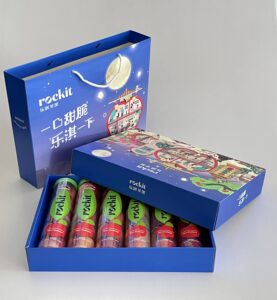
Pick up an apple in the store and it will say Jazz or Ambrosia or Envy – not Mr Apple or T&G or Bostock or Craigmore. The assumption is that the taste-seeking consumer can’t tell the difference between a Bostock or a T&G apple, but they do know a Granny Smith from a Red Delicious … and have a preference.
But with Rockit, it’s all about size-conscious consumers (not taste), and in 30 countries Rockit stands for size … small size.
Size matters, says Rockit! And they ‘bet the house’ on that unique selling proposition. No ‘Plan B’.
They don’t see the ‘small size’ preference as a passing fad. A top variety can have a 15-25 year strong market appeal. Nor do they fear a competitor for the ‘small size’ market. It would take 20 years or more for someone else to develop a Rockit alternative, introduce it to growers, plant the trees at scale, bring them into production and crack the market.
So it would appear premature to call Rockit a sinking ship. Apples in hand, Rockit’s fate is now more in its skill as a marketer than as a grower. Yes, consistent product quality must be ensured to support premium pricing, but that’s merely the price of entry. Survival requires consistently exceptional marketing creativity.
Think Apple versus DOS!

Call it what it is…undersized, overpackaged, overhyped, overpriced, bland tasting little apple.
I guess Thousands of Acres of tree’s will be uprooted or re-grafted, I wonder how many China stole and planted?!