

[As published in Summer 2025/26 BayBuzz magazine.]
A small revolution is unfolding in Hawke’s Bay’s rural communities – and its wellspring is the rise of Collective Catchment Groups.
You might say catchment groups are nothing new. But today, of 43 across southern, central and northern Hawke’s Bay, seven are big collectives with dozens, in some cases hundreds, of landowners and mana whenua working together to draw on significant Government funding to employ co-ordinators/leaders, tackle together issues like soil erosion, water quality, pest control – and foster resilient and connected communities.
“These collectives are having a huge impact on our rural communities,” says Richard Wakelin who heads up HBRC’s Integrated Catchment Management Group. “They are re-building community spirit, re-building a collaborative approach to shared resources and giving confidence to landowners to make the changes they need to – even if it’s something as simple as taking the first step in laying a trapline or selecting the right native plants for riparian planting.”
Adds director of environmental company thepa.nz, Tipene Cottrill, who has worked across two catchment collectives, “These groups are getting stuff done and on a big scale.”
Catchment Collectives began in Southland more than a decade ago with dairy farmers coming together to tackle regulatory issues. Now catchment collectives have sprung up around the country and in May this year the Government signalled its ongoing support for catchments committing $36 million over four years through MPI’s On Farm Support team.
Hawke’s Bay’s first big collective was The Pōrangahau Catchment Group formed in 2019, encompassing almost 88,000 hectares and quickly becoming a recipient of a $2.1 million Freshwater Improvement Grant from the Ministry of the Environment to support and develop projects benefitting the health of its water bodies.
By 2022 other large catchment collectives – the Guardians of the Ruakituri River (35 kms north of Wairoa), Tukituki, Karamu, and the catchment between the Tutaekuri and Ngaruroro rivers – were starting to form in our region. Cyclone Gabrielle underlined their importance and they have been joined by the the Kaweka Community Catchment Collective and Ahuriri Tributaries Catchment Group Trust.
Encompassing the Tutaekuri and Mohaka river catchments, the Kaweka Community Catchment Collective comprising 64,587 hectares, incorporates Dartmoor, Rissington, Patoka and Puketitiri hubs which were created after Cyclone Gabrielle. As well as huge farmer support, the Collective is engendering rural community with offerings as diverse as Box Fit classes, a Red Cross workshop and Vegetation Fire training.
Between Two Rivers Community Catchment Collective (B2R) takes in the land between the Ngaruroro and Tutaekuri Rivers and became vital for farmers and mana whenua (including the communities of Ōmahu, Moteo, Waihohiki and along Taihape Road, downstream from Pukehāmoamoa) in the wake of Cyclone Gabrielle.
Now B2R is run as partnership between mana whenua and the wider community.
“B2R is a bit special,” says HBRC’s Wakelin. “Right from the start it has engaged with mana whenua and formed a co-governance and co-leadership model.”
Trish Nuku, from Ōmāhu Marae has been involved with B2R from the start. She says “by embedding tikanga and mātauranga Māori into decision-making, B2R has built trust, respect, and a shared purpose among mana whenua, farmers, and agencies. We see our community as the beating heart of effective catchment action.”
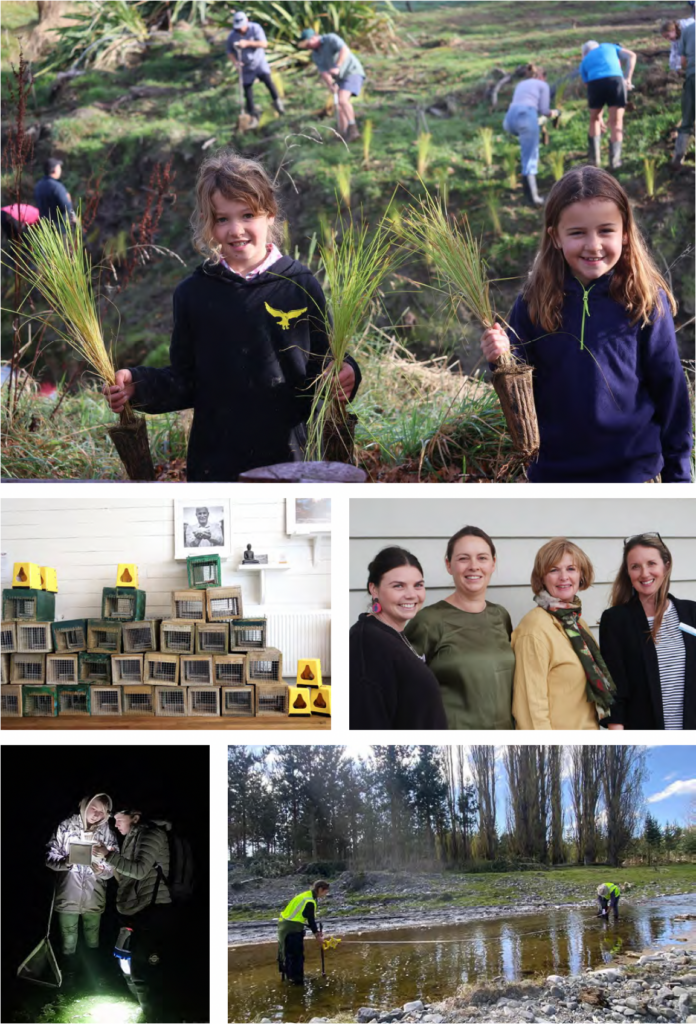
B2R has secured significant funding from MPI, the Cyclone Gabrielle Appeal Fund, Eastern and Central Communities Trust and NZ Landcare Trust among others. It initially worked to future-proof community halls, distribute fencing materials and help with post-cyclone recovery activities. Now it has numerous projects underway, including a partnership with Hunt for Good to address the feral deer problem and run wānanga on how to break down a deer carcass and distribute meat to the community. Another project is focused on water quality in Lake Rūnanga and is trialling floating wetlands with help from local schools.
The biggest catchment collective in HB is Tukituki Land Care (TLC) which was set up in 2022 bringing together 17 sub-catchment groups made up of 824 landowners covering 250,000 hectares. Its boundaries span from the Makaroro in the Ruahine to Takapau and down to the lower Tukituki Corridor coast at Haumoana.
Calling itself “A cohesive voice for the land”, TLC was funded by MPI in 2022 to the tune of $900,000 over three years, enabling it to pay contractors to support the sub-catchments and to employ Michelle Goodman from Tukipo to be the overall Collective Catchment Coordinator.
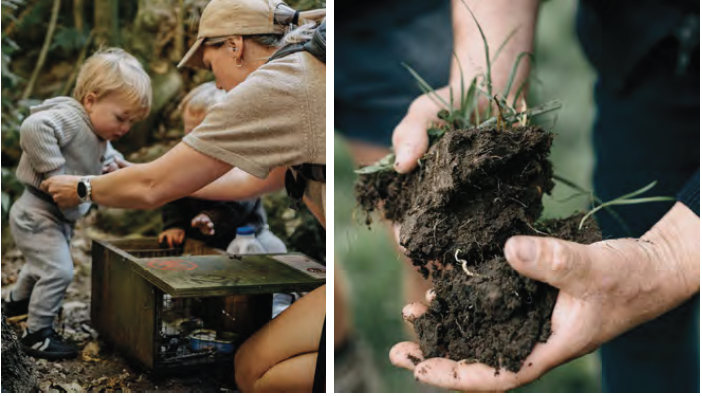
TLC manages basic administrative tasks for the whole collective such as funding applications, health & safety policies/issues, setting up incorporated society status. It also engages with farmers across the collective, bringing them an awareness “of how to maximise land use potential for their farm”. It recently ran a ‘Poplar Pole Workshop’ to teach farmers how to establish a nursery and grow the right poplar poles to help combat erosion. A Trap Library with 400 free-to-borrow traps has also just been launched.
Another TLC initiative is THR3E – a project which asks all landowners within the collective to come up with three environmental changes on their farm over three years. “It could be something small like cleaning up a yucky ditch and planting it, or it could be big,“ says Goodman. “We want farmers to set achievable goals that contribute to healthier land and waterways.”
The Tukituki Catchment has finished its initial three-year funding from MPI and now has “Lights on Funding” to June 2026. “We’re waiting for a Government announcement on more funding in February 2026,” says Goodman. “In the meantime we’ve got momentum, we’ve got people on board and we’ve got energy to keep going.”
In October HBRC held its third one-day Regional Catchment Support Forum in Hastings showcasing funding, HBRC workshops and support catchment groups can draw on. It was an important networking day with as many men as women involved, and after talking with several women it became clear to me the catchment collectives are revolutionising the way rural women can be involved in their communities, for some even employment.
One of these is Angela Mackie, who is the manager/administrator for the Ahuriri Tributaries Catchment Group Trust (ATCGT), which spans 9,000 hectares, nine farms and about 1,100 life-style blocks.
Angela lives in Puketapu and has an eleven- and eight-year-old and says her part-time paid role fits perfectly with being a mother. She is passionate about making a difference in her catchment too, even if it is something small like helping to change the quality of a stream’s trickle into the Ahuriri estuary.
“There is real merit in catchment groups connecting people,” she says. “I love getting out on the ground and doing things, getting to know the cultural side of my area and learning about Mana Ahuriri and Wharerangi Marae’s involvement.”
Rachel Lyons, a former events manager, is now Catchment Project Manager for the Karamu River Catchment Collective (KRCC) which she describes “as one of the most complicated and diverse catchments”. It takes in rural and urban areas over 96,920 hectares and runs from Mangatahi, Maraekakaho and Kereru, down to Lake Poukawa, Peka Peka wetland, passed Mangaroa Marae, Twyford and to the Karamu Stream weaving its way through Havelock North towards Clive.
Although the KRCC was formed in 2021, it is only getting up a head of steam now with $900,000 in MPI funding announced in May, to be delivered in tranches through to 2028. At the Committee’s AGM in August, Chair Willie Lyons announced strategy and funding opportunities. Already a project behind Mangaroa Marae cleaning up the Paritua Stream has been identified and there have been talks with Hastings, Havelock North Forest & Bird to help with planting projects on the lower and upper Irongate Streams.
In February 2026 there will be a special meeting to set up a skills-based Kaitiaki Board to ensure the right knowledge is at the table.
“The Karamu catchment is a resource-rich economic powerhouse, positioned at the heart of Hawke’s Bay’s highly productive land,” says Rachel. “In a time of uncertainty around water security and the upcoming TANK plan changes, KRCC has a unique opportunity to lead grassroots-driven, sustainable change that delivers enduring benefits for both the community and the environment.”
And that’s right on task with the Collective Catchment “revolution”, so watch this space.

Great to see this happening – we’ve been involved in the past with plantings and clean-ups and it’s very satisfying (and you get to see areas that you’ve never thought of before)