

The Environment Court recommendation is in, we’re now just a Ministerial decision and a Royal Assent away from a Water Conservation Order covering the whole of the Ngaruroro River. But what does it actually mean, will it make a difference and what can we conclude from it?
Back in 2015, a group of parties led by Fish and Game applied for a WCO over the entire length of the Ngaruroro, from mountains to sea. The move had been over 10 years in the making and came part-way through the TANK (Tūtaekurī, Ahuriri, Ngaruroro, Karamu) community limit-setting process. Fish and Game’s motivation was, in part, to preserve the near-pristine water condition, wild & scenic character and fishing conditions of the upper reaches of the river. They also dreamed of a slew of new WCO’s across the country on the back of a Ngaruroro precedent.
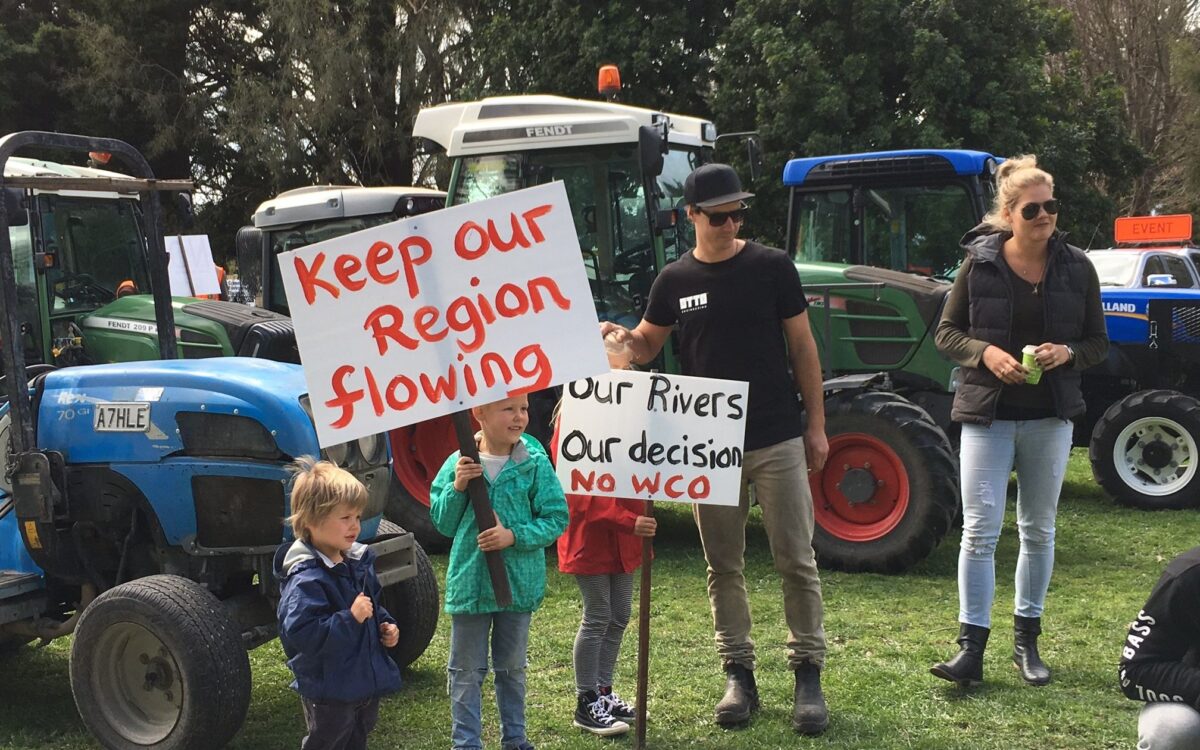
At the instigation of Baybuzz Editor Tom Belford (then TANK Group member and Regional Councillor), a bunch of environment and agriculture sector reps met at Bostock Kitchen to see whether any compromise or cooperation would be possible. Various camps emerged. HBRC Chairman Rex Graham vehemently opposed any Order, as did a high-profile grower group championing “Say No To The WCO”, with attendant billboards and tractor rally. Fish and Game & partners were unmoved.
Eventually HBRC would arrive at a more neutral stance, but not until the 2019 Special Tribunal hearings that gave rise to a decision in favour of an Order, followed by the Environment Court appeal. Winegrowers took a nuanced stance, not objecting to an Order for the upper part of the river but noting the devil in the detail.
So what is a Water Conservation Orders and how do they work? WCOs are a protection mechanism set out in Part 9 of the Resource Management Act 1991. Anyone can apply for one. The key test for granting a WCO is whether any nationally outstanding amenity or intrinsic values exist for the waters. All any Order can do is preserve the existing state of those values. In other words, maintain things as they are.
So what will the new Order do? Essentially, it will prohibit damming and lock in the existing ‘natural’ state in the mainstem of the river and in the tributaries above the Whanawhana cableway – the point where the river spills out of its gorge into the top of the Heretaunga Plains. Below Whanawhana, where the river is significantly altered by human activity and farming inputs, mainstem damming will be prohibited and the existing Fernhill 2,400L/s low-flow water take cutoff mandated. Existing use rights are unaffected but HBRC remains free to enact higher standards.
There is no doubt that the WCO introduces another level of protection and control on the state of the Ngaruroro, an additional complication for HBRC to take account of and an additional stick to potentially be beaten with. But does it make any difference to protection of the river in practice? The answer, in my opinion, is no.
By the time the Ngaruroro WCO application was filed in 2015, the second iteration of the NPS-Freshwater Management was in play, which already featured the ‘maintain or improve’ imperative that was intended to ensure no further degradation of water quality nationally. Beyond that, two Environment Court decisions – the infamous ‘King Salmon’ case and Ngati Kahungunu’s successful HBRC Plan Change 5 appeal – had already ushered in a much more protective tone to environmental controls. So by 2015, the ‘existing state’ of the Ngaruroro, in the tender hands of the TANK community process at that time, was already guaranteed.
Time and the law march on. The Labour Government’s Essential Freshwater Package and with it, in 2020, the fourth and current iteration of the NPS-Freshwater Management, introduced a whole new decision framework for water – Te Mana o Te Wai – putting the mauri of water and its intrinsic ecological qualities firmly as first priority. Arguments and appeals currently swirl around the TANK Plan – some modest attempts at clarification or minor amendment, others more fundamental. But there is zero chance of any change allowing the Ngaruroro to deteriorate.
So what can we learn from all this?
Firstly, that the existing state of the Ngaruroro, already relatively assured at the time of the WCO application, is now assured multivariously via the new WCO itself, the TANK Plan and the NPS-Freshwater Management.
Secondly, that in the contesting over water, rhetoric to enflame passions and entrench positions is not in short supply but matters little compared to a detailed understanding of the law and results only in huge waste of time and resources.
Thirdly, that the real challenge for Hawke’s Bay is not to litigate existing-state bottomlines for waterways but to agree as a community on a pathway to improving their condition under the new Te Mana o Te Wai framework, whilst making our community stronger, more united and more climate-resilient. Whatever that looks like.
Xan Harding is a current HBRC Councillor and previous water advocate for the Winegrowers. These opinions are his own.
