

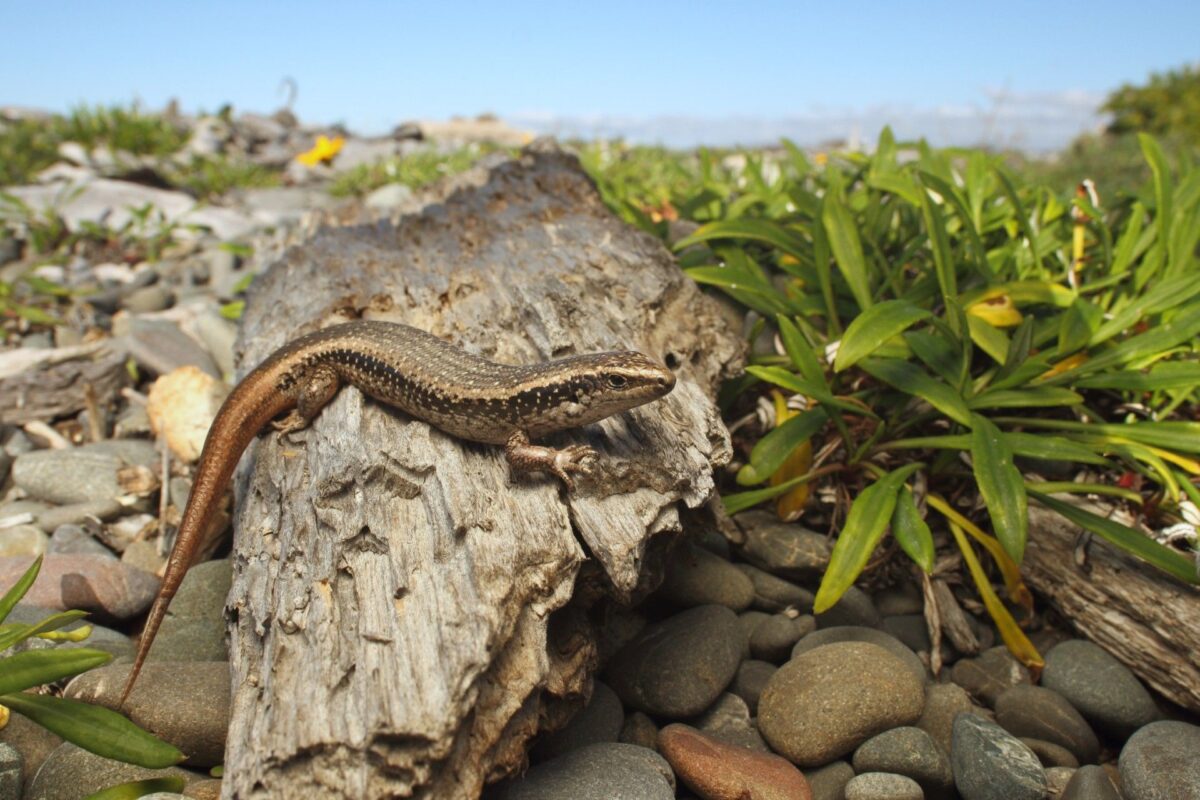
There’s a Skink Squad in Hawke’s Bay on a mission to save one of the region’s last known native colonies.
The squad is made up of experts from Biodiversity Hawke’s Bay, the National Aquarium NZ, Department of Conservation, Napier City Council and Hawke’s Bay Regional Council.
Acting general manager of the aquarium Joe Woolcott said someone in the group came up with the “light-hearted” name and it had stuck. “We’ve got people who have been involved with the relocation of the skinks over the last few years as we attempt to understand more about the population and essentially what the best thing to do with them is.”
He said the predator-proof northern spotted skink sanctuary built by the Napier City Council along Marine Parade in Napier was the best outcome for the rare species.
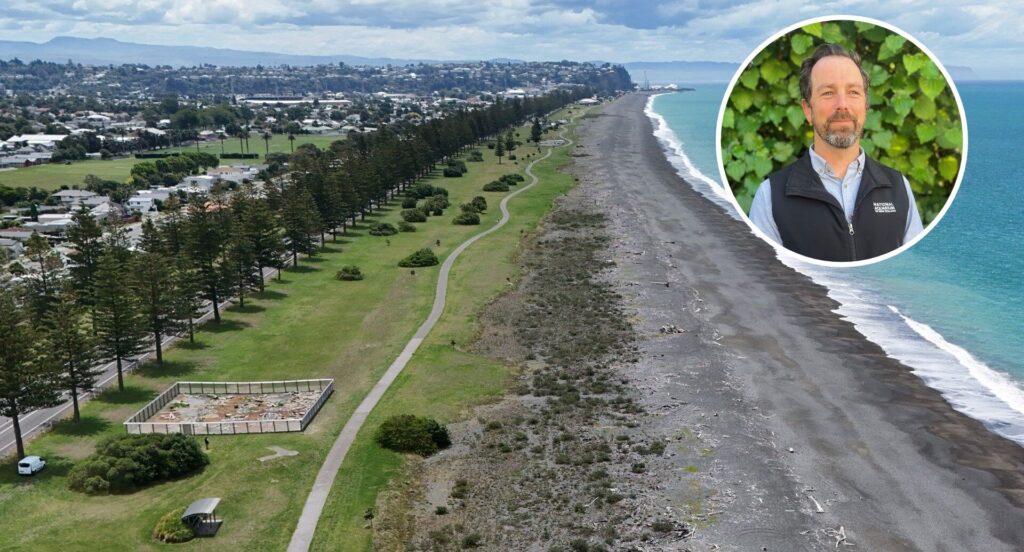
Four adult skinks, two males and two females, were the first to be relocated from the Napier foreshore in April.
The skinks, which are protected under the Wildlife Act (1953), were being moved in preparation for a $37.4 million stormwater infrastructure project between Maraenui and Te Awa to help prevent future flooding events and allow 400 new Kāinga Ora homes to be built.
Woolcott said a combination of techniques was used to capture the skinks, including visual and hand searches. “There’s also trapping, which basically involves a lure and a container that the skinks can walk into but can’t walk out of.”
He said they could be hard to spot and they moved fast. “They’re quite agile, and they can jump as well. So, that’s quite a challenge to try and catch them.”
Staff have spotted the skinks basking in the sun from outside the enclosure and feeding on insects, but have been careful not to disturb them while they settle into their new environment.
“We do have monitoring equipment in place, which helps us identify individuals and gives us a better understanding of how the population is tracking,” Woolcott said.
He said it was hard to estimate how many native kōkōwa there were in Hawke’s Bay, but he thought around 20 to 100. The Skink Squad was hoping to find 20 to 30.
“This species is seriously diminished. And while their numbers are very low, the chance of rebuilding their population in the current environment outside the sanctuary is incredibly low due to predation, human disturbance, and the nature of the habitat they’re in.”
The squad hopes the project will help grow the population.
“New Zealand has native lizard species, and there are dozens of them. But this particular one is large and charismatic and very unique to our area here.”
He was hoping that once people knew a bit more about the skinks, they would feel excited and realise how important it is to keep them in the sanctuary.
The skinks take about two years to reach maturity, when then can breed and have live young.
He said he was “chuffed” with where the project and the sanctuary were. “We’re starting to see it, you know, when I’m down in the sanctuary, it’s become a stop-off point for a lot of the cycle tours and things like that. They’ll stop and talk about the sanctuary and what it’s all about.
“In time, as the sanctuary develops and evolves, and the plants grow, it’ll become something which is loved by everyone,” Woolcott said.
He said the best time to spot a skink in the enclosure was when it was warm and sunny and they come out to bask in the sun near cover. But, he said, you would be very lucky to spot one until the population increases.
DID YOU KNOW
– Native kōkōwai/northern spotted skinks can grow up to 20cm in length
– Their scientific name is ‘Oligosomakokowai’ – kōkōwai means crimson/dark red in te reo Māori and is attributed to their deep red bellies
– Their diet includes crickets, cockroaches, spiders… and even fruit
LDR is local body journalism co-funded by RNZ and NZ On Air.


Flood mitigation to allow more houses to be built on low lying wet lands – wouldn’t it be better to put up predator proof fences and allow the skinks to thrive?