

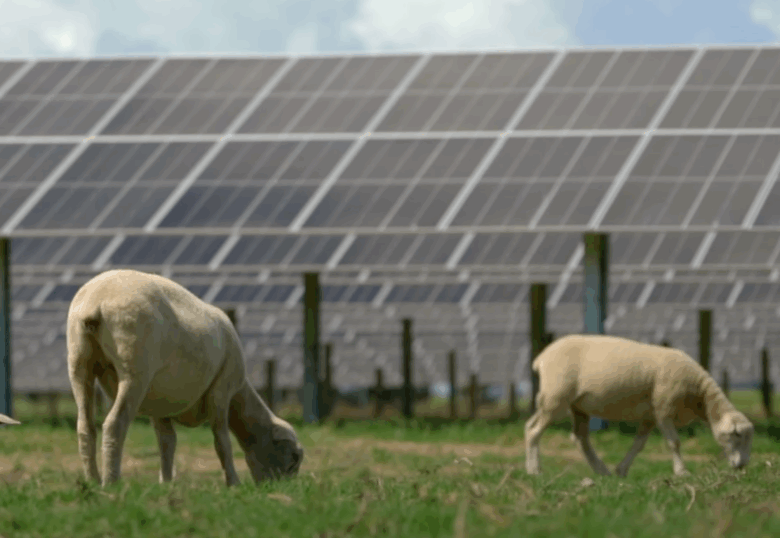
Ongaonga set to get third solar farm, but the future of one is already in question
A 35 hectare solar farm at Ongaonga was announced last week involving a partnership between lines company Centralines and developer Lodestone Energy. It will tie generation to Centralines’ distribution business.
The farm, which will feature 46,000 solar panels, is said to be able to generate 52 gigawatt-hours of renewable electricity a year, to power around 9,000 homes (a figure that has been questioned by BayBuzz readers).
The $50 million project is funded in part by government ($8 million from the Regional Infrastructure Fund), equity from Centralines and Lodestone Energy, and a bank loan.
The 12-month build will commence in December, and once complete will connect to Centralines electricity network via a new switchroom located next to Transpower’s Waipawa grid exit point.
Billed as a strategic investment in Hawke’s Bay’s energy future, the solar farm promises to provide 80 construction jobs, including 30 high skilled roles and provide an energy source that can compete with the gentailers, helping to keep prices stable.
However, it may not be all plain sailing. As the country heads toward local body elections in October, campaigning beginning next month, it will be interesting to see how locals respond.
Ongaonga, home to just over 150 people, has been chosen as a site for three solar farms in total due to large amounts of flat surface, proximity to a substation, and unirrigated soil.
Solar business failures
However, the future of one of those solar farms, the already consented 144ha SkySolar project, is now in question with the company placed into liquidation in 2023. This follows the collapse of another solar company, SolarZero, late last year. Its owner, global investment firm BlackRock, blamed “unsustainable losses”.
A worrying trend, given the government subsidies some of these projects rely on to get off the ground. In the case of SolarZero, the Government invested $100 million of taxpayer dollars via New Zealand Green Investment Finance (NZGIF), a ‘green bank’ set up by the previous Labour government. That fund was axed in April, with Climate Change Minister Simon Watts saying the fund had “limited results” and there was less need for government involvement in the renewable sector as private investment interest grew.
Now the RIF appears to be filling those shoes.
Public concern around safety
Another Ongaonga project – ground zero for solar in Hawke’s Bay – a 239ha farm by Helios Energy, is facing a consent hearing this month.
Noteworthy, because another Helios solar farm near Naseby, Central Otago, is on hold after its resource consent was opposed by the majority of submitters (149 out of 181). Opposition was largely due to heightened fire risk, and the potential for resulting groundwater contamination.
Critics say the risk of fire is heightened by the industrial scale of the solar farms, which in the case of the Central Otago project is 560,000 solar panels – so, much much larger than the new Ongaonga project.
In Naseby, locals are highlighting the need for vegetation management and proper oversight to avoid the risk of fire, which exponentially increases when transmission lines, transformers and switchgear are involved.
Comments on an earlier BayBuzz article about the Ongaonga solar farm article hint that locals may be similarly pessimistic about the Centralines project.
Cost of everything the ‘big election issue’
Add to all that, the cost of upgrading transmissions lines for solar farms like these is immense.
In a briefing to the incoming Energy Minister in 2023, Electricity Networks Aotearoa’s stated that rapid decarbonisation, at the lowest cost to consumers, would require an initial investment of $42 billion in the 2020s and a further $22 billionspecifically for electricity distributors to prepare networks for rapid electrification and distributed generation.
To put the country’s ambitions in context, a new report from the Auditor General targeting electricity distribution states that to meet net zero carbon targets by 2050, electricity will need to cover 60% of our total energy needs, up from 25%.
For the 2023 calendar year, only 0.8% was coming from solar, with 60% of generation coming from hydro and 18% from geothermal. There is a long way to go then.
It’s fair to say that ratepayers have never been more angry about rising costs, and Hawke’s Bay has had its fill of expensive disasters. The first indication about public sentiment on solar in the region will be the consent hearing for Helios’ Ongaonga plans.

Wouldn’t there be the same, or more, generation if every home in HB had solar panels (subsidised by say 50% for the ratepayer to have installed) – there would be less possibility of pollution and all the other current objections to the solar farms and the power generated would be fairly large – maybe supplying each home individually with any surplus into the grid? The cost I would imagine would be either similar or less than a solar farm establishment.