


How Hawke’s Bay is merging fitness, wellbeing and sport
[As published in Mar/April 2026 BayBuzz magazine.]
The new meet-up spot in Hawke’s Bay is not the pub.
It is the gym floor at 6am. It is the run club that meets while the streetlights are still on. It is a sauna bench where strangers become familiar between heat cycles. It is the cold plunge where someone swears once, laughs, then goes again because the person beside them is doing it too.
What is driving it is not only personal improvement. It is connection.
People still want their people. They just want to feel good tomorrow.
In Hawke’s Bay, that mindset is showing up through a merging of fitness, wellbeing and sport. The lines that used to separate training, competition and recovery are blurring. What is rising in its place is a network of micro-communities built around movement, accountability, and the shared habit of living better.
Three local examples sit right at the centre of it: Ora and Hyrox style fitness racing; the challenge-based coaching communities being built by trainers like Tamati Samuels; and the rise of recovery spaces like O-Studio Hawke’s Bay, supported by smaller offerings such as The Sauna Project and Tuki Wellbeing Co.
These are not just services anymore. They are social ecosystems.
Ora and Hyrox: when training becomes a sport, and a scene
On a busy morning at Ora in Karamu Road, Hastings, the sweat is real, but it is not the first thing you notice. It is the greetings, the banter, the way people train hard and still look after each other.
For Ryan Tongia and Rachel Tongia, that is exactly the point.
“People don’t just come in because they know fitness and health is good for them,” Rachel says. “They come in to check in with their mates. Someone just saying, ‘How are you today?’ is so important to start the day.”
Hyrox has amplified that community energy because it gives people a shared target and a sport-like structure to train for. The format combines running with functional stations. It is tough, but not complicated, and the skill barrier is low enough that everyday gym-goers feel welcome.
“The sport itself, what makes a difference, is accessibility and inclusiveness,” Ryan, a former professional rugby player says. “It’s more low-skill based. So the barrier for entry is, people feel like, well, I’m willing to give that a crack.”
Rachel says the options matter for first-timers.
“Anybody can do it. You can do a relay. You only have to run twice, do two stations, that’s achievable for everybody. Or do a duo where you share it.”
From first event to weekend spectacle
Ora’s first Hyrox-style event in April 2025 attracted about 80 entrants. Now it has grown to more than 400 entrants.
The next event will be held again at the Tomoana Showgrounds in Hastings on April 18 to 19. Entries have been uncapped to meet demand, and athletes can choose between a full simulation and a half simulation.
For Ryan, the mission stays simple.
“It’s about more people moving,” he says. “That’s our big mission here, to get as many people moving as possible.”
The local growth mirrors what is happening nationally and internationally. Auckland has surged from just over 6,000 registered athletes in 2025 to just under 11,000 this year. Melbourne has pulled crowds of more than 24,000 competitors. Hyrox is turning into a fitness festival, and Hawke’s Bay is building its own version of that atmosphere.
Matty Pearce: The new athlete pathway, powered by community
If Ora is one of the hubs, Matty Pearce is a case study in what the hub can create.
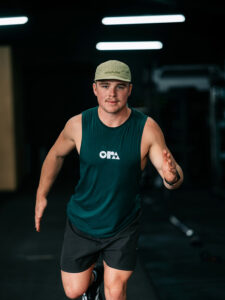
Matty has always enjoyed running, and he played rugby at school until that chapter ended abruptly when he broke his neck in a match. It forced a reset. The hunger for challenge did not disappear, but the path forward needed to be smarter. Hyrox gave him that path.
“My journey began with Hyrox last year, early last year, when Ora hosted their first Hyrox event indoors here, and straight away, off the bat, got hooked,” he says. The hook was not only performance, it was people. “I called a mate along. I just wanted to meet more people that were like minded, and then just wanted to be in that kind of fit, healthy space,” he says.
That community is what sealed it. “For me, the beautiful thing about Ora and being a part of it is the community,” Matty says. “It’s just a high energy gym and real happy place, safe place for people that they can come in and just be themselves.”
Matty is also a mental health advocate. Last September he ran at least a half marathon every day of the month, raising money for mental health and backing the message that consistency and connection can change lives. Now he is chasing bigger goals. “I would love to really get a placing in my next Hyrox in the Pro Division. So I’m looking for top three,” he says. “And then hopefully getting on that elite 15 world circuit.”
Ora’s Hyrox rise is also taking other locals to the sport’s biggest stage, with Hyrox couple Faryn Ngawaka and Rebecca Wright heading to Stockholm in June to represent New Zealand at the HYROX World Championships.
Tamati Samuels: fat loss coaching, but make it a community
While Hyrox has created a sport lane, another growth lane is booming beside it: structured challenges built around belonging.
Tamati Samuels is a personal trainer and online coach based in Napier with a large Instagram following and a style that is deliberately unconventional. He is direct, energetic, and refreshingly specific about what he does.
“Fat loss, because that’s the main thing we want to lose, and we want to maintain as much muscle as we can,” Tamati says. “My goal is to lose more fat than muscle.”
His reach is already well beyond Hawke’s Bay. “Mainly New Zealand, but I’ve got a few in Australia and a couple in the UK,” he says. “One in Portugal.”
He runs eight-week fat loss challenges using group workouts, tailored training, tailored nutrition delivered via an app, and regular communication. The structure is firm, but the feel is social.
“I found that a lot of people would love challenges because it brings in a more community aspect to fat loss,” Tamati says.
He is also clear he is not interested in punishment culture.
“My thing with fat loss has to be enjoyable, sustainable,” he says. “Sustainability and consistency is what I strive for as a coach.”
Recovery goes mainstream
The third lane is recovery, and it might be the fastest-growing of all.
Not long ago, recovery was treated like a luxury. Now sauna, hot and cold plunging, float therapy, massage and compression recovery are being built into the weekly routine of everyday people.
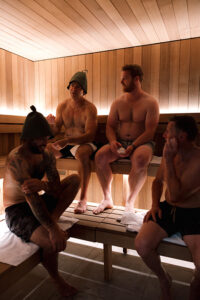
O-Studio Hawke’s Bay sits right at the front of that wave locally. It is part of a nationwide franchise, with the Hastings based studio the sixth of nine locations opened so far, and another three planned to open in 2026. Anna Lorck is the Hawke’s Bay franchise owner.
Anna sees the shift as an evolution that mirrors what happened with gyms themselves.
“Going to the gym used to be something for bodybuilders or elite athletes,” Anna says. “Fast forward to today, and movement, strength training and recovery are now part of everyday life for so many of us.”
She argues the next step is treating mental wellbeing with the same normality as physical training.
“Mental maintenance needs to become just as accepted, understood, and practiced as physical activity is to feeling good and keeping well,” Anna says.
Sauna is one of the cornerstones, partly because it is physical, and partly because it forces people to slow down.
“Heat is powerful, it boosts immunity and speeds up recovery,” Anna says. “When you step into a sauna it’s basically forcing you to slow down, giving you a moment to pause, breathe and just be.”
Recovery is also becoming social. People book sessions with mates, talk between rounds, and build connection around healthier rituals. Even international comedian Jimmy Carr visited O-Studio while in Hawke’s Bay in January and shared a sauna session with locals.
The smaller wellness wave: beach saunas and valley resets
Alongside larger hubs like O-Studio, smaller wellness offerings are growing too.
The Sauna Project runs a mobile, wood-fired sauna experience that sets up at beaches in Napier and Te Awanga. Tuki Wellbeing Co offers a more secluded, retreat-like contrast therapy experience in the Tukituki Valley. Different settings, same idea: recovery as a regular habit, and a place where people connect.
What it all adds up to
On the surface, these offerings look different. Hyrox is sport. Challenges are coaching programmes. Saunas and floats are wellbeing. But zoom out and the pattern is clear. Hawke’s Bay is building health-styled micro-communities, and fitness, sport and recovery are merging into one lifestyle.
People still want to go out. They still want to meet up. They still want stories, laughter, and a sense of being part of something. They are just choosing places that make them stronger, calmer, and more connected.
Sweat is the new social.
Starting like most kiwi kids playing rugby barefoot on frosty Hawke’s Bay mornings, Damon became a sports editor for the local rag and then a sport promoter for the ASB Tennis Classic, the national rugby championship and the Auckland Blues. He served 15 years on the board of Sport Hawke’s Bay, five years as chair, and continues to be involved in sport governance locally.
