


[As published in September/October BayBuzz magazine.]
When it comes to numbers and goals, the future of electricity in New Zealand is huge, as is the challenge to our hometown electricity provider, Unison.
Most of us think of Unison and its 420 HB-based employees simply as the company that runs the wires and cables delivering electricity to our homes and businesses. However, the ‘Unison Group’ includes a number of other service and manufacturing companies aligned with its electricity expertise. We’ll get to the ramifications of that later.
New Zealand can achieve nearly 100% renewable electricity by 2030, with 4.3 million EVs on the road by 2050. And if we reach that goal, we will save a staggering 22 million tonnes of CO2e annually by 2050 – this would represent 70% of the total transport savings required to be net zero carbon in 2050.
But this will require a $71 billion investment in New Zealand’s electricity distribution infrastructure by 2050, with $22 billion of that coming in the remainder of this decade.
And important climate and sustainability goals aside, in the ‘here and now’ focus of our daily lives, as consumers we want energy security, which Unison describes as, “Ensuring reliable and affordable access to energy, ensuring resilience against shocks and disruptions, and the ability to meet current and future demand”.
Energy security and energy sustainability must be achieved alongside energy equity – keeping electricity available to all at a fair, affordable price.
How to achieve each of the elements of what Unison calls ‘The Energy Trilemma’ is embedded in the company’s 274-page 2024-34 Regulatory Asset Management Plan (RAMP), recently released, with the somewhat sexier moniker … Powering Thriving Regions.
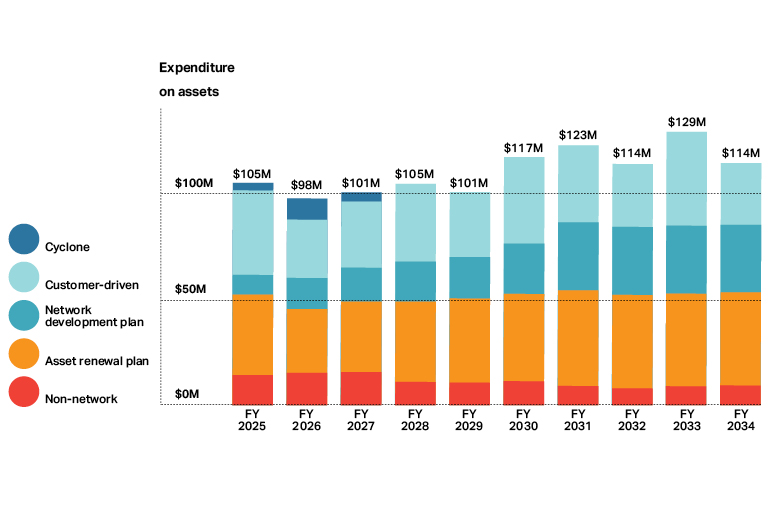
For Unison in Hawke’s Bay alone, $750 million will be invested over the next ten years, with $61.9 million in 2024/25. All ultimately paid for by electricity consumers. RAMP describes every project over $250,000 … dozens of them, with tantalizing names like ‘new 11kV Fernhill Feeder’, each with a purpose description, multiple solution options, with varying advantages/disadvantages and costs. Seven pages on caring for Unison’s 66,000 poles.
Hopefully HBRC’s new flood protection plans will be so complete. To say nothing of our district councils’ water infrastructure plans.
While full of reader-numbing technical detail, the RAMP also includes illuminating discussions of the assumptions and trends that shape Unison’s planning around investments that have asset lives of up to 80 years – from climate change and environmental goals to demographic changes and worker shortages to government policies, AI, technology change and consumer habits. In short, Unison’s view of the world in which it must operate over the next decade and beyond. Alongside risk assessments and detailed performance reporting.
It would be welcome to see such comprehensive contextual thinking on the part of our (5) councils and our Regional Economic Development Agency.

BayBuzz sat down with two key principals at Unison – Jason Larkin (General Manager Commercial & Regulatory) and Gaganpreet Chadha (General Manager Networks & Operations) – to help distill the key takeaways from the strategy.
Recovery
Probably uppermost in most minds in the aftermath of Cyclone Gabrielle is the simple question: Is our electricity supply more protected and secure today than it was then? How?
Of course the major power vulnerability exposed by Gabrielle was the flooding of the Transpower-owned Redclyffe substation, the major entry point for electricity into the region.
Transpower, with Unison at the table and concurring, has adopted an ‘uplift’ strategy aimed at repositioning electrical gear higher above current ground level, with further margin to spare in the event of future flooding. This work is just starting. Jason Larkin emphasises Unison’s ongoing engagement with Transpower to keep this partner “on focus”.
Nevertheless, when asked what Unison saw as the biggest vulnerability were a Gabrielle-scale event to re-occur next February, Larkin identified the Redclyffe facility, given that Transpower’s high voltage resilience work will not be completed until 2027. However, other changes completed would ensure much quicker restoration of 110v power to the community – “within hours”, says Larkin. With Redclyffe lifted, “after 2027 we shouldn’t see any flood having the impact of disrupting electricity supply to the region we saw [from Gabrielle],” says Gaganpreet Chadha.
He adds that actually mobilising the Unison workforce during such an emergency would remain problematic if confronted again by communications and transport issues – road blockages, bridges out. “We ensure we are prepared and have the plans and resources to respond to any emergency; however, we are also dependent on other infrastructure and services”.
Unison says it has “frequent relationship meetings” with Transpower, adding: “Unison has the opportunity to provide input into any proposed mitigations that will reduce the likelihood and consequences of future GXP (Grid Exit Point) outages.” My fingers are crossed.
Unison has made considerable progress with its own resilience improvement, which would – Larkin and Chadha confirm – limit any future substation flooding outages to hours as opposed to days or weeks.
Larkin points to several projects aimed at building more resilience in the delivery system, with interim improvements begun immediately after the disaster. For example, the Awatoto substation was flooded and a redesigned substation will be relocated to an area with more flood protection ($12 million); meantime, the existing control electronics have been lifted six metres above ground. Likewise with new substations replacing those flooded in Esk Zone ($5 million) and Tutira ($5 million). Power lines crossing rivers have been moved or made more resilient. In addition, work underway to bolster power coming into our region from the south will be completed in 6-9 months, as a further hedge against reliance on Redclyffe.
A key project underway to enable better response is institutionalising a comprehensive register of critical sites connected to Unison’s electrical network. The Register will include emergency management organisations like New Zealand Police, Fire and Emergency New Zealand, Civil Defence Emergency Management (CDEM), St John New Zealand; hospitals and large aged care facilities; air and seaports; lifeline utility infrastructure like three waters installations, telecommunication, fuel depots, and large industrial customers.
The RAMP devotes a chapter to risk assessment – who is responsible; how risk is identified, weighed and responded to; and which risk averting investment priorities are given priority.
An interesting discussion is provided of ‘High Impact Low Probability’ (HILP) or Extreme Events. With funds and expenditure constrained by regulation, this involves weighing investments mitigating against risks with lower consequence but higher likelihood, against investments protecting against HILP events both from natural hazards and other incidents that could lead to major asset system failures as experienced in the aftermath of Cyclone Gabrielle.
In its discussion of risks from natural hazards, it is fair to say that earthquakes rank highest in terms of network vulnerability. Unison comments: “All of Unison’s zone substation buildings have been seismically strengthened to mitigate potential risks.” And: “Unison’s coastal network would be significantly impacted by either a near-source, or distant-sourced tsunami. Due to the uncertain impact and level of inundation a tsunami may have, mitigating action plans currently focus on reducing potential risks to employees, and the public through evacuation of staff and the making safe of electrical equipment.”
Unison has planned for any compromise of its earthquake-protected Omahu Road headquarters. “Unison has constructed a purpose built, level four compliant, AOC (Alternative Operation Centre) adjacent to its Arataki Substation in Havelock North. This building provides a comprehensive disaster response facility capable of housing all network operational and other critical business functions.”
Turning to extreme weather, Unison reports: “The significant impacts of Cyclone Gabrielle and other well documented events on infrastructure and local communities, both domestically and overseas, is testament to an increasing threat of extreme weather events. There is acknowledgement that the impacts of climate change are likely to affect the future frequency and severity of these type of events. Consequently, Unison is engaging with a number of national working groups to better understand the implications of climate change, and what mitigations or adaption strategies will be required to lessen the impact on the business. This includes the longer-term impacts of sea level rise on Unison’s asset portfolio.”
And finally, “Unison understands its obligations as a lifeline utility and is taking steps to increase its engagement and participation with local lifeline groups including representation on the Hawke’s Bay Engineering Lifelines Executive Committee.”
Sustainability
Assuming our electricity supply is more secure, what further upgrades or changes does Unison plan to meet increased demand and sustainability goals?
A key trend Unison must address is decentralisation of the electricity system.
The RAMP comments: “Technologies such as solar photovoltaic cells and batteries have the potential to reshape the electricity industry if they reach a level of efficiency that makes them complementary, or even a credible alternative, to centralised generation, transmission, and distribution. Unison’s research into these technologies strongly suggests that they will have an impact on the business, but that material uptake will occur in the latter half or beyond the planning period of the AMP within Unison’s network footprint.
“Most of the assets which will be installed during the ten-year planning period will however last far beyond that time (some assets having a life of up to 80 years). It is therefore essential that the asset investment decisions being made now consider the prospect of future uptake of DER (Distributed energy resources, e.g. solar, EVs, batteries).”
Anticipating growth in DER, where users can become suppliers and have more direct/smart control over their power demand and storage, requires rethinking and retooling many ‘one way’ (i.e., electricity flowing only out to users) aspects of the Unison electricity system. Too technical for this article, but a major focus of future network planning.
In the meantime, Unison’s policy is “to support the objectives of customers wishing to utilise Distributed Generation by ensuring any potential detrimental effects are prevented or mitigated.”
As electricity users in the region can become suppliers to the local grid (e.g. a solar farm as described in Tess Redgrave’s article herein, Solar Power Farming), Unison must purchase their electricity, assuming technical specs are met. Unison added 767 solar or distributed generation customers to its Hawke’s Bay network in the last year – “steady, not exponential growth” – now totalling around 3,000 installations, and is seeing more interest in larger scale projects.
[Solar aside, Unison will soon be adding over 100MW of geothermal power to its network from Taupo facilities. The new Harapaki wind farm on the Napier-TaupŌ Road, capable of powering 70,000 homes, must feed into the Transpower grid, meaning that electricity can go anywhere in the system.]
Unison works closely with councils’ planners to anticipate development growth, be that a sub-division like Iona or Irongate industrial expansion.
A major driver of HB’s expected demand for more electricity will be residential growth (8,200 more homes in next ten years) compounded by consumers’ increasing adoption of electricity-driven efficient heating, hot water systems, smart appliances, EVs and solar energy. A typical project to address residential growth would be $7 million for upgrading cables and substations serving new sub-divisions in Havelock North and Arataki.
Consumer use of electricity is the toughest to keep on top of, says Chadha. Taking EVs for example, incentive policies can change pace of adoption and when consumers actually charge their vehicles could create peak loading issues that require expensive added system capacity. On the other hand, better home insulation reduces demand.
Businesses will require growing capacity, needing another projected 490 hectares of industrial land. Such system expansions are paid for by the developers directly to Unison under price settings established by the Electricity Authority and overseen by the Commerce Commission.
And other businesses and institutions will embrace decarbonisation, transitioning in HB from gas-fired boilers. Unison is working with the region’s top 50 users of process heat to plot their conversion to electricity from gas.

As an example of anticipating growth on the business side, the Camberley substation will be rebuilt to meet the needs of the growing health care sector surrounding Omahu Road.
As BayBuzz has reported online, Unison will be deploying facilities modelled on its sustainability award-winning Windsor substation in Hastings. This facility won the ‘Low Carbon Future Award’ at the New Zealand Energy Excellence Awards in July 2022. It is 100% solar powered, with zero carbon emissions.
As another use of developing technology, Unison now uses aerial LiDAR imaging (and next, satellite imagery) to survey its entire power lines network to identify vegetation hazards (think trees and power lines, fire risk). This preventive work, crucial to protecting rural supply, is handicapped by inadequate regulation of tree owners in Unison’s view, and has previously been a time and labour-intensive process with built-in human inconsistencies.
Cost and pricing
So, how does all this get paid for?
Unison recently announced its dividend payment to the HB Power Consumers Trust would be $17.25 million, up from $15.8 million the previous two years. Where does this dividend come from?
Unison revenue of $359.9 million has two main sources – charges paid by retail electricity marketers (like Contact, etc) which are strictly regulated, and unregulated earnings from the following separate businesses: Unison Contracting Services (offers specialist contracting services), ETEL (the largest transformer manufacturing company in NZ), RPS Switchgear (specialises in custom switchgear), and Pringle Beleski and Associates (PBA, provides high voltage expertise).
You pay the regulated chunk through your preferred retailer.
In Napier the cost of electricity per kilowatt hour (kWh) is 33.75 cents (of which the energy cost is 21.61 and the line fee is 12.14) compared to 40.62 cents in Waipukurau (where the energy cost is 20.89 and the line fee is 19.73 cents). The NZ average total cost per kWh is 33.61 cents (average line fee 11.89 cents). From there, your retail bill of course depends on how much electricity you use and when, with all sorts of plans available from over a dozen retailers.

The line component cost (Unison’s revenue) depends on factors like population density, distance from power station, terrain, extent of commercial/industrial users.
Demand and growth projections like those in this RAMP are used by the Commerce Commission to approve regulated expenditure plans and set the price Unison can charge retailers, reflecting cost of current lines service, reasonable investments in system growth and improvements, and a stipulated profit margin. That margin is currently set at 4.57%.
Distribution businesses like Unison lobby their case to regulators. Under recent settings Unison’s operational costs have surpassed allowances due to inflation and increased capital spends.
New settings have just been issued, which will dictate revenue and prices, allowable expenditure, and service reliability for the five-year period beginning 1 April 2025. This included, to Unison’s relief, a 25% increase for all lines providers in allowed infrastructure investment in recognition of recovery and resilience needs generated by recent severe weather, extraordinary inflation pressure, interest rates, and accelerated electrification objectives. “We’re comfortable with the plan,” says Chadha, “but 35% would have been better to ensure investment keeps pace with growing demand, especially related to decarbonising transport and industry.”
Access to capital aside, Unison’s Chadha points out that the pace of investment is significantly constrained by people, both technical and field staff, to deliver the programme – ongoing labour shortages throughout the industry “and not just a NZ issue,” he adds. And to a lesser degree, supply bottlenecks for materials.
In any event, a substantial unregulated revenue growth opportunity for Unison comes from its subsidiary businesses. In its latest annual report, these businesses provided 24% ($28.1 million) of its total earnings (EBITDA), while regulated lines earnings were $87.4 million.
Although the unregulated business earnings can be plowed back into those businesses, used for new acquisitions and to reduce borrowing, they do not cross into the regulated lines business. And arguably this subsidiary revenue and profit is more directly important to HB consumers because it is the primary source of the HB Power Consumers Trust dividend.
Thomas Edison predicted: “We will make electricity so cheap that only the rich will burn candles.” And nowadays, those who can’t afford portable generators!
Many of us give no further thought to our electricity than paying our bill, banking our Power Trust dividend and hurling an expletive when the power fails. But a lot happens behind that light switch … and the Unison folks seem switched on.
That said, reflecting on the certainty of future severe weather and other challenges to our power system, it’s worth noting that Edison also said: “Everything comes to him who hustles while he waits.”
