

[As published in March/April BayBuzz magazine.]
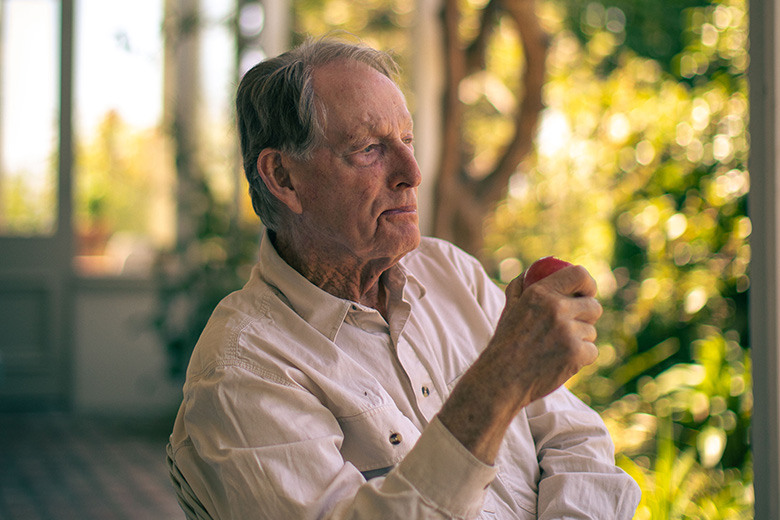
“India,” says David, “has a way of capturing you.” Be careful, he was warned before leaving on his first visit some 40 years ago.
David Cranwell is telling me the story he’s told more than a few times before, yet after all the retelling, he still can’t quite put his finger on why the vast and diverse place is so captivating; he still can’t quite seem to articulate it.
That’s strange in and of itself, as David seems to be very articulate about many things, but this experience has him lost for words. It’s a feeling, you see.
Dispatched to India in the late 1980s by the charismatic, forward thinking Apple and Pear Board CEO, Joe Pope, David was well and truly hooked from the get go. On the place and the Indian people. “They do so much with so little,” he says more than a little reverently.
Back then ‘the Board’ as it was simply known in the trade, was a single desk trading monopoly. The single desk bit meaning they were the only organisation in New Zealand that growers could sell to. Anything else was illegal and not everyone played ball. Another former board employee talks about board staff who could ‘raid’ a dairy, and demand to know where you’d bought your stock.
‘Ello ‘ello ‘ello, what’s all this then? Where did those Braeburns come from?’
“On the regulation side of things you don’t make too many friends,” David offers with a wry smile and playing it close to the pads.
The fifteen years at the Apple and Pear Board were good to him and for making contacts. His big regret was that no-one in New Zealand really saw the boom coming out of Asia. “Don saw it though,” says David, referring to Dr Don McKenzie of the old DSIR, who was the brains behind developing the Pacific Rose variety, an Asian favourite. “Don saw it coming.” David is quick to make sure credit is given where it’s due.
David had become a ‘finder and a minder’ for the board working on various market development projects and spearheading one for the board on behalf of the World Bank, with the goal of modernising the Indian apple industry.
Here then, was when David became hooked. As a direct result of the work, supplying root stock and systems, New Zealand became the first country to export apples to India, who now ranks 4th in terms of world production.
His time in India fuelled David’s other passion, the Himalayan Oak Trust he started. It’s a tree that he ironically first came across up Gisborne way. The Himalayan Oak has an incredibly resilient root system. It actually draws water up from the subsoil releasing it at ground level, plus it’s an evergreen making it ideal for sucking carbon out of the air. It’s not just the tree that puts things back though – it’s the trust itself. Money from selling the trees in New Zealand – work now undertaken by Plant Hawkes Bay – heads back to India to help a local village from where the acorns come.
The fruit industry is a tough one in any country… “Great one day, rotten the next,” explains David, neatly summarising the sad experience of anyone who’s ever bitten into a soft floury apple. Like every industry you have to innovate or die. In the apple game this often means new varieties. Like wine, and grapes, apples also have an element of fashion about them. Gewürztraminer anyone?
To illustrate the fashion angle, David explains that in the 80s New Zealand might have produced one million cases of the stalwart Cox’s Orange; today we’d be lucky to produce 50,000.
In the early 80s Braeburn and Royal Gala – New Zealand natives, so to speak – started the drive for new varieties. Royal Gala, descends from the Golden Delicious and Kidd’s Orange, and has cousins in Braeburn and the tangy Pink Lady. Pacific Gala is another mutation, with a more vibrant red colouring and slightly crisper.
Braeburn has a better shelf life and greater acidity means it stores well. That’s critical for an exporter like New Zealand sitting on the edge of the world. “In the 80s it used to take three weeks to get an apple shipment from Napier to Belgium, now it’s 80 days or more,” says David, shaking his head somewhat incredulously.
You can, David reckons, have too much of a good thing. Developing new varieties needs deep pockets. And time. Lots of time. Be prepared, as David has, to invest 20 years or more in a breeding programme to maybe get one or two successful varieties to market.
David’s own breeding programme on the Tuki, which started in 2000, has resulted in the Posy variety. By David’s own admission the apple is “a bit of a prima-donna” with a low yield. “You might get 2,000 cartons a hectare,” David elaborates, “as opposed to 4,000 a hectare with Braeburn.”
But Posy has a lovely pink flesh colour bursting with a delicate almost peach like flavour. It’s a huge hit in Asia, for where it was originally intended, and also has the benefit of being market ready ten days before any other apple of the season. First up, best dressed and all that.
It’s a numbers game, and from what started out as 7,000 seedlings, David now has about a thousand on the orchard that he’s keeping an eye on. In particular there’s the mysteriously named TCL 41, for example, which he thinks will have better skin and store longer.
Very much a goer that one. Indeed, David’s fingerprints can be found on numerous new breeds over the years.
Growing on the property David and Margaret almost didn’t get. It was nearly sold to another buyer, but the owner Alf Mcleod didn’t much like the cut of the buyer’s jib, and when Alf asked what he was going to plant, the potential new owner gave Alf the news that he wouldn’t be planting anything, and had plans to bring in the bulldozers and lay down a trotting track.
Alf then delivered some bad news of his own to the bulldozer, which is how David and Margaret came to be on the Tukituki orchard. “We had no money, but lots of hope. I’d had plans for persimmon. Big plans,” says David somewhat wistfully. “They’re only really taking off now. 50 years later.” he adds with a chuckle.
“It’s unforgiving land,” David explains sort of adding, partly by way of explanation: “It’s on the dreaded Havelock pan.” I have no idea what that actually is, but David assures me that if I “were to go down 700-800 metres”, it’d be like concrete.
I’m taking his word for it.
He’s used to swimming upstream. There’s worry about GE, and like everything David sees it as a balancing act. Yes, we might get disease resistant strains, but the temptation to breed too many varieties could be a disaster for the farmer. The biggest threat though to the New Zealand apple industry as he sees it – and no surprises – is climate change and the inconsistency of summer.
There’s the rising tide of course, and sea water has already reached into some coastal Nelson orchards killing off trees. Plus, there’s talk – more frequently – about some Royal Gala ‘getting sticky’ early.
“Maturity has shot ahead,” says David. The implication for growers is they need to select pick to get the best yields. Posy needs to be picked three times in a season.
“Gone are the days of strip picking the Red Delicious or Granny Smith crop all in one go,” says David. Of course it all adds to the cost, and the margins are as thin as the skin on the apple. “Grower management,” he says, “needs to go from pretty good to bloody marvellous.”
David’s driven by the thought of creating something. “Riding the rollercoaster” as he puts it. The implication being every creative endeavour has its ups and downs. The sweetest fruit being at the top of the tree and all that.
David describes himself as one of those annoying people that never gives in. He’s building a boat to prove it. It’s been on the dreaming board for about forty years and ten in the making. He proudly shows me the rudder made with Kauri from the old family homestead in Henderson. This part has been under construction for two years alone and has recently been delivered.
When pressed gently for an ETA on completion, David is quick to say he could have it finished almost immediately. I don’t believe him for a minute. People like David take their time to get it right.
But it does raise the question of how he’d like to be described, and David’s quick to reply:
OMG Haha … There is a lovely little book
‘The man who planted trees’
I identify with that. Call me what you like, many have
Horticulturist, tree lover, apple breeder, boat builder, I don’t know or really care.
It’s a simple message that tells you everything you need to know about David Cranwell: he’s not being flippant in the last line, he just doesn’t seem to stand much on ceremony.
He cares deeply about a great deal, his beloved wife Margaret of 57 years – whom he may have ‘forgotten’ to tell about this article – will be right at the top.
What people think of him very much at the bottom
