

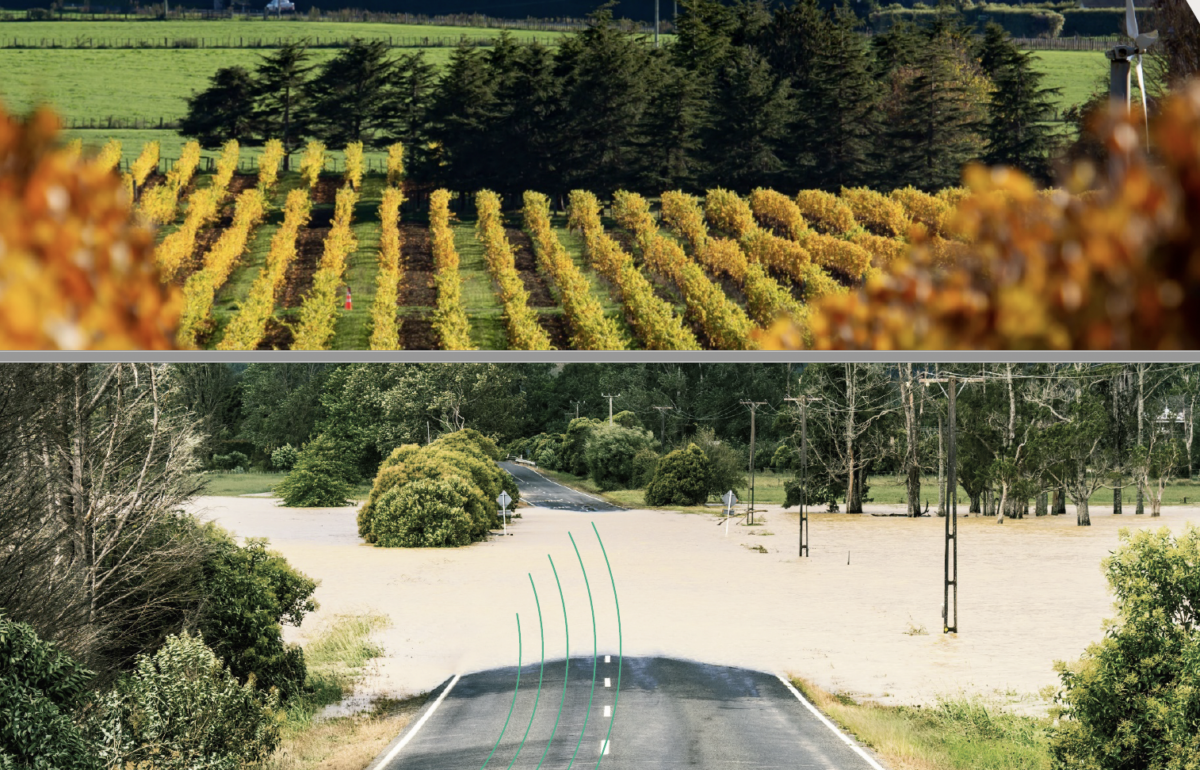
Two reports with challenging news for Hawke’s Bay growers and farmers have surfaced recently.
Boston Consulting Group (BCG) issued an update on the economic effects of Cyclone Gabrielle on the HB horticultural sector, while Rabobank, NZ’s only specialist food and agri bank, published a white paper warning that NZ farmers must move firmly to reduce their on-farm emissions.
Boston Consulting Group
The BCG report noted that little cash support had come into the Bay for individual farmers from Government in response to the cyclone, while loan support was not widely picked up as farmers were reluctant to increase debt with their futures uncertain and interest rates high.
Shortly after the cyclone, an initial BCG report prepared for the sector estimated cumulative losses for HB hort would total $3.5 billion from 2024-2030, with $920 million needed for critical response to replant crops and reinstate production. But since May 2023 the government has provided only $240 million in grants (roughly $80 million) and concessionary loans.
BCG estimates the sector needs at least $410 million more in government funding, at least $345m for replanting and reinstatement and $65m for on-farm clean-up, concluding: “Without this support, the sector is unlikely to recover its pre-cyclone state by 2030.”
The report noted differing impacts across the sector:
“Annual crops (e.g. onion, squash) have recovered better than perennial crops (e.g. apples, pears, peaches) due to their ability to move off damaged land after one year’s lease. Some annual crops also have a higher resistance to silt, waterlog and related diseases.
“Larger corporations rebounded better than small or medium businesses (SMEs) due to the large corporations’ better access to resources, talent and capital. SMEs cited more difficulty acquiring bank loans than before the cyclone.”
Commenting further: “In addition, emotionally drained, many small farmers who were near retirement age chose to exit early rather than rebuild their land. While corporatisation is not in itself a bad thing, more support is needed to help small farmers navigate the transition.”
BCG also comments on the need to factor in climate change, recommending: “Assessing the risks of climate change on New Zealand’s regions by modelling different climate scenarios, assessing the costs of potential damage and identifying the current funding gap for adaptation actions in each region. With this information government can develop a heat map of climate risk to guide prioritisation.”
Rabobank
While BCG focused specifically on the Hawke’s Bay situation, and horticulture within that, the Rabobank paper addressed the bigger ‘external’ challenges posed by overseas market expectations regarding GHG emissions and sustainability practices. Indeed, the paper is titled: Maintaining our emissions edge: Protecting New Zealand’s position as an emissions-efficient food producer.
Rabobank observes: “While the Coalition Government has taken steps towards a regulatory ‘breather’ for under-pressure farmers, other drivers such as international sustainability targets and new obligations within trade agreements will continue to provide strong incentives towards more emissions-efficient production … it would be unwise for farmers and the government to ‘coast’ during this respite.”
Rabobank cites a major report prepared by Chapman Tripp that found “over 80% of NZ’s exports are headed to countries with mandatory climate-related disclosures in force or on the way, while free trade agreements are increasingly laden with enforceable obligations on emissions and other sustainability targets.” Rabobank discusses these growing obligations at length.
Rabobank’s blunt warning:
“There are other voices at the table that are getting louder. These are the voices of customers (with increasing expectations of the world’s most powerful food processing and marketing companies) and from the wider supply chain, including investors, who also face significant regulatory pressures to minimise Scope 3 emissions.
“This growing web of international obligations will not afford New Zealand producers the same patience that the New Zealand Government has extended to them. While regulatory pressures may have temporarily abated, Rabobank’s view is that farmers and the the government should not get complacent and should use the rest of the dialogue and the timeframes to move forward to protect its pre-eminent role in global food production.”
At a practical level, Rabobank recommends:
“We need to establish a comprehensive national framework of standards and guidance of good practice along with quantifiable benchmarks. Within this, a consistent and trusted approach to obtaining farm-level data on GHG emissions will be a key enabler to reduce emissions within the agricultural and land sector.
“At farm level, this starting point is essential in allowing farmers and producers to measure and effectively prove where individual farms’ overall environmental impact stands. At a national strategic level, a clear understanding of the range and average of emissions in a particular sector and region is important to see which farms are already performing well and need further support and which farms are lagging and require assistance to improve on the spectrum of emissions intensity.”

In short, in addition to all the other ‘in their face’ challenges, NZ farmers need to lift their game with respect to sustainable, emissions-reducing practices. Or get left behind. A tough message to take aboard, especially in a cyclone-afflicted region like ours.
The BCG report is here. The Rabobank white paper is here.

Given the Paris agreement specifically states that no climate initiative should impact on food production one wonders where these so called climate pressures are really originating.
Internal woke civil servants I suspect.
Luckily China, our largest market does not have enthusiasm for these initiatives.
We spend time in Australia and go with family to an Aldi store – one of over 700 in Australia that have taken double digit market share off the two big chains.
The reason consumers shop there is price !
To think these consumers are worried about emissions you have to be living in an alternative world.
We need to be very clear in just how sustainable these climate initiatives really are – Think Trump, Le Pen in charge.
The fact they will have no whatsoever effect on global temperatures needs to be factored in.
Reducing production, as there is currently no alternative technology, in New Zealand, the world’s most efficient producer delivered to market will simply increase global emissions as less efficient producers expand to meet unchanged demand..
Absolutely hit the nail on the head
Below is an extract from an article published on 9 July 2024 by Devex, a website on global development issues:
“What the world can learn from Denmark’s carbon tax on agriculture
The Nordic country is set to become the first in the world to take this measure as part of its plan to slash its carbon footprint and seeks to inspire others to follow its steps.
Last month Denmark, a major pork and dairy exporter, reached a historic agreement with farming and conservation groups to introduce a carbon tax on livestock farming, making it the first country to do so.
To fulfill Denmark’s target of cutting its greenhouse gas emissions by 70% from 1990 levels, the deal calls for taxing farmers 300 Danish krone (about $43) per ton of carbon dioxide equivalent emissions. The tax, which would start in 2030, would apply to all greenhouse gas emissions from livestock digestion and manure handling and will be increased to 750 Danish krone by 2035…”
More can be found here:
https://www.devex.com/news/what-the-world-can-learn-from-denmark-s-carbon-tax-on-agriculture-107908?access_key=&utm_source=nl_dish&utm_medium=email&utm_term=article&utm_content=cta
Pricing at discounters is no longer the sole decider.
Germany-headquartered Aldi-Süd and Aldi-Nord both have explicit climate and environmental policies, also stated in Australia:
https://www.aldi.com.au/sustainability/good-planet/
And from HQ in Muelheim, Germany, here’s a translation:
“Climate and environmental protection is important to us at the ALDI SOUTH Group. As a major food retailer, we can do a lot to reduce our carbon footprint. Be it with new, energy-saving technologies or the reduction of microplastics … Just as important is the preservation and promotion of biodiversity, forest and water protection as well as natural ecosystems that can absorb and bind CO₂. Forests, moors and bodies of water bind CO₂. Water and forest conservation are therefore important building blocks for climate protection.”
End quote.
https://www.aldi-sued.de/de/nachhaltigkeit/klimaschutz-umwelt.html
New Zealand exporters, also under the new EU-New Zealand FTA Agreement, will face mounting market requirements to deliver sustainable produce — from retail chains such as Aldi, Edeka and Rewe.
John, the days when pricing alone persuaded the overseas customer — if that was ever the case — are long past.
I felt moved today to twice submit comment to attach to your pertinent
article “Tough messages for HB growers and farmers.”
Denmark, roughly matching NZ in terms of population, is and has been an
EU trendsetter, also on wind energy.
And, food importers here in Europe are very much focused on climate and
environmental goals. I know in part, because here in Rhineland I often
shop for our household at our local branches of Aldi (-Süd), Rewe and Edeka.
A tweek, if you prefer:
.. instead of sustainable produce, I’d suggest “sustainability-oriented”
produce.
And, among the chains given as examples, please added Metro, a major
wholesale chain serving hotels and restaurant kitchens as well as caterers.
Another is Rungis, headquartered in Paris, France.
Rungis Express, near Bonn, now belongs to Metro.
https://de.wikipedia.org/wiki/Rungis_Express
Kind regards, Ian J.