

Our Regional Economic Development Agency recently estimated the export value from Hawke’s Bay’s forestry sector at $292 million, or 9% of HB’s exports (based on 2023 data).
That value is generated from around 141,000 hectares of planted exotics (think pine). The typical harvest is about 3 million cubic meters of timber each year. While there’s a near-term dip in supply forecast, long-term the supply is expected to increase.
About 44% of the harvest is processed by folks like Pan Pac and Napier Pine; the rest is exported as logs, with some 90% transiting Napier Port. In its 2024 financial year, the Port exported 2.87 million tonnes of logs and says “the supply of maturing logs remains strong”.
And then there’s the logging waste – slash as we commonly term it, wood residue to the trade – currently with no economic value, but posing environmental and human risk, which Cyclone Gabrielle underscored.
Two projects are germinating in Hawke’s Bay to make higher value use of our forest resource.
REDA preparing biomass strategy
The first is an exercise driven by NZ’s Energy Efficiency and Conservation Authority (EECA) and advanced in HB by REDA, to explore the potential of burning low-grade logs and wood residue to create thermal energy for industrial heat purposes. The initial feasibility analysis reports that 44 Hawke’s Bay facilities, who now using 86% of HB’s piped gas to generate industrial heat, could more economically use biomass and lower their emissions footprint if appropriate scale and cooperation could be achieved.
We have reported on this project at length, so won’t go into the detail here. But we can update courtesy of Lloyd McGinty of consulting firm Whirika, who has been engaged by the HB Forest Group to work with the various players to help them understand the regional market opportunity. McGinty has focused initially on the region’s potential suppliers of wood biomass, confirming the potential supply volume. This work projects a 2.5-5Mt harvest per year, yielding ample wood residue (600,000 tonnes).
Recently the project issued a request for ‘Expressions of Interest’ from potential HB users of wood biomass as a fuel to begin to firm up the demand side of the equation (presently HB demand is estimated at 250,000 tonnes). McGinty says that current users of natural gas face constricting supply and rising costs, adding that a company seeking gas for a new facility would not at this point be able to secure a gas contract. He encourages potential HB users of biomass to get in touch and complete an Expression of Interest.
McGinty aims to serve up an HB biomass energy strategy by year’s end for consideration.
Carbona
The second project would not – at least in the first instance – be physically based in Hawke’s Bay, but the team conceiving driving it is, with ambitions for Hawke’s Bay in their vision.
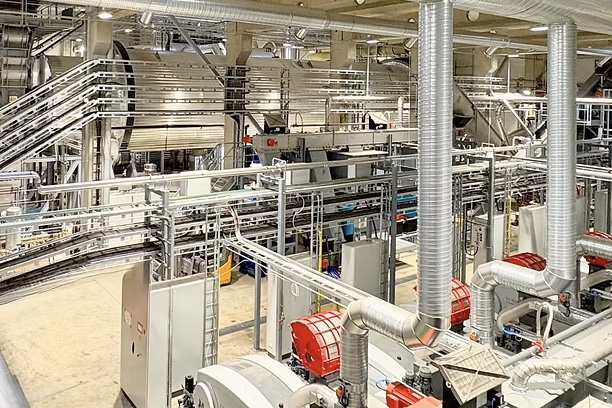
This effort is led by long-standing Hastings-based company Polytechnik and its purpose-created offshoot – Carbona.
Last month, Minister for Energy (and Climate Change) Simon Watts announced a MOU between Genesis Energy and Carbona to produce torrefied wood pellets with the potential to replace coal with biomass fuel at Huntly Power Station.
Genesis has publicly announced a target of using 300,000 tonnes of biomass fuel to displace its coal generation at Huntly by 2028.
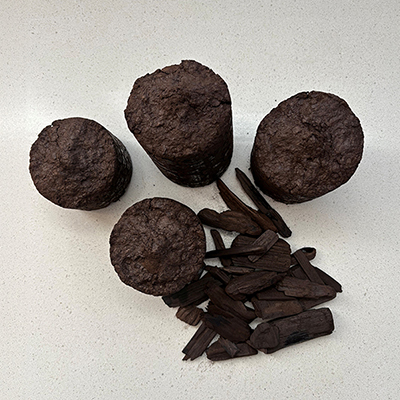
Torrefaction is a proven technology for super-heating wood (and other biomass) in a low-oxygen environment, removing moisture and volatile compounds, producing a dry, energy-dense product referred to as torrefied biomass. The process itself generates the energy to meet its own energy requirements, so it’s carbon neutral. And with what’s typically left behind from logging as slash given new value (instead of destructive potential), it can be economically used as feedstock for the torrefaction process.
David McGregor (Carbona) and Christian Jirkowsky (Polytechnik) are driving this project. I interviewed them recently in Hastings.
McGregor estimates the NZ market for industrial use of substitute torrefied pellets (by the likes of Fonterra) is 800,000 tonnes per year. But to Carbona, this is just the starting point. The Huntly project alone would initially use a plant fueled by 300,000 tonnes, but could consume 500,000 tonnes of pellets to generate electricity.
For its part, Genesis recognizes it needs a secure, coal-substitute fuel source that is neither sun, rain or wind reliant to generate electricity in dry years. Genesis has trialed the process already at smaller scale and is now looking to scale up with Carbona.
Other major NZ user industries, including dairy, meat, steel and cement – all needing to address electricity prices and emissions footprints – would readily lift the domestic market to around 1.5 million tonnes, which is ample scale.
Internationally, the market would be in the tens of millions.
The plant to get this started will be one of the biggest in the world. Carbona is in the process of organising investment from iwi, NZ wood processors and overseas investors. While ticking important environmental boxes, “it has to stand up on its own feet” economically, says McGregor. That case involves producing electricity at a lower cost than the only other possible alternative … imported LNG, which is increasingly expensive and insecure from a supply chain perspective. McGregor, just back form Finland, where Polytechnik is in the last stages of commissioning a plant of similar scale, is confident the numbers are clearly in favour of torrefied biomass.
Carbona’s target is to commission the plant in the Central North Island in late 2027, with production replacing coal in 2028. If it produces at a scale beyond Huntly’s needs, Carbona would envision shipping torrefied biomass to other customers via Napier Port.
Similar plants would be viable in forest-rich regions like Hawke’s Bay, where Carbona is confident they could stand up an economically viable plant fueled by 180,000 tonnes of wood waste. As noted above, the EECA analysis indicates that supply is readily available in the region (600,000 tonnes).
Torrefied biomass produced in Hawke’s Bay could be used as a gas substitute for industrial boilers locally or for export, either to the South Island (substituting for coal) or overseas … a prospect Napier Port might find enticing.
BayBuzz energy and climate reporting is sponsored by Unison in support of independent local journalism. Any editorial views expressed are exclusively those of BayBuzz. Unison is not associated with those opinions.


This sounds like a great idea to utilise the slash from forestry – getting rid of a major destructive matter and making power for industry that doesn’t add to our climate problems. Having seen the destruction caused by slash I think any way of reducing, or clearing, the stuff has to be a major step forward – the fact that it has other major benefits is great and research should be encouraged by local and central government
Hi Grant,
Biomass is utilised in the region as energy but it is mostly in the wood processing sector like sawmills, Pan Pac etc. Currently, more than 85% of all businesses in Hawkes Bay utilise natural gas as their primary fuel for process heat (steam and hot water). However, the future of natural gas supply is not looking secure so biomass is an alternative fuel option to replace gas.
The more businesses we can switch to biomass will reduce the volumes of slash being left (securely) at a forest skid site. The benefits are numerous for the environment, the community and for businesses (as a long term low cost energy source).
The environmental benefits are impressive … but ultimately the economics will float or sink it. The costs of gathering, loading, carting and stockpiling slash all factor into the equations. I wonder, also, whether the ash residue has value, possibly as backhaul loads for the ‘bin lorries’ to return nutrients to the forests?
Hi Gary,
Forest residues (aka slash) is expensive to collect and transport but when you compare it against other fuels like diesel and natural gas it is very competitive. There is also good long term supply of biomass in the region especially when natural gas supply is not looking secure.
Ash ideally should be returned back to the forest to complete the cycle. The volumes are low and ash represents less than 0.5% of a total load (depending on the quality of the load- bark and dirt represent more ash). Ash can be utilised in a compost too.