


Where the wood came from and what is killing the creatures remains unknown, says HBRC.
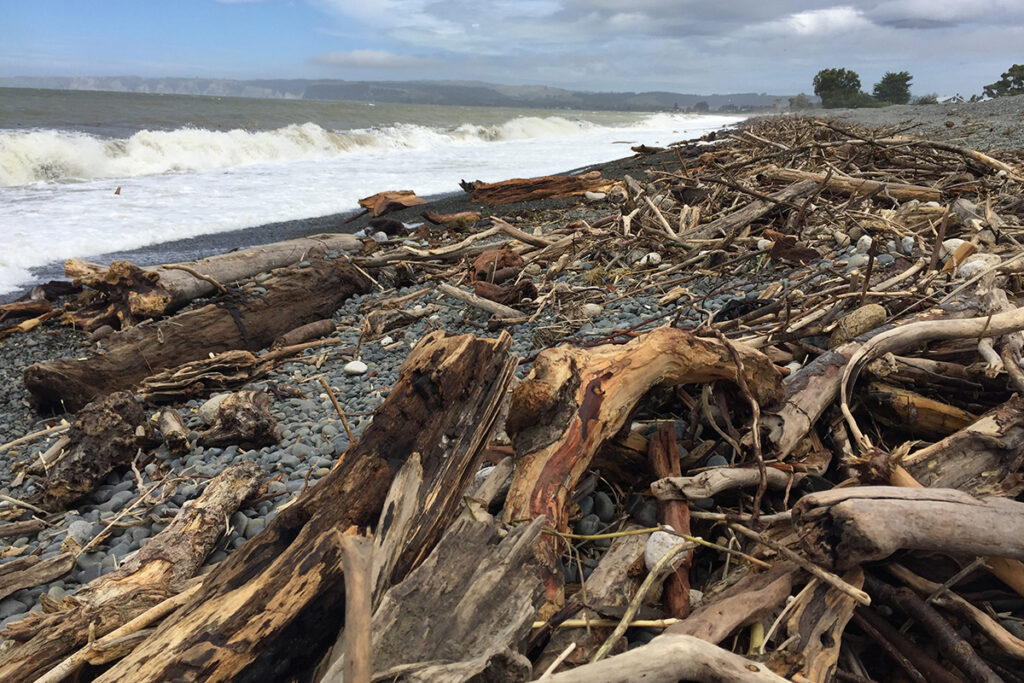
Haumoana resident Keith Newman says he’s never seen this much wood debris wash up on the beach, even after heavier rain events than the region experienced last week.
Other residents who have lived there longer concur – it’s an unusual and “fairly major event”.
“There are a lot of people talking about it locally. Most people will say we had something like that back in Cyclone Bola times, but it’s rare. That beach is pretty much pristine.
“Right now, everything is being shaped by probably a meter deep of – it’s not driftwood – some of it is old, some of it is quite large, some of it is tree trunks, some of it is pine which is clearly come out of the Charlton Road commercial pine forests. But a lot of it is willow. I don’t know if it’s just the rain pushing it down from the Ruahines. But we’ve had stronger rainfall and not seen that as a consequence.”
There had also been chatter speculating that recent Council tree trimming activities on the banks of the Maraetotara River may have had an impact – either by clearing the flow, or by debris being left behind.
However, Hawke’s Bay Regional Council said in statement released Friday afternoon that the source was unknown.
“Sources of unusually large amounts of driftwood in the water and on several Hawke’s Bay beaches is not yet clear, but the materials appear to be small and of mixed origin and not from recent forestry operations,” Hawke’s Bay Regional Council Group Manager Asset Management Chris Dolley said.
Any material identified as forestry slash would be “followed up” by the council – but otherwise the responsibility for the clean-up and maintenance within the riparian margin rested with the landowners of rivers, streams and watercourses within the various catchments that discharge into the Bay.
The situation would continue to be monitored he said, and pointed out that there were ecological benefits for the fenced off area between Westshore and Bay View, strewn with wood, because it is a protected habitat of the New Zealand dotterels.
At the same time, dead sea life – kina, starfish, crayfish and sea cucumbers – have washed up on the beach at Hardinge Road, and the Napier Harbourmaster Adrian Wright, reports that floating wood debris is making port activity a little more difficult than usual.
He said the debris might present issues recreational boat users and commercial vessels and anyone engaged in water activities over the long weekend.
“Due to weather there is an excessive amount of driftwood/debris in the ocean and all boaters and other users should avoid (if possible) being on the water.”
If it was necessary to be on the water, he advised a heightened level of caution because driftwood and other debris can cause bodily harm, adversely affect vessel propulsion systems, and the physical integrity of smaller crafts.
The dead sea life on Hardinge Road beach was being investigated and samples had been taken for analysis, Science Manager Anna Madarasz-Smith said. The situation was considered isolated and unexplained.
“This event is heart-breaking, and shocking for our community, and indicates the marine ecosystem is struggling.
“We have had heavy rain and warm seas, and this may have contributed to this event. Our team are out on the water today taking samples. We need to undertake scientific analysis to determine the cause, and it may be some days before we have any answers,” she said.
The Regional Council is taking the lead on this situation as this is possibly a wider environmental issue – with support from Mana Ahuriri, Te Whatu Ora, Ministry for Primary Industries, National Aquarium of New Zealand, Department of Conservation, and the Port of Napier.
The Regional Council’s pollution response team is investigating for any spills in the known high-risk areas in the vicinity.
The public are urged not to gather or consume the dead sea life.
Public Interest Journalism funded through NZ On Air.
Photo: Dead sea life. HBRC supplied.

The dead sea life all live on the sea floor. Could it be that mud from the rivers in flood has washed into the sea covering the sea floor and covering the said life, killing them?
Thanks, Patricia.
In addition to the sediment from flooding, the red algae in the ocean blocks the light for bottom dwellers, compromises visibility for sea creatures seeking food, lessens oxygen in the water, etc, and other detrimental affects. A very stressful time for ocean inhabitants.