

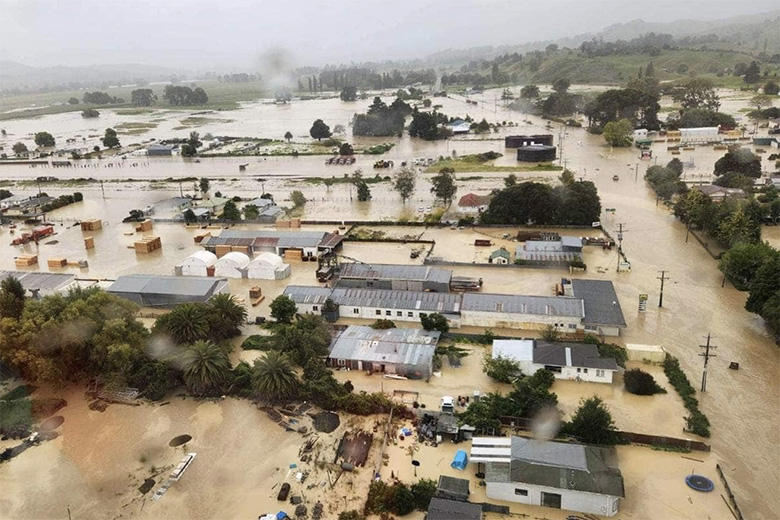
As documented with our own eyes at the time, hours and hours of video and thousands of photos, we all know a helluva lot of water fell and flooded across Hawke’s Bay during Cyclone Gabrielle.
Now, NIWA has completed a thorough analysis – based on reviewing historical data, data recorded at some twenty river gauge sites during flooding, and extensive modeling – to report more precisely what exactly happened in terms of flooding in catchments across Hawke’s Bay.
The current data included any information about river stage heights, estimates of peak flow discharge and anecdotal information about places where the river overflowed. The analysis sheds light on the peak flows that occurred at these locations and attempts to recalculate the future likelihood of severe flooding events.
Bottomline: at 13 of the 20 sites examined, Gabrielle was the largest flood on record.
As HBRC Chair Hinewai Ormsby put it: “The modelling reinforces that the cyclone flooding was largely unprecedented. The sheer volume of the cyclone’s flooding and its impacts on flood mitigation infrastructure could be compared to having a 100-bed hospital where suddenly 500 patients turn up.”
The principal value of this analysis will be to inform planning and design of our necessary flood protection improvements and approaches to managing the overflows associated with future extreme weather events.
Although the Regional Council has restored the level of protection that existed before Cyclone Gabrielle, huge decisions await our community as to the level of future protection that should be provided, how, and at what risk tolerance and cost.
HBRC is looking at these issues as part of the independent review it commissioned on the performance of its flood protection schemes during the cyclone, its internal review of the major Heretaunga and Upper Tukituki flood control schemes, and in planning the flood protection mitigation measures that need to be implemented to move remaining homes in seven heavily affected locations out of their present 2C categorisation.
The new analysis provides better insight into how and where water flowed on a catchment by catchment basis, enabling all mitigation planning and measures to be more finely tuned.
The analysis also makes a big point of estimating the likely recurrence frequency of similar flooding (technically, the Annual Recurrence Interval (ARI) or Return Period).
Here the analysis is more backward looking, comparing Gabrielle to past flooding. And arguably of less practical value. NIWA acknowledges that although it has revised all previous estimates to now indicate greater frequency, these are imprecise given climate change.
For example, what we witnessed in Cyclone Gabrielle might have been considered previously a 1-in-1000 year event; such an event is now estimated to be a 1-in-400-500 year occurrence in the Heretaunga Plains.
BUT, as NIWA notes, that next event could happen at any time! “Because flood events occur randomly, just because a large flood with a high ARI has just occurred, there is no guarantee that there will not be another one in the near future.”
Not a happy thought when our recovery planners are looking at a 10-year time frame to recuperate from Gabrielle. Lots of crossed fingers out there!
The report notes:
“Severe ex-tropical cyclones only reach New Zealand periodically, but often cause extreme flooding when they do. Because they occur less frequently than ordinary rainfall events, we have less understanding of the statistics of their occurrence, making it vital to learn from Cyclone Gabrielle …
“The effects of climate change are expected to also affect rainfall intensity and the occurrence or intensity of ex-tropical cyclones reaching New Zealand. These effects could change the ARI of these flood peaks in the future. The reported values, however, represent our current best estimates of the ARIs of the flood peaks that occurred during Cyclone Gabrielle.”
So, not a lot of help there for our councils’ planners, other than, ‘Build better … and faster!’
For anyone interested in diving into the full report, here it is.

Great—-we need ACTION. (Local)governments are masters in producing (expensive) reports and endless huis and the like. Our house got wiped out (when I bought it the council indicated that it was in a ‘flood safe’ zone….), thank God for good insurance. Could not handle another 1-1000 year event though. All effected households and businesses in our small town deserve proper mitigation – repairs of the broken stop-banks doesn’t do it. “When do we need it = we need it NOW”
GIven that we have NO records going back 500years and given we have experienced significant floods in 1938,1988 and 2023 the notion that Gabrielle was a one in 500 or some other random number in my opinion is a nonsense.The above facts places Gabrielle at less than 1 in 50 and I am sure there were recorded flood s prior to 1938. SO NIWA and regional council stop trying to have a lend of my intelligence!!
We should compare our rivers to a gutter on a house. When there is some debris in a gutter, it soon moves along to the outlet and blocks the outlet. Within a few minutes the gutter overflows. This same situation occurred at many bridges along these rivers, especially at Waitangi, where the low rail bridge captured a vast amount of tree slash, which definitely would increase the height of the river flow prior to the bridge failing. These types of bridges are essentially turned into a weir once they have captured enough debris. New bridges with higher decks and fewer pylons are needed to ensure the slash can pass under without blocking the flow.
When will the planners, fix-it teams and people at large appreciate that from the mountains to the sea, rivers flow where they will, according to volume? We need to learn to respect them as we do, the seas, and live alongside, in harmony with nature. Give our rivers the space they demand!