

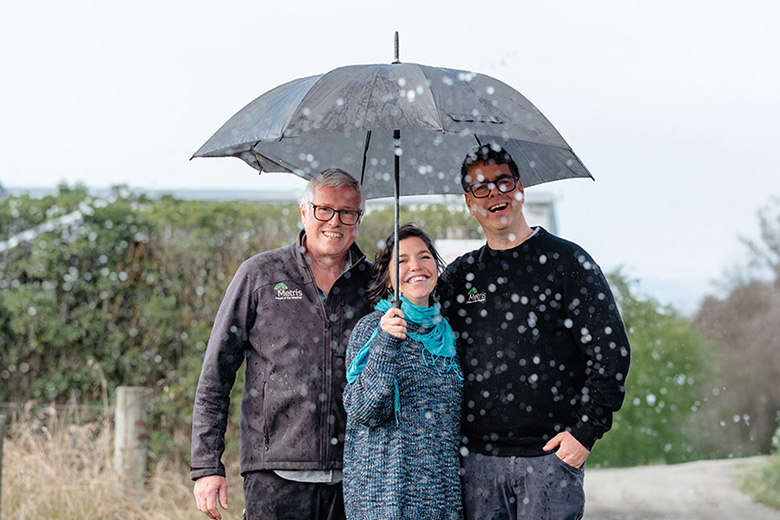
[As published in July/August 2026 BayBuzz magazine.]
From a handshake deal, Mark Bart has built Metris into a market-leading forecasting platform and range of tools that set businesses up for success.
Mark Bart is animated. He’s excitedly painting a picture of the time he crewed a converted passenger aeroplane, stripped of its seats and fitted with intricate scientific instruments, through the ash cloud of an Icelandic volcano.
It was 2010, and the Eyjafjallajökull eruption had grounded air travel across Europe for weeks. Well, most air travel. Mark held a research position in atmospheric science at the University of Leeds and, as he describes it, “got to boost around in our converted BAe146 whisper jet, measuring air quality. I learned so much.”
Mark is obsessed with weather, with climate, with the particles in the air, and with measuring all of it. He is the brains (and the Berocca-in-human-form) behind Metris, a Havelock North-based weather measurement and forecasting company that operates around 350 weather stations with over 5,000 individual sensors across New Zealand.
From a weather jet flying into Chile and the Sahara, he’s come down to earth somewhat and the bulk of his business, now, is focused on horticulture, with a promising side-hustle in construction.
Way beyond MetService
This is no MetService, Mark explains – the weather stations planted in the orchards and fields of their 250 customers are building out an interpretation layer on top of raw data that delivers time-critical information to growers.
“MetService might tell you it’s windy or sunny or rainy, but it can’t send an alarm to your mobile to get you out of bed ahead of a frost, or drill down to the nitty gritty detail. Metris can advise on whether it’s a good day to spray, at what time spraying should start and when to stop. And it can code this by specific zones, hour by hour and right down to individual sites.”
Each night, information from the sensors dotted across New Zealand (but primarily within the key horticulture regions of Hawke’s Bay and Bay of Plenty) is plugged into a supercomputer in the United States, generating around 15 gigabytes of data that feeds into forecasts tailored to Metris customers. Mark jiggles the mouse on his PC and a screen springs to life showing a spray forecast for Elwood Road, colour-coded for clarity.
When applying chemicals, explains Mark, growers need to know they’re not going to be blown around or washed away within minutes. If they’re going to get the frost fans out or call up the helicopters, they need to be certain they can justify the cost. And 1,500 individual users agree – Metris has accumulated a legion of fans who rely on their sensors and this platform and consider it key grower infrastructure. “Many of our new customers will come to us when an orchard manager has moved to a role in a different company and it’s not running Metris. They want the information and level of detail they used to get each morning in order to do their job well, so that’s when we often get a call for a new installation.”
Origin story
The business is Mark’s baby now, but he didn’t birth it. After completing a PhD in chemistry at the University of Canterbury, but with a strong physics thread running through it, Mark spent time at the Measurement Standards Laboratory in Lower Hutt, doing precision temperature work for industrial clients including steel mills and the Methanex plant in Taranaki. The travel bug took him overseas, riding a motorcycle across Russia with his partner, Jane, and to the job in Leeds.
Back in New Zealand, Mark found himself doing air quality monitoring work with clients that included the Huntly power station, but restless and underutilised, he yearned for a challenge.
In 2016, he got a call from his school friend Paul Heaps asking if he could build a frost alarm for an orchardist, which led him to Howard Staines – a Hawke’s Bay horticulture stalwart who had spent more than 20 years running a one-man weather forecasting and pest modelling operation. He was ready to retire – and Mark had an appetite for something new.
“He said, ‘I want to sell the business’ and I said ‘Sweet! I’m keen to get into this!’”, Mark recalls. “We shook hands, he stayed on until 2022, and I paid him out over four years.”
Paul, who became a shareholder and partner in Metris, was instrumental in those early days, getting the weather station network started and making sales. He’s stepped away from the daily grind but today’s team remains lean and high-performing. Mark works alongside technician Chris Arts – “what shall we call you? Service Manager?” asks Mark, glancing at his colleague. He explains that Chris – who enjoyed a 38-year career in aircraft maintenance – handles everything from routine servicing to weather station builds to emergency callouts. “When you hire a weather station, you get Chris with it.”
Justin Courtney, based in Dunedin, is the founding chair and leads the South Island side of the business while Pilar Ortega-Hamal, an environmental management graduate, handles everything else – mainly customer service and operations.
Alongside granular weather forecasting, Metris runs pest and disease models that flag bacterial and fungal infection risk based on weather conditions, taking into account impacting factors like heat and leaf wetness “because a read-out of data alone isn’t enough – it needs interpretation”. There’s also a soil moisture monitoring system that calculates how long growers should run their irrigation to keep trees in the optimal range. The client list includes household names across apples, kiwifruit, grapes and a range of other crops.
Pricing is accessible, beginning at $72 per month, which covers the hardware, the platform, and Chris. The gear is leased rather than sold, meaning maintenance, upgrades, and repairs are all included. Chris says he’s seen far too many growers buy a weather station off the shelf, which degrades over time without the requisite attention and then starts spitting out unreliable data.
It’s a wonderful role in a growing industry with work that is perpetually varied and exciting. “One day is never the same as the next,” he says. “Mark is constantly coming up with amazing new ideas, which I then need to build something for!”
New products
Right now, there are a handful of new products and solutions commanding Mark and Chris’s attention. Metris is in the midst of developing a dust forecasting product aimed at the construction sector and with trials underway in Australia. “You want to predict dust risk before it becomes a problem, which gives site managers time to run water trucks before breaching their resource consent limits,” says Mark. “If you’re measuring dust, it’s already too late.”
The product has already won an innovation award, so the next step is scaling and utilising AI models to help with the time and labour-intensive customer on-boarding journey. “As it stands currently, it’s about a week of work for me. We’d like to get to the point where it’s a self-service platform and users can enter their location, link their local data, and get a dust forecast without my input.”
Closer to home, the next major development in the horticultural space is closing what Mark calls “the water loop” – moving from measuring and predicting soil moisture to actually controlling irrigation systems automatically. “We’re playing with a prototype right now which can measure the weather, predict the weather, measure the soil moisture, then turn on the pump and the irrigation system for exactly the right amount of time to keep everything optimised.”
Then, there’s the beetle sensor. Ants and other crawlies love Metris’s rain gauges, says Mark, because they are warm, dry and cosy. So he’s in trouble-shooting mode, finding new ways to deter orchard critters from eroding their valuable infrastructure.
Their business tagline is ‘ahead of the weather’ but it’s safe to say Mark, Chris and the team are staying well ahead of the future too. “What we do is personalised,” Mark offers. “But there are other innovations ahead for us, for sure, and I think the business will look completely different in five years’ time.”
