

[As published in July/August 2026 BayBuzz magazine.]
From the paddocks of Pātoka to cutting edge AI
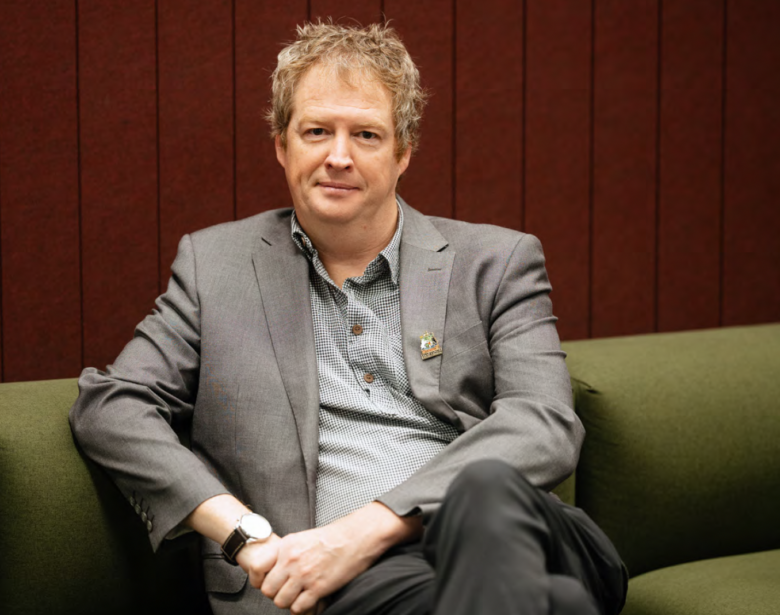
Growing up on a sheep and beef farm in Pātoka, north-west of Napier, didn’t obviously point to a future in artificial intelligence. But for Callum Ross, founder of deep-tech startup RossAI, the seeds of his AI venture were planted early.
“My father was a shearer. We were always designing, making things on the farm because stuff broke down and you’d have to fix it.”
Ross says that number-8-wire upbringing led him into engineering and industrial design, then on to roles with some of New Zealand’s most innovative exporters, such as Fisher & Paykel Healthcare, Rockit, and Next Window.
“I’ve learned so much from those companies and it’s filtering through to what I’m doing now.”
Today, Ross is the founder/owner of a business that’s generating a lot of buzz, and growing at a rate that most can only dream of.
Sustainable origins
It all started around seven years ago, when Ross was approached to help develop a novel packaging product – a cellulose clip – as a substitute for conventional plastic.
“That was our BioClip, which was made out of wood pulp. It kicked off where we are today.”
That early work set a direction that still remains.
“Our ethos is around being sustainable,” he says. “Fast forward to now, a lot of our products are based on reducing carbon footprint.”
RossAI now designs and builds about 95% of its products in New Zealand, from electronics to hardware, and software.
“What we don’t make is either the AI chip itself – we bring that in – and anything other than the actual hardware,” Ross says.
“That’s kind of our unique part. We make as much of it as we can, and where we can’t we’ll have it made locally.”
Being rooted in Hawke’s Bay is not just a manufacturing choice, it’s central to the company’s identity.
“We’re designing, prototyping and producing much of the technology locally, working directly alongside growers, manufacturers, councils and infrastructure operators.
“We’re trying to prove that globally relevant deep-tech products can genuinely be built from regional New Zealand.
“We want to make things that are Hawke’s Bay: Hawke’s Bay materials or Hawke’s Bay labour,” he says. “Everything we do, we want to promote Hawke’s Bay. That’s our passion, that’s our connection to the community. Growing up in Hawke’s Bay, this is our home.”
Four brands, one ambition
Ignoring the venture-capital playbook that says “focus on one thing”, Ross has deliberately done the opposite.
“We’ve got four brands at the moment,” he explains.
• WasteLens – AI-powered waste monitoring and contamination detection
• LabLess – real-time in-situ liquid and environmental monitoring
• OpsLens – real-time operational monitoring and reporting
• NAGS – robotic growing and automation systems for horticulture
RossAI is also developing its own AI brain, called AiON that will eventually sit over all of the company’s hardware.
“That’s really bringing all of our products into one brain,” he explains.
“You’re not just reporting in your dashboard, you’re actually creating a knowledge bank and intelligence that you can interact with.
”It’s multiple areas of your business, that you can access, essentially cutting out all the different types of reporting and software, and simplifying that whole process.
“There’s a big disruption, I think, in the market around ERP systems, whereas a brain bank or a system like this can actually replace that, and it’s a fraction of cost.”
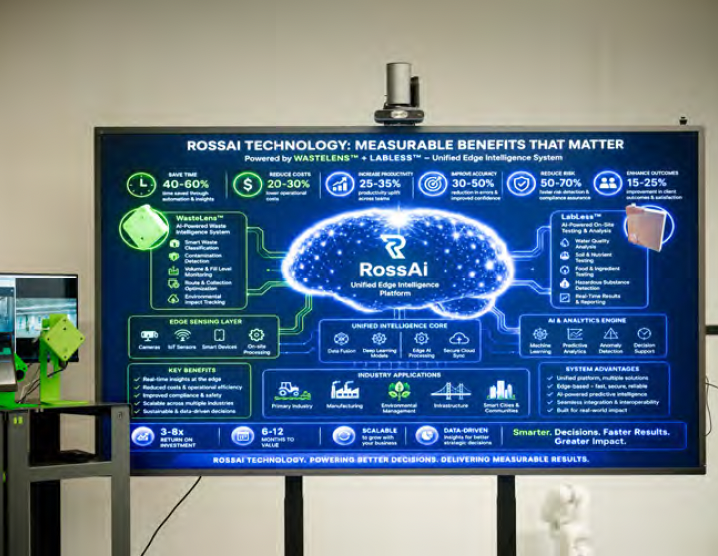
Ross acknowledges that potential investors have pushed him to narrow the focus. “And I’ve said, ‘Sorry, I can’t actually do that. It’s not me.’”
Triple-digit growth
While the technology might be cutting edge, RossAI’s product suite focuses on solutions to age-old problems: wasted time, wasted product, wasted energy, saving money, how to make better decisions. It’s an approach that’s finding favour.
“In the last six months our productivity has just shot up,” Ross says. “We’ve seen huge growth – about 120% – in the last six months.”
Today, most revenue is domestic, but not for long.
“We’ve probably got, in the pipeline, half a million dollars’ worth of projects,” he says.
“We’re moving into that $500,000-plus range annually. We’ve just signed an agreement with a company in Canada. New South Wales is a big one for us. We’ll be exporting pretty soon.”
He’s under no illusions about the pace, or the risk. “I think we’re going to see a massive uptake (globally) in getting solutions to market. The speed is phenomenal,” he says. “It’s actually frightening how fast a lot of this tech is moving.”
That’s why RossAI deliberately “overspecs” its hardware and keeps as much as possible in-house.
“LabLess is exceptionally overspec’d, for something in the wine industry, but it’s actually going to be a great fit for what we’re doing now.
“It’s configurable and adaptable to all industries, but we’re focusing on one or two core ones at the moment.”
AI at the edge – and in the office
The RossAI team is surprisingly small, numbering just six (not all of them full time), complemented by a few contractors.
How do they manage to get so much done, BayBuzz asks?
“We use AI extensively,” Ross says, “automating a lot of our processes.”
The most staggering example is TenderTed, developed by RossAI in partnership with Co-Intel AI, (and launching later this year) to automate responses to tenders, RFPs and funding applications.
“Instead of taking 30 to 60 hours to do a tender, we can do it within ten seconds,” Ross says.
“Responding to a tender takes a huge amount of resource. We can do that within seconds.”
That frees the team to spend time on higher-value work.
Crucially, RossAI is betting on “AI at the edge” rather than in distant data centres.
“There’s a movement that we’re seeing with a lot of our products, and it’s called AI Edge,” Ross says. “AI Edge technology is processing a lot of the AI in situ. Everything’s on the device… it’s secure, it’s not in the cloud.”
He sees security and sustainability as intertwined. “You’re not relying on big data centres,” he explains. “Data centres obviously consume a lot of power, water – there’s huge demand from data centres – but our model is that everything’s processed in situ.”
Predicting problems before they happen
Across waste, water, manufacturing, and primary industries, RossAI’s systems are designed not just to measure, but to predict.
“This is where the evolution of prompting and AI (is going). We’re going to see prediction. AI will tell us that this week you’re going to have ‘this challenge’, or this week you’re going to see an uptake of usage.”
Ross sees big potential in health and safety and infrastructure monitoring.
“We can almost predict a near-miss happening,” he says.
“If someone’s coming too close to a machine, we can actually say, ‘there’s a 95% chance that you’re going to see an accident this week,’ because we’ve got all this data in between.”
For Ross, the real value is making complex operational data understandable – and actionable – for people running plants, factories, and councils.
“Our goal is just helping New Zealand businesses get a little bit more competitive in productivity, just understanding productivity,” he says.
“We try and measure against OEE – overall equipment effectiveness – and that can be quite challenging to get up to a level of being effective.”
Where to next?
When asked about what the end game is, Ross is clear.
“My goal is to actually have a company … a tech company here in Hawke’s Bay.
“We want to really export our products, and make sure that we retain that sustainability story.
“This is home for us,” he says. “This is a passion – it’s 24/7. I enjoy 3D printing things. If I can make something overnight and show somebody that it will change their business model, then great.”
In other words: the farm kid from Pātoka is still doing what he’s always done – designing and making things that solve real problems. The tools might have changed. The ambition has not.
