


The HB Regional Council released three reports this week looking into the physical circumstances and flood management surrounding the 26 June Wairoa River flooding affecting over 400 homes.
Most contentious in the aftermath have been claims that HBRC staff ‘botched’ the situation by acting too slowly to cut a new exit channel to sea to release the flood flows.
The reports suggest an alternative approach might have been attempted, but without certainty it would have worked.
Instead, given an ‘event’ involving unique circumstances – from inaccurate weather forecasting and modelling to the pre-flood location of the river mouth to extreme waves affecting the bar crest – the thrust of the reports is that the flooding would have occurred regardless of measures being attempted.
What in fact ‘saved’ Wairoa from worse flooding was creation of a natural breach of the bar in the morning of 26 June, creating another exit point for the floodwaters.
Consultant Graeme Campbell, Strategic Advisor Te Uru Kahika (the group representing NZ’s regional and unitary authorities), with 45 years’ experience in flood risk management and river engineering observed:
“Events of this type are likely to become more frequent. Options for managing this risk are being considered as part of the wider Wairoa flood resilience work currently being undertaken. These flood risk management options need to include stopbanks, channel dredging, mouth training, mouth cutting, house raising, managed retreat and many other options. It is unlikely that any one measure, and particularly mouth cutting, is going to be sufficient to manage future flood risk.
“What is clear is that Wairoa Township cannot rely on mouth cutting as the primary form of flood risk management because of the operational difficulties and uncertainties of always keeping the bar in an ideal position ahead of a flood, sea swell event or combination of the two.
“It is clear that all procedures were taken into consideration with respect to making decisions on the cutting of the Wairoa Bar from early in the week before the event through to the decision to prepare for a cut on Friday 21st and the start of the cut on Tuesday 25th June 2024. By that time, it was too late to complete the cut on the 25th June and the flood and sea swell events on the night of the 25th June and the morning of 26th June 2024 overtook events.”
Adding: “Judgements must be made, with the best information and experience available at the time. Staff need to be supported in making those judgements.”
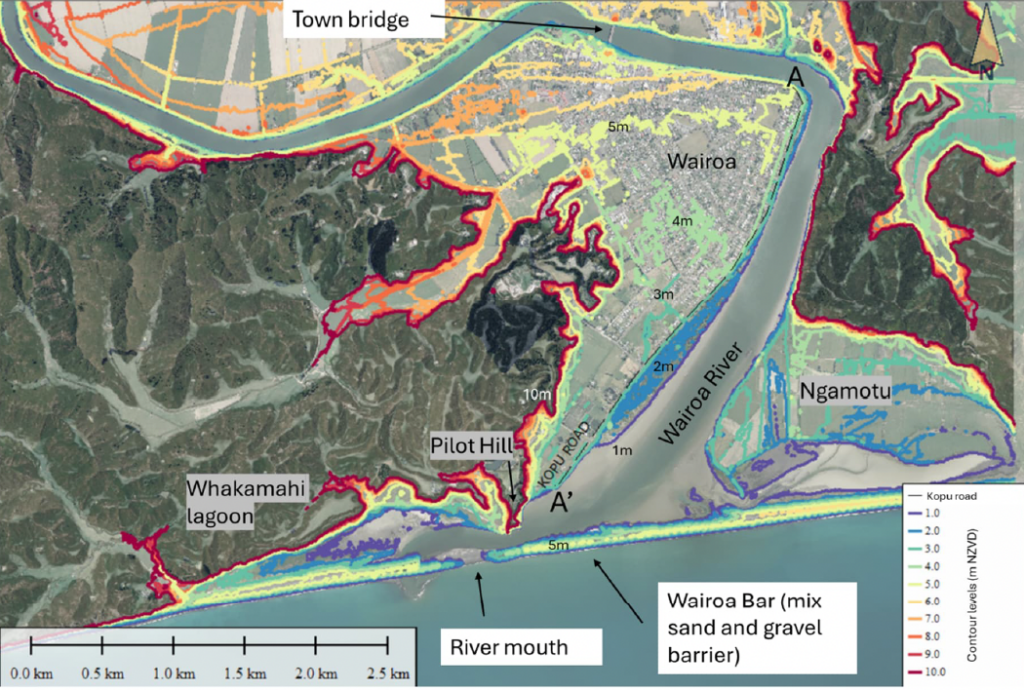
A report by Rivers Engineer Kyle Christensen also looked into the flood mitigation decisions made at the time. He notes that “none of the five ‘Key Success Factors’ for a river mouth opening were satisfied ahead of the 26 June event.”
“Even if the contractor had been instructed to commence works on the Friday prior to the flood event, four or the five key success factors still would not have lined up for a successful mouth opening on the following Wednesday.”
But Christensen notes that an alternative approach – lowering the crest of the bar instead of attempting a full cut through it might have in effect hastened creation of the natural breach that did eventuate.
“I consider that at the point on Monday evening when the rainfall and resulting river flow forecast changed to show rising river levels from about 8pm on Tuesday night that potentially a more productive use of Tuesday might have been to try and lower a section of beach crest as much as possible…”
“There were communications from Pryde (Ed: the Wairoa earthworks contractor) suggesting that crest lowering was what should be progressed on Tuesday but this was not interpreted as being an alternative method by HBRC and in the end a standard full mouth relocation procedure was followed.”
In any event, after discussing both earlier deployment to cut a channel or focusing instead on crest lowering, Christensen concludes with a series of unknowns:
“What can be said for certain is that neither of the scenarios outlined in these counterfactuals were executed so there was effectively no mitigation in place in terms of a lowered section of beach crest or open pilot channel for this flood event. Whether this would have made any difference is unknown due to the large waves that occurred prior to the flood rising sufficiently and low tide conditions occurring for a breach to possibly form from these works. It is also possible that the river might not have had sufficient energy to overcome the large waves any earlier than when the natural breach occurred no matter what preparatory works were in place.
“Notwithstanding the above, having either option in place would have likely been better than nothing and at least provided the possibility of a breach occurring earlier in the event which might have reduced the extent and duration of flooding.”
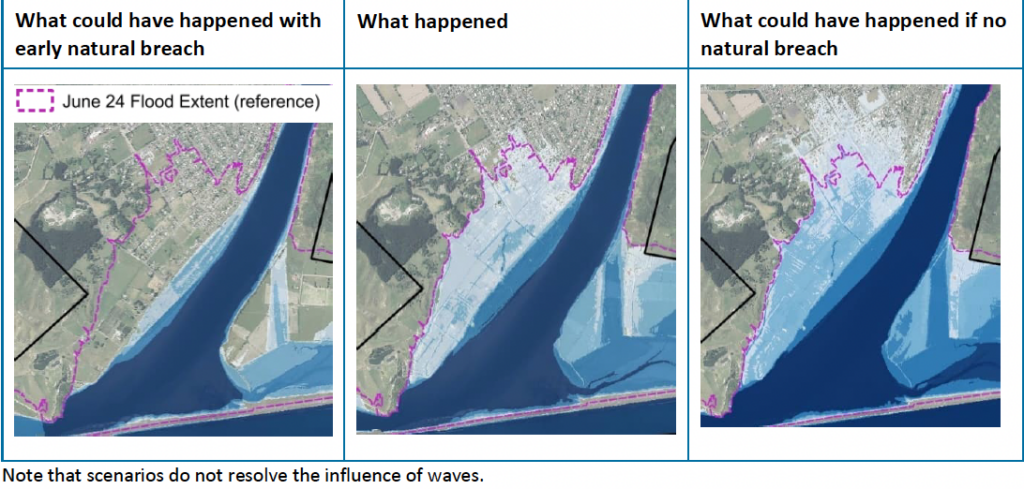
The unknowns around these alternative actions are consistent with the Tonkin + Taylor study, which is by far the most in depth analysis technically.
Says T+T: “…the combination of high rainfall, rising river level, spring tides, large waves, storm surge, as well as the position and size of the river mouth through the bar, all coincided to influence the flooding experienced. The joint coincidence is therefore likely rarer than the individual elements and makes management of the situation more complex.”
The T+T analysis dives into the effects of the extraordinary wave conditions and the fact that during the flood event the river mouth was located west of Pilot Hill, meaning the flood waters needed to go through two narrow passages to escape, resulting in a more substantial back-up (i.e. more flooding in town).
T+T ‘s modelling shows that: “…with a 16m wide manual breach established and maintained in place prior to the flood event, peak flood level attained in town could have been reduced from what occurred, although flooding would not have been completely eliminated.” But adds: “HBRC note that past opening attempts have been blocked by wave action re-filling channels before the river flow can wash out the bar.
Whether or not the manual breach could be maintained throughout the flood event is not known, especially given the extreme surf that occurred at the coast during the actual event.
“For the June 2024 event, it is feasible that wave action on the bar could have closed a channel that was recently cut using mechanical intervention.”
And it gets worse. “Coastal adjustment to sea level rise at Wairoa over the next decades may result in higher bar levels, which may reduce the potential for natural river breaching of the bar.”
So, a heap of maybe’s and uncertainties.
In their totality, these reports say, yes, we could have been better prepared in various ways, but that might not have saved the day!
HBRC Chief Executive Dr Nic Peet commented that steps have already been taken to improve monitoring of the river bar and to improve its current condition. “Working with a local contractor, we have lowered the existing beach crest and created an overflow trench in the Wairoa Bar, 500m to the east of Pilot Hill. The trench is to allow the river to overflow the bar in a rainfall event and also allows a new opening to be completed more quickly, when conditions allow.”

“Further, we are making sure that we have a comprehensive operational plan in place for the management of the bar and are working to ensure that we have enduring and clear arrangements in place with a local contractor.”
But he added: “In future, Wairoa cannot depend on bar openings as the only method for preventing flooding in the lower part of the town. As sea level rises and storms become more intense, further options are needed. We are committed to investigating these together with Wairoa District Council, Tātau Tātau o Te Wairoa and the Crown.”
A point echoed by HBRC Chair Hinewai Ormsby: “We will diligently find the right longer-term solutions, not just for managing the river mouth better but also for ensuring that the entire Wairoa River flood management system provides the best flood mitigation possible for the township.”
The full reports are available here.

After Cyclone Gabrielle, Forest & Bird Freshwater expert, Tom Kay, made a case for allowing the rivers extra room, which allows for weather events. His presentation didn’t include Wairoa, but perhaps the same principles apply?