


[As published in November/December BayBuzz magazine.]
On a remote, sheer hill-face above the sea at the northern end of Cape Sanctuary’s Ocean Beach, a little bit of spine-chilling magic is unfolding.
It is Monday 14 October and forty-eight juvenile tuatara that have been transported up from Victoria University of Wellington earlier in the day are about to be released into a newly built mouse-proof one hectare enclosure at the Cape’s new seabird site extension.
Liz Lowe, a co-owner, with husband Andy, of Cape Sanctuary, crouches down and helps ease the first fledging reptile, no bigger than the size of her hand, into a prepared area of coastal scrub, rocks and natural lime.
“Conservation in action!” Liz exclaims as the small creature – a remnant of Aotearoa’s ancient natural taonga – slips off to its new home. A cheer goes up from an excited crowd of 40-odd watching on, among them Chair of Ngāti Kahungunu Iwi, Bayden Barber, and Todd Dawson, CEO of Napier Port, who has helped fund the new extension, as well as Cape volunteers, members of local hapū, DoC workers and university researchers.
It is nearly 20 years since Liz and Andy Lowe, in partnership with the Robertson and Hansen families, set up this 2,500 hectare sanctuary, bounded by a 10.6 kilometre predator fence. It was to be a pioneering project that aimed to combine bird, animal, plant and tree restoration with the demands of a modern working-day farm, with approximately 50% of its land in farming and forestry.
Today the Sanctuary, privately funded by the Robertsons and Lowes, can count many successes – one of them a thriving population of some 200 tuatara. And in fact, the ones released today, are “returning home”. Their eggs were laid by adult tuatara at the Sanctuary last October. Five clutches were then carefully dug up and transferred to Wellington for research into incubation conditions.
“The Cape is a very good site for tuatara with compelling evidence they once lived here,” says Nicky Nelson, Dean of Science at Victoria University, who led the first successful translocation of tuatara to the Sanctuary in 2012. She has come back regularly with students to weigh, measure and monitor the reptiles and says the Cape’s resident population is of special interest to researchers observing how the species responds to climate change at a coastal site.
Branded ‘one of HB’s best kept secrets’, Cape Sanctuary had always been a bit of a mystery to me. I’d heard the stories of the exclusive golf course on the Clifton side and of the rich and famous staying at the Lodge and going on night kiwi tours. And I had read media coverage about kiwi chicks who died back in 2017.
What’s more, in 2002 when the Lowes proposed building a village-style community of 900 homes on 75 ha at the southern end of Ocean Beach, I wrote a submission opposing any development at the iconic beach that had played a huge role in my HB childhood.
The village didn’t go ahead, but the Sanctuary did. Now providence has delivered me here to get a ‘birds-eye’ view of Cape Sanctuary today and find out where it’s heading.
Several weeks ago I joined Andy and the Sanctuary manager, Rachel Ward, at a 140-year-old restored hut nestled into the Ocean Beach sand dunes.
Just before my visit, a Jobs for Nature crew, Te Ngahere, had finished planting 15,000 natives on one of the steepest slopes towering above Ocean Beach. That makes more than one million natives planted since the Sanctuary began – a mammoth effort I note as I look up to the hillsides of green that were once barren.
Dunes
Another visible success at Cape Sanctuary is the complete rebooting of the 240 hectare dune system, much of which we are sitting amidst. An intensive restoration programme has removed stock, wilding pines, blackberry, boxthorn, lupin, pampas and maram grass. In their place native silvery spinifex grass and orangey tuffs of pĪngao, that Māori call the eyelashes of Tangaroa, are knitting across the dunes and literally bringing them back to life.

“A lot of people thought I was mad,” says Andy. “That it’d be impossible to do this project on coastal land here. There were reports saying the dunes were stuffed – a waste of time restoring.”
Fortunately Geoff Walls, a scientist with DoC, said the dunes needed “intensive care” work but could be saved. Apparently maram grass, in particular, suppresses the dunes’ growth. Without it, they are a dynamic and expanding ecosystem.
I look up at a big wall of golden sand curling upwards like a giant sculpture, its virgin surface smooth and pristine. These dunes are an exemplar of a NZ dune system in a near natural state and are considered nationally significant.
“The dunes are also the Sanctuary’s history book,” says Andy.
Biological fossil deposits dating back thousands of years reveal what animals and birds lived here once and might again. Among them the bones of Aotearoa’s unique ancient natural taonga – kiwi, moa, and in the case of tuatara dozens of their jawbones – as well as at least 30 bird species, skinks, geckos and bats.

The archaeological information is just as compelling. Hundreds of midden heaps have been found along with evidence of houses, storage pits, gardens, flaking floors, cooking fires and burial sites.
The dunes are wāhi tapu to local Māori and in recent years the Sanctuary’s cultural adviser Dawn Hariata Bennett, a member of the local Ngāti Mihiroa, a hapū of Ngāti Kahungunu iwi, has worked with archaeologists from Otago University unearthing koiwi (ancestral human remains) found sitting upright in the sand “facing east to see the sunrise”. The koiwi are carbon-dated and interned at an unspecified site in the Sanctuary.
The Māori name for Ocean Beach is Waipuka, meaning plentiful food and water, and it was once home to many of Dawn’s ancestors.
Today the main inhabitants of the Waipuka dunes are endangered dotterels and kiwi who often fossick here at night.
Kiwi
Some 800-900 eastern North Island brown kiwi and approximately 40 kiwi pukupuku (little spotted kiwi) roam free at Cape Sanctuary, many choosing as their favoured habitat the 400 hectares of pine forest.
The Sanctuary is New Zealand’s first Kōhanga Kiwi site for the eastern North Island brown kiwi sub-species, which means it releases out home-grown birds (over 1,000 grams) to other conservation projects via an annual round-up in collaboration with hapū iwi, DoC and Save The Kiwi. The most recent release was this year, when the Royal NZ Air Force donated one of their 18-seater helicopters to translocate 19 birds from the Cape to the northern Ruahine bush.
Retired Havelock North ecologist John McLennan, who has worked with kiwi throughout his 40-year career with Landcare and DSIR, set up and for many years ran the Sanctuary’s kiwi programme. I met him for coffee and asked about the 2017 death of 25 chicks.
“It’s been so unfair,” he said of ongoing negative media coverage. “The Cape had one bad year in a sequence of very good years and drought was the major factor with hungry chicks looking for soil insects and leaving the safety of nocturnal habitat for daylight where they became prey to swamp harriers and getting lost. And in that particular year, myself and then-manager Tamsin Ward Smith had left and there were new staff who were learning.
“But even in their worst year, the survival rate of chicks at the Cape [56%] was better than just about everywhere else.”
“We’ve got the best record for kiwi of everyone in the country bar none,” says Andy, when I mention “the debacle” as he calls it. “In our breeding population we’re getting between 1.6-1.9 chicks per adult male, which is a record. Our population is exploding.”
Other Sanctuary success stories include the kākāriki, and especially 120-odd kākā parrots, that are flourishing under the guidance of Rachel.
The Sanctuary is also part of the national Takahē Recovery Programme, with a current population of 11 and growing. On the day we release the tuatara juveniles, I encounter one of the distinctive purple/blue red-beaked takahē waddling on grass just metres in front of me. Soon after Rachel and I peer into a burrow and see a young fluffy, grey-faced petrel nesting. Historically thousands of seabirds used to make their home on these hilltops. Now grey-faced petrels, originally translocated from Moutohorā (Whale Island) are the first seabirds to successfully return to burrows after years at sea. With ongoing help from Napier Port, the Cape aims to bring ten endangered seabirds species back to nest over the next ten years – fluttering and flesh-footed shearwaters and Cook’s petrel for starters.
The seabird programme is the first of its kind on mainland New Zealand – the only sanctuary combining seabird restoration with forest-birds, animals and plants.
“It’s been nearly 20 years, but we’re still really in the setup phase here,” reflects Andy. “We’ve broken the back of it, but the Cape is a scientific experiment and we haven’t always got it right. We tried to put saddlebacks in the inland Rough Block, for example. It didn’t work. We’ll try again soon in our coastal forests.”
Volunteers
Essential to Cape Sanctuary’s work is another species called ‘volunteers’. At any one time some 200 people are on the list, doing everything from daily feeding of kākā, biodiversity monitoring, to pest and weed control and tree planting.
“I couldn’t do this without our volunteers,” says Andy. “Volunteer labour is better than financing a workforce. If we pay $30 bucks an hour each for ten people out working here, seven hours a day, that’s $2,000 a day.

“We really try to value volunteers’ time and skills. We try to make it socially appealing for people to volunteer and they have free use of several huts in return. They can come out for the day, spend the night here. Bring grandkids out. As long as people want to volunteer, they’re welcome.” Even though most of the current volunteers are retired, he assumes he’ll have a volunteer labour force in place 30 years from now.
“We’re getting a constant flow of people in and out,” adds Rachel, who runs the volunteer rosters. “Most people get addicted to this place. It gets under your skin.”
One is retired beekeeper John Berry, who has volunteered at the Sanctuary since its beginnings. He’s helped with predator control and bird translocations from offshore islands and is currently responsible for regularly checking kākāriki nests, keeping starlings out of them.
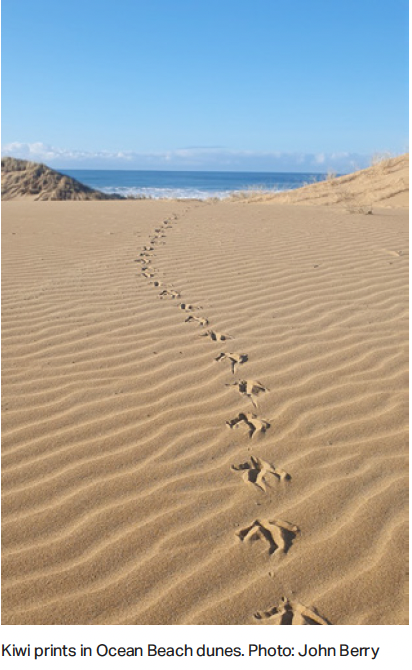
John, with his long grey hair, beard and gentle demeanour is a Sanctuary treasure. He knows the place like the back of his hand and will happily spend half the night out here looking for kiwi, spotting glow worms, and telling a good yarn, or two, as a paid tour guide for guests at Cape Kidnappers’ lodge.
“I am passionate about birds and the bush and I’m comfortable out here,” says John. “I love doing what I’m doing.” In exchange for his effort, John keeps about 32 hives at the Sanctuary, selling Cape Sanctuary Honey at the HB Farmer’s Market every Sunday.
Dawn Hariata Bennett has volunteered as the Sanctuary’s cultural adviser since 2017 and is on site about three times a week. She sources and officially chaperones all species from other places, usually hapū to hapū, to the Cape and vice versa, and is continuing the strong relationship her late mother Hariata Baker and first cousin Paratene Huia began when the Sanctuary was formed in 2006.
“Our hapu are so fortunate to be part of this,” says Dawn. “It’s a two-way street for us. Our taonga species are being returned here and it doesn’t cost us a thing!
“Liz and Andy Lowe don’t do anything without advising us. Our tikanga and our kawa (protocols and etiquette and the way they are done) are always considered.”
Undoubtedly the “ultimate volunteer” and more, at Cape Sanctuary, is Liz Lowe.
“Andy is the visionary behind the sanctuary,” observes Rachel. “Liz is the day-to-day backbone. She is involved in every single facet of the sanctuary from predator control and tree planting to going out for hours at night catching kiwi for the Kōhanga Kiwi programme and taking part in every species translocation. She should have an honorary PhD in conservation.”
Future
What next for Cape Sanctuary?
“Could a village of houses still happen out here,” I ask Andy straight off.
“Not in my lifetime,” he says. “I still think a village would’ve been fantastic. But I always had a vision for a conservation project.
“Everyone thought we were trying to do a conservation project as a trade-off for a village. That’s the way the media portrayed it, which was bullshit.”
His current goal is to make Cape Sanctuary financially sustainable in the next few years through tourism. “I’ve got a lot of tourism ideas for this site [Ocean Beach side]. Walking, guided walking. People want to see the dunes, species, iwi history. There’ll probably be more huts.” (There are already three huts with accommodation at Ocean Beach, all available for volunteers use.)
Cape Kidnappers and Ocean Beach fall into a Natural Preservation Zone (NZP) in the Hastings District Council Plan, a move Andy initiated around 2010, although building development within the zone is now more restricted than he may have originally hoped for. (See BayBuzz 2016).
Andy describes himself to me as “a bit all or nothing,” but says you have to be pragmatic. “You do what is possible.” He recently had his large sea-side woolshed renovated, to be used as a base for eco-tours and education. In February he set the wheels in motion establishing a charitable trust, now officially named Te Kauwae Education Trust, drawing on Cape Kidnappers Māori name Te Kauwae o Maui (the jaw bone of Maui).
“We used to have school groups out, but it interfered with our day-to-day work across the site, staff and volunteers were becoming caregivers sort of thing and we’ve got to focus on saving these species.
“The Trust has been set up with hapū, local businessmen, lawyers. The idea is they can use the property for education – for everyone! Grandparents, parents, to kids … people can learn about growing trees from seed, learn about the environment, learn about sand dune restoration. Someone will say they want to do a school project on birds for example, and they can.”
Environmental planner Stephen Daysh, who worked for the Lowe and Robertson families when the NPZ was being developed, is chair of the Trust and trustees include HBRC councillor Martin Williams, lawyer Philip Hocquard, Māori leader Mike Mohi, as well as other representatives of Heretaunga mana whenua who whakapapa to Ocean Beach.
“We will be underway with the initial education programmes in 2025,” says Daysh. “We will start slowly with a small number of schools with day visits to view the Sanctuary and do volunteer work, with the woolshed run as environmental education centre.”
It’s hard to get any figures out of Andy: what it has cost to run the Sanctuary so far? Financial planning that will secure its future?
“The Robertson and Lowe families will continue to fund the Sanctuary,” he says. “Vermin control has to happen, we’ll always fund that. But other things like species translocations, which are expensive, they can be up to $60,000 to $70,000 a time, are nice to haves, and we’ll look at those as they turn up.
“Hopefully we won’t need vermin control in 30 years. Technology will’ve taken over. In fact, already companies in NZ like ZIP are starting to revolutionise predator control.
Emeritus Professor of Ecology at Victoria, Charles Daugherty, a trustee on the Hawke’s Bay Biodiversity Trust and a director of ZIP Zero Invasive Predators Ltd (ZIP), suggests Cape Sanctuary’s work is a ‘Call for Action’ for Hawke’s Bay.
“When will the rest of us take advantage of its conservation work and step up and be conscious of and do something about predator control so we can establish a bird corridor into our towns and cities?”
“We don’t want this to be a big expensive zoo,” adds Liz Lowe. “The vision is to create corridors and pathways and engage with HB, get kids trapping in backyards, control our cats and encourage the ‘halo effect’. This means that the Cape’s work and species flow out into wider community.”
John McLennan, who continues to consult to the Sanctuary, hopes one day we’ll see kiwi in our HB backyards “and hear them calling at night when we’ve gone to bed”.
McLennan loves Cape Sanctuary for two reasons. “We need private initiatives like this, there’s not enough money to go around. And the Cape is conservation in an everyday landscape where multiple activities take place and people can enjoy normal lives.”
“We’re like a nursery trying to save species for future generations so our grandkids can see them,” says Andy. He and Liz also have a collection of some 500 artefacts found at the sanctuary including fish hooks, species bones and pounamu treasures, all officially recorded with Te Papa, which Liz says they hope one day to incorporate into an onsite museum.
Andy dreams of bringing Fiordland forested penguins up here too. “And one day I’d love to have kākāpō. They would’ve been here once, but whether it’s safe for them?”
But for now, the release of the 48 juvenile tuatara is finished. If all goes well, amazingly most of these creatures could live for up to 200 years! And that is just one small part of the magic unfolding at Cape Sanctuary, which will benefit all of us in Hawke’s Bay, and beyond.
For more information and to book a public tour of Cape Sanctuary see: www.capesanctuary.co.nz

My wife, brother in law and myself were all volunteers some years ago before it became a bit much for us with other voluntary groups we were also involved with. Cape Sanctuary was a fantastic place and we loved our involvement —we were there when the first Kaka were released, and used to have greedy kakariki sitting on us while we carried the food trays outside…we helped release Kiwi chicks into the Sanctuary and transported them from Rotorua to HB – I think our transport numbers were about 25-26 in total. Our grandchildren helped release one or two which they still talk about today. We’ve transported sick birds to Palmerston Nth for treatment and returned them to the Sanctuary. We did do some work in other areas as well – overall a great experience…. we may get back to helping with transport in the future once other volunteer works dies down… but Cape Sanctuary is definitely a HB icon and needs full support from all Bay organisations.
Awesome. Inspiring Thanks for letting us know the details. For the Vision, hard work love and money well spent. A great start to Saturday morning.
Wonderful. A breath of hope. ❤️