

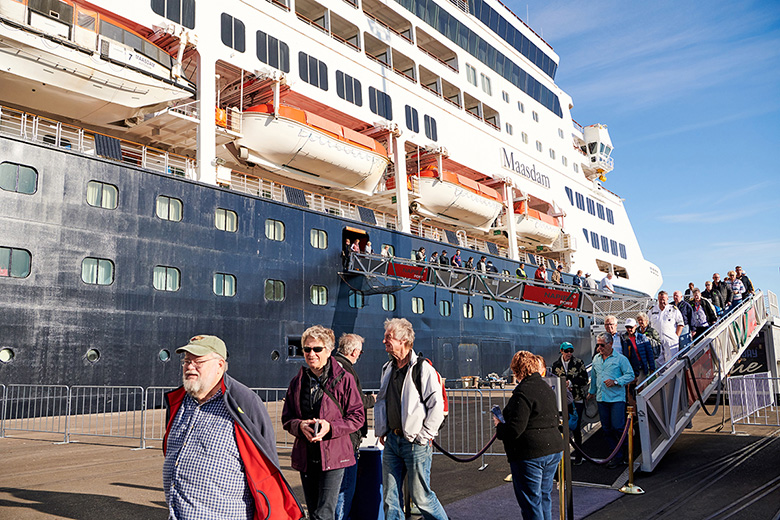
Trying to ascertain the actual value of Napier’s cruise visitors to Napier’s economy is a descent into a bookkeeping rabbit hole.
BayBuzz has been digging into this; frankly because we’re skeptical that the often-touted $200-$300 per passenger (from Cruise Ship Assn) who disembarks to visit the city and its immediate surrounds has much grounding.
We recently queried NCC officially for some relevant numbers, as well as questioning Napier Port and a few businesses that market to cruisers.
First of all, it would help to pin down how many cruisers leave their ships … and for how long?
The percentage cited by NCC is “about two-thirds” (the Port estimates 90%). With about 160,000 total passengers estimated for the 2023/24 season, NCC’s estimate would translate into 105,600 passengers, each spending $250, taking the average of the official guesstimate. That’s $26.4 million for the season (or $36 million if you use the Port disembarkment rate).
However, by comparison, other NCC data puts the entire ‘International visitor’ spend in the 2023/24 November-March cruise window at $26.9 million, which would suggest that 100% of the region’s foreign visitors arrive by ship. Including all your cuzzies from Oz, the UK etc.
Another data set put the entire ‘International’ spend over the two-year window ending September 2024 at $76.2 million, or $38.1 million as a yearly average. And yet other data puts the Napier ‘International’ spend at $41.5 million for the 12 months ending September 2024.
The above figures are based on electronic card transactions that can be tracked and assigned with some precision, unlike the $250 per passenger figure.
Is it plausible that five months of cruisers could provide 64% to 70% of Napier’s total international visitor spend?
Again looking at NCC-supplied data, the average on-shore window for Frank and Martha Cruiser to spend their joint $500 can be estimated at 6 hours. Consequently, when you look at the tour packages – cycling, winery visits, etc – offered by various on-shore vendors, it seems that 4-5 hours is about the longest time cruisers feel safe wandering around. Can’t have a Cinderella problem!
For example, Prinsy’s Tour, a well-established provider of van tours of HB wine country, offers an 11am-3:30pm package for $170pp. Tākaro Trails offers self-guided cycling at $65 per hour.
Such offerings are clearly relevant for computing how the Cruiser couple might spend $500 between them. But given that cruising is all about consuming unlimited pre-paid food and drink on board, it’s hard to picture a heap of on-shore café and bar spending.
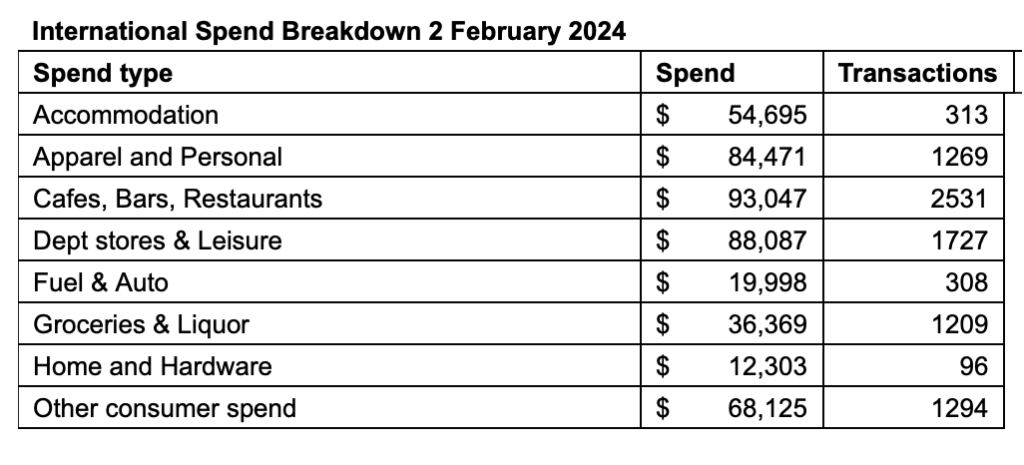
Here’s a table provided by NCC depicting a day of actual ‘International’ spending on a typical cruise day. It’s hard to see a cruise passenger making purchases in most of these categories:
On the other hand, the ‘official’ numbers – based entirely on electronic card transactions – appear to leave out other revenue that finds its way to our on-shore vendors.
For example, an outfit like Tākaro Trails (and other serious tour/attraction vendors) has marketing contracts with the ship operators, who sell their cycling package on-board. That transaction seems invisible to the official bean counters, but yields real revenue to Tākaro. Karen at award-winning Tākaro puts the ship-booked tours at around 30% of the company’s gross income. And that’s a “very significant” slice, as she puts it.
So why poke around at this?
Obviously visitor revenue is important to Hawke’s Bay, not just Napier City, which probably reaps most of the cruiser share … and especially to certain businesses, as you see with Tākaro Trails.
But visitors come in all stripes – friends and family, business meetings and conferences, sporting and music events … and possibly lastly, ‘tourists’.
NCC’s data puts the entire electronic card spend in the city over two years at $2.34 billion. $1.6 billion of that came from its residents. $396 million from other Hawke’s Bay folks, $59.9 million from Wellington, $56.3 million from Auckland, $156.3 million from the rest of NZ, and $76.2 million from International.
Setting aside the spending from Hawke’s Bay folks – the locals – it would seem that Napier enjoys a two-year $348.7 million visitor spend, or about $174.4 million annually. Basically, 14.9% of the annual total.
Interesting numbers to be aware of when one contemplates HB’s reputed ‘billion dollar’ tourism economy, how much visiting ‘just happens’ and how much is generated by dedicated marketing … and how much should be spent for that purpose, and who should pay for it.
Do you have a view on what a cruise passenger is worth? We’d love to hear from you, especially if you sell/market to cruisers? In Dunedin they’re protesting against cruisers because cruise ships are major polluters … what do you think of that?
Note: Again, keep in mind that these figures are based on electronic card transactions that can be tracked and assigned with some precision. No cash or online banking transfers here.

We did a long cruise around Europe. We probably spent no more than $50 each per day. Some days a little more. Other days nothing at all as we just walked and looked. We ate and drank on the ship, because we had already paid for it. We were allowed to take food and water off the ship, so would often just have a little bite to eat in a park somewhere.
What about the other side of the coin Tom? I.e. the “costs” associated with cruise tourists. Air, noise and marine pollution, biosecurity risks (if a passenger unwittingly bought in a brown marmorated stink bug Hawke’s Bay’s horticultural sector would go in to meltdown). Then there’s the impact on our infrastructure etc which ratepayers pay for. If we’re going to weigh up how much cruise passengers are worth we must remember to consider both sides of the ledger.
The port charges ships for the use of its facilities: is that income included?
What about the goodwill spread by happy cruisers when they return home, encouraging other visitors to visit Napier (or NZ in general)?
The COVID lockdowns are another possible source of insight. When the cruisers stopped calling, by how much was the local economy (as opposed to the population) depressed?
Maybe MBIE would consider surveying cruisers on board about their spending habits in NZ.
I worked in Simply NZ, a gift shop full of NZ trinkets, merino wear, All Blacks t-shirts etc ( much of which was made in China.
Many passengers came in. They bought key rings, argued about discounts on merino wear as they could buy the same thing ( nz made) on the ship. They bought little else.
Local cafes said they had many passengers buying a coffee so they could sit for a while and people watch. No one ate though.
So I do wonder where the $250 pp was spent?
Mostly by those who did a tour – can’t see where else their money would have been spent?
I would rather not have those passengers visit Napier because of the pollution caused by those massive ships. But I can see that the port who are surely the biggest winners would welcome them.
I worked in passenger transport for a number of years both in HB and in Auckland. My observations of the cruise industry was that the majority of the income benefit to locals accrue to “embarkation/disembarkation” ports. Here passengers either arrive at the ship or leave the ship to return home and require transport to/from airports( generally.) Shuttle and taxi operators benefit. A few departing passengers arrive a day earlier for a hotel night before a cruise.
Often at these ports the cruise liner unloads waste and replenishes food/drink from local sources which is very valuable to suppliers. As Napier is simply a “stopover” port for a small number of hours these benefits are not seen here.
Tour operators will gain business from pre-booked and pre-paid customers via the cruise line, who presumably take a portion of the tour cost. What proportion of each operators total customers this is will vary, requiring detailed data to assess the value to any port. The tour may or may not include lunch so I also suspect overall incidental food and beverage spend by cruise ship passengers is minimal.
Ian D Trembath
Hōhepa Creative Works down Tennyson Street is sometimes seen by some cruise ship tourists. But I can’t remember ever selling anything to them.
I always wonder how Napier’s infrastructure digestes those days with up to 3000 additional visitors.
Gracious of you to ask the people of Napier Tom.
We all know more upon more is the answer to everything just ask our political elite.